
Youmian Textile at Melbourne 2026: Hotel Linen for Australia’s Small-Batch Buyers
Jump to section
MELBOURNE — 9 November 2026 — Nantong Youmian Haochen Textile Co., Ltd. is exhibiting at China Clothing Textile Accessories Expo (CCTAE) in Melbourne from 17 to 19 November 2026, presenting hotel bed linen, terry, bathrobes and fabric woven at its own mill. The show runs at Melbourne Convention and Exhibition Centre (MCEC).
It is the third exhibition the company has staffed since late September. INTERFABRIC Autumn 2026 in Moscow ran from 29 September to 1 October. The 140th Canton Fair in Guangzhou closed on 4 November. Melbourne opens eleven days later.
Three shows, three continents, eight weeks. The reason, according to the company, is not lead generation.
Why a hotel linen manufacturer flies that much
“New buyers are welcome, but a booth is not really a lead-generation machine,” the company said. “Most of the hours go to accounts we have worked with for years, and to buyers who have been in discussion for months and still have one unresolved question.”
That question rarely survives a video call. Three examples come up repeatedly.
1. Colour matching needs one light source
A returning client wants to switch fabric quality on an existing programme. Samples go out three times; photographs go back and forth a dozen. The colour is still slightly off. The problem is not the mill — it is the white balance in the photograph, the colour gamut of the screen, and the temperature the parcel sat in on the way over.
Three swatches laid on one table under one lamp settle in five minutes what email cannot settle in a month.
2. A shrinkage complaint needs the actual goods
A hotel laundry reports that linen is shrinking, but cannot say which batch or which stage. Is it the weave, the finishing, or the laundry’s own water temperature and drying curve? The answer sits in the wash label, the seam allowance, the laundry’s wash log and the hand of the fabric — all of which require the goods in front of you. Over a screen, everyone is guessing, and guessing is how supplier relationships end.
3. MOQ and lead time need the production schedule on the table
Buyers stall on two numbers: can the minimum order come down, and can the lead time come in. Neither answer lives in a sales script. Both live in the production schedule. Opening the plan, naming the looms that are actually running, and showing the delivery dates of the last three shipments is what makes a commitment stand up.
“Selling and after-sales are the two places where deals quietly fall apart,” the company said. “A show moves both of them into the same room.”
What the Australian market actually asks for
Australia is a small market by population — around 25 million — but a demanding one. According to the China Chamber of Commerce for Import and Export of Textiles, China exported USD 6.31 billion of textiles and apparel to Australia in 2025, split between USD 1.70 billion of textiles and USD 4.61 billion of apparel. In the first four months of 2026 alone the total reached USD 2.17 billion, lifting Australia to China’s eighth-largest single-country market for the category. Under ChAFTA and RCEP, textiles enter Australia duty-free.
The defining characteristic is short-cycle ordering. Australian hotel groups and contract suppliers rarely commit to container volumes up front. They test with a few hundred pieces, reorder on occupancy and sell-through, and expect a colour-matched repeat within weeks. A mill that cannot run a 300-piece order without losing money will lose the account at the second reorder — not the first.
That is a flexibility test, not a price test. It is also why the Melbourne conversation tends to be about minimums, repeatability and response time rather than cents per unit.
Compliance runs alongside it. Australian buyers increasingly ask for documentation on chemical safety, biosecurity treatment and end-of-life claims before they will list a supplier. Two background guides cover this in detail: importing eco-certified hotel linen into Australia and Australia’s hotel sustainability requirements. A third, sustainable hotel linen for Australian hotels, looks at how procurement teams are writing those requirements into tenders.
What is on display in Melbourne
The stand is organised around fabric rather than finished product. A wall of hanging swatches runs the length of the booth, each length labelled by weave, yarn count, thread density and width, so that buyers can read the specification before they handle it.
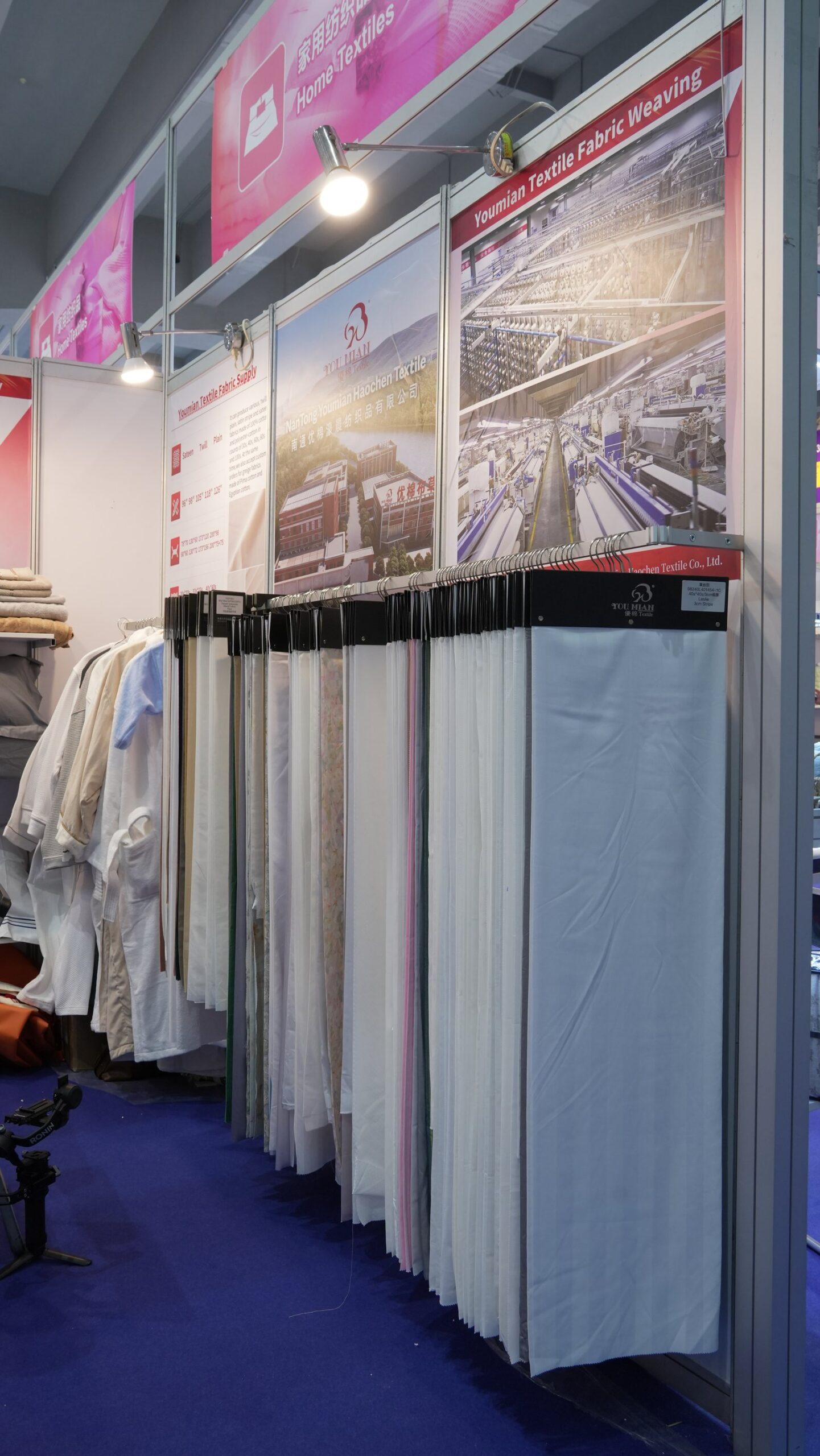
- Bed linen — sateen, twill and plain weave, plus stripe and jacquard for branded programmes; yarn counts from 60×60 to 128×128, thread density from 173×120 to 300×120, fabric width 240–300 cm. See the hotel bedding range.
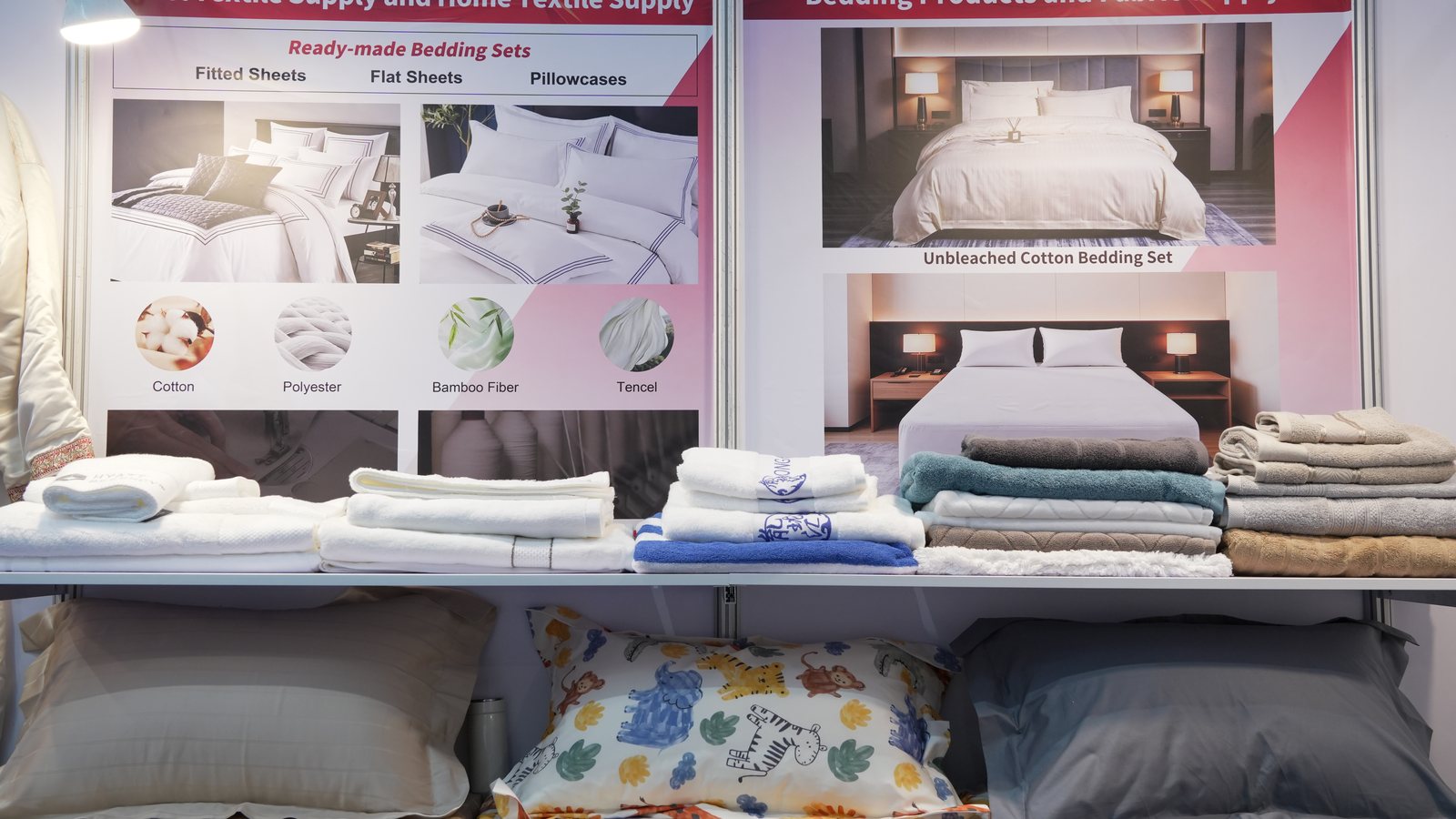
- Terry — bath towels, hand towels and bath mats across multiple GSM weights, including hotel bath towels built for industrial laundering.
- Bathrobes — terry, waffle and velour constructions, with embroidery and branded labelling for hotel bathrobes programmes.
- Pillows and duvet inserts — fillings matched to hotel segment and climate.
- Mattress protectors — waterproof and encasement options for hygiene and durability.
- Table linen — for restaurants, banquets and catering operations.
- Fabric by the metre — greige and finished, for buyers running their own cut-and-sew.
OEM and ODM work — custom colour, embroidery, branded packaging — is quoted on the stand. Details of the programme are set out on the OEM / ODM page.
Manufacturing behind the display
Youmian has made hotel linen for 21 years. The company operates a 20,000 m² finishing base in Nantong, Jiangsu, alongside a 46,000 m² weaving base with more than 600 air-jet looms, producing 5,000,000 metres of fabric and 650,000 pieces of finished goods a month.
A new 18,000 m² weaving hall comes on stream in the fourth quarter of 2026, adding 120 latest-generation air-jet looms and 420,000 metres of monthly capacity.
Quality management is certified to ISO 9001, ISO 14001 and ISO 45001. Products hold OEKO-TEX STANDARD 100 certification — certificate SHWO 108278, issued by TESTEX, Product Class II — and the company is recognised as a Jiangsu High-Tech Enterprise. The full chain, from fibre to finished carton, is documented on the supply-chain traceability page.
Questions buyers ask before booking a meeting
Where and when is Youmian exhibiting in Melbourne?
At China Clothing Textile Accessories Expo (CCTAE), Melbourne Convention and Exhibition Centre, from 17 to 19 November 2026. The team is on the stand for all three days.
What is the minimum order quantity for custom hotel linen?
500 pieces per item for custom bedding, a figure set by the minimum dye batch rather than by sewing capacity. Bathrobes start at 300 pieces per item; mattress protectors at 200 pieces per size. Stock qualities can ship in smaller quantities.
How long do sampling and bulk production take?
A counter sample takes 7 to 15 days. Bulk production runs 30 to 45 days after pre-production sample approval. Ten to twenty industrial wash cycles are recommended before a sample is signed off.
Which certifications does Youmian hold?
OEKO-TEX STANDARD 100 (SHWO 108278, TESTEX, Product Class II), ISO 9001, ISO 14001 and ISO 45001, plus Jiangsu High-Tech Enterprise status. Certificate numbers can be verified with the issuing bodies.
Can a small trial order be run before a full programme?
Yes. Trial quantities are quoted on the same specification as the bulk order, so that the sample approved on the stand is the sample that ships. The full procurement sequence is set out in Hotel Linen Sourcing: 8 Questions Buyers Ask Before Placing an Order, and the broader sourcing process in How to Source Hotel Linens from China.
Meeting the team in Melbourne
The Youmian stand is staffed by the export team and technical staff for the full three days, with fabric and finished goods on hand for handling rather than photographs.
Buyers who would like a slot reserved before the show opens can contact the team with their specification, volumes and target dates; samples can be prepared in advance and held at the booth.
The show runs 17–19 November 2026 at MCEC. For buyers unable to travel, the same specifications are quoted by email year-round.
Want to Know More About Our Products?
View All Products Now English
 Русский
 Español de México
 Português do Brasil
 العربية
