
Hotel Bathrobe Buying Guide: Waffle, Terry Velour, and Microfiber Compared
Jump to section
A hotel bathrobe is more than an amenity—it is a tactile extension of your brand that guests physically experience every day of their stay. The right bathrobe enhances the perception of luxury, comfort, and attention to detail that drives positive reviews and repeat bookings. Yet with waffle weave, terry velour, microfiber, and numerous other fabrics available, selecting the right bathrobe for your property requires careful consideration of climate, guest profile, laundry infrastructure, durability requirements, and budget. This comprehensive hotel bathrobe buying guide compares the most popular constructions, explains their performance characteristics, and provides a decision framework to help procurement managers choose robes that delight guests while withstanding the rigors of commercial hospitality operations.
Why Bathrobe Selection Matters in Hospitality
Bathrobes are among the most frequently used and most personally experienced textile items in a hotel room. Guests wear them after showering, while ordering room service, during spa visits, and while relaxing in their rooms. A plush, well-fitted robe contributes to that “I never want to leave” feeling that luxury hotels cultivate. Conversely, a thin, scratchy, or poorly sized robe immediately signals cost-cutting and undermines even the most carefully designed guest room.
From an operational standpoint, bathrobes represent a significant investment. Quality hospitality robes cost $25–$75 per unit wholesale, and a 200-room property operating at 3 par requires 600 robes—representing $15,000–$45,000 in inventory. Making the right choice protects that investment and minimizes replacement frequency.
Waffle Weave Bathrobes
Construction and Characteristics
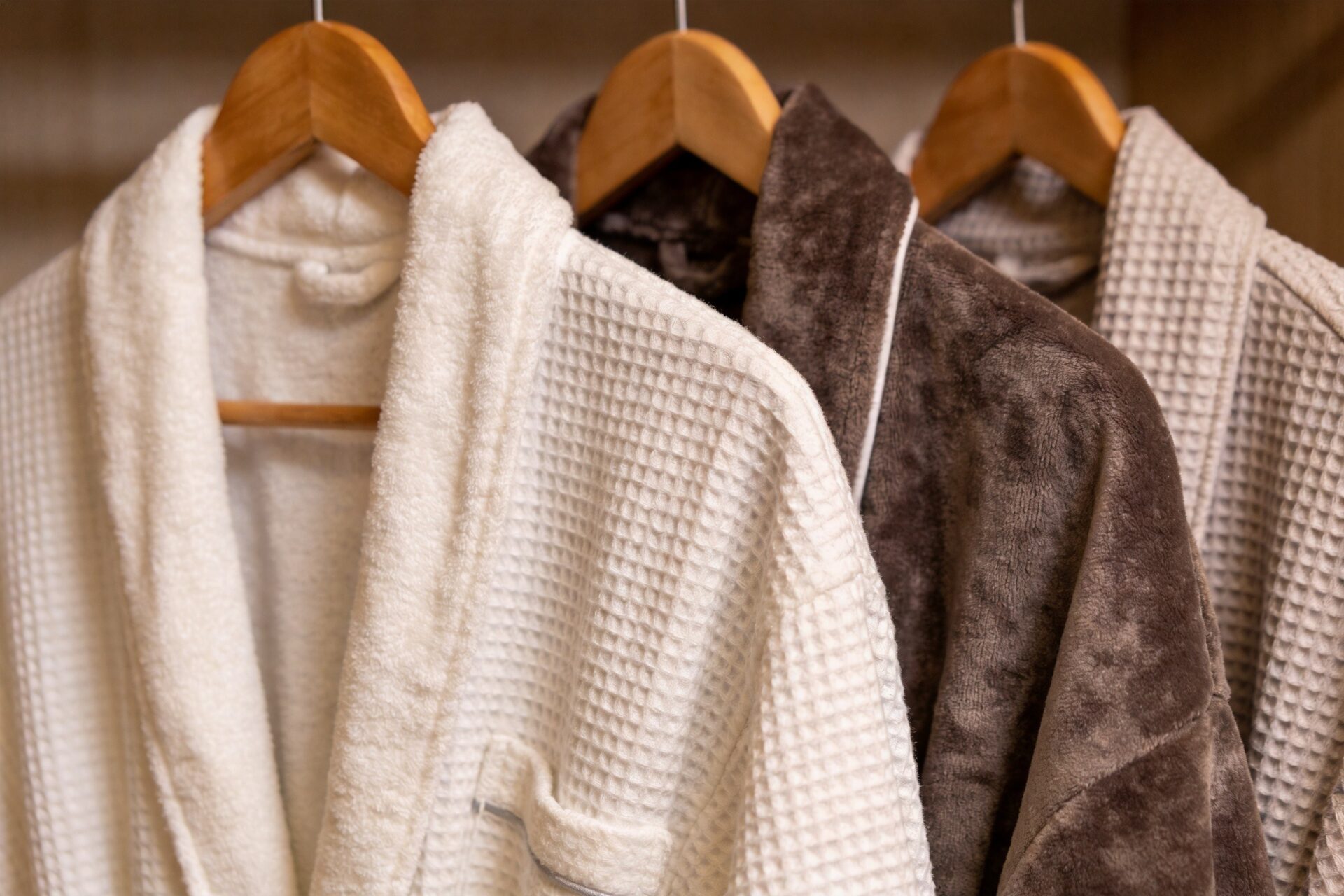
Waffle weave robes feature a distinctive honeycomb texture created by a weave structure that forms small, recessed squares across the fabric. This construction is lightweight, highly breathable, and naturally quick-drying. Waffle robes are typically made from 100% combed cotton with a weight of 220–320 GSM, though lighter versions in cotton-poly blends are available for tropical climates.
Advantages
- Quick drying: The open weave allows air circulation, reducing drying time by 30–40% compared to terry robes. This is particularly valuable for properties with high turnover or limited dryer capacity.
- Breathable in warm climates: Waffle robes feel cool and comfortable in humid or tropical environments where a heavy terry robe would feel oppressive.
- Lightweight packability: Ideal for spa use, poolside service, and properties where robes are frequently transported between floors and laundry.
- Lower laundry cost: Lighter weight means less water retention, shorter drying cycles, and lower energy costs per robe.
- Classic aesthetic: The textured waffle pattern conveys a refined, spa-like elegance popular in boutique and wellness-oriented properties.
Disadvantages
- Lower absorbency: The open weave is less absorbent than dense terry cloth, making waffle robes less ideal immediately after a shower.
- Less plush: Guests expecting a thick, enveloping robe may find waffle weave thin or insubstantial.
- Snagging risk: The raised grid pattern can catch on jewelry or sharp objects, potentially leading to pulls and damage.
- Shorter lifespan: Waffle robes typically last 150–250 wash cycles, compared to 300–500 for quality terry.
Best For:
Spas, wellness retreats, tropical and subtropical hotels, boutique properties, and any operation where quick drying and a refined aesthetic take priority over maximum warmth and absorbency.
Terry Velour Bathrobes
Construction and Characteristics
Terry velour robes combine the absorbent looped terry construction on the inside with a sheared, smooth velour finish on the outside. The interior terry loops provide excellent water absorption, while the exterior velour offers a soft, luxurious hand-feel and an elegant appearance. These robes are typically made from 100% ring-spun or combed cotton at 350–500 GSM, with premium versions reaching 550 GSM.
Advantages
- Superior comfort: Velour’s smooth, plush exterior and terry’s absorbent interior create the best of both worlds—luxurious feel against clothing or skin outside, effective drying inside.
- Premium appearance: The sheared surface provides an ideal canvas for embroidery, making velour robes the top choice for branded luxury properties.
- Good warmth: The denser construction provides moderate warmth, suitable for air-conditioned environments and temperate climates.
- Durability: Quality velour robes withstand 300–500 commercial wash cycles when properly laundered, offering excellent long-term value.
- Guest perception: Velour is the robe construction most commonly associated with five-star hotels and premium resorts.
Disadvantages
- Higher cost: Velour robes are among the most expensive options, typically costing $40–$75 wholesale per unit.
- Longer drying time: The dense terry interior retains significant water, requiring 50–70 minutes of commercial dryer time.
- Potential shrinkage: Without proper pre-shrinking and sanforizing, velour robes can shrink 5–8% over the first 5–10 washes.
- Shows wear: The smooth velour nap can become matted or crushed over time, reducing the premium appearance before structural failure.
Best For:
Luxury hotels, four- and five-star resorts, premium spa facilities, and properties where the bathrobe is a signature brand element and guest expectations are high.
Microfiber Bathrobes
Construction and Characteristics
Microfiber robes are made from ultra-fine synthetic fibers—typically polyester or a polyester-nylon blend—with individual filaments measuring less than one denier. The result is an exceptionally soft, lightweight fabric with high absorbency and rapid drying characteristics. Microfiber robes typically weigh 200–300 GSM, making them the lightest hospitality option.
Advantages
- Ultra-soft hand feel: Microfiber has a silky, almost suede-like texture that many guests find extremely comfortable.
- Exceptionally fast drying: Microfiber dries 2–3 times faster than cotton, reducing dryer time to 20–30 minutes and cutting energy costs significantly.
- Wrinkle and shrink resistant: Synthetic fibers do not shrink or wrinkle like cotton, maintaining a neat appearance with minimal finishing.
- Lightweight: Ideal for travel, spa, and warm-climate use where heavy cotton feels cumbersome.
- Stain resistant: The tight synthetic fiber structure resists staining and is easier to clean than cotton in many cases.
- Cost-effective: Microfiber robes typically cost $15–$35 wholesale, making them the most budget-friendly premium-feel option.
Disadvantages
- Breathability concerns: Synthetic fibers do not breathe as well as cotton, causing some guests to feel overheated or clammy.
- Static buildup: Microfiber can generate static electricity, particularly in dry, air-conditioned environments.
- Environmental concerns: Petroleum-based synthetics shed microplastics during washing and are not biodegradable. Properties with strong sustainability commitments may prefer natural fibers.
- Lower perceived luxury: While soft, microfiber lacks the natural, substantial feel of cotton and may not meet five-star guest expectations.
- Heat sensitivity: Microfiber can melt or scorch at high dryer temperatures, requiring careful temperature management.
Best For:
Budget and mid-scale hotels, gyms and fitness centers, tropical resort pools, travel-focused properties, and operations prioritizing low cost, fast drying, and easy maintenance over premium natural-fiber feel.
Side-by-Side Comparison
| Feature | Waffle Weave | Terry Velour | Microfiber |
|---|---|---|---|
| Material | 100% cotton | 100% ring-spun/combed cotton | Polyester or poly/nylon blend |
| Weight | 220–320 GSM | 350–550 GSM | 200–300 GSM |
| Absorbency | Moderate | High | High (synthetic wicking) |
| Drying Time | 30–45 min | 50–70 min | 20–30 min |
| Warmth | Low–Moderate | Moderate–High | Low–Moderate |
| Durability (wash cycles) | 150–250 | 300–500 | 250–400 |
| Wholesale Cost | $20–$40 | $40–$75 | $15–$35 |
| Climate Suitability | Warm/humid | Temperate/cool | Warm/humid |
| Luxury Perception | Moderate (spa-chic) | High | Low–Moderate |
Additional Bathrobe Types to Consider
Terry Cloth (Unsheared)
Traditional looped terry cloth robes on both sides offer maximum absorbency and durability at a lower price than velour. They are the workhorse of mid-scale hotel baths, providing excellent function without the luxury aesthetic of velour. Expect 350–500 GSM construction and 300–500 wash cycle lifespan.
Shawl Collar vs. Kimono Styles
Beyond fabric, bathrobe cut affects guest perception and comfort. Shawl collar robes feature a folded, lapel-style collar that adds warmth around the neck and a sophisticated, loungewear aesthetic. Kimono-style robes have a simple stand-up collar and a straight, open cut, offering a lighter, more minimalist look popular in Asian-inspired and boutique properties. Shawl collars use slightly more fabric and cost marginally more but are the standard choice for luxury hotels.
Bamboo and TENCEL™ Blends
Eco-conscious properties may consider bamboo viscose or TENCEL™ lyocell robes, which offer silk-like softness, natural antibacterial properties, and strong environmental credentials. These materials are typically blended with cotton for durability and are priced at a premium. They are particularly well suited to sustainability-focused luxury brands and eco-resorts.
Sizing, Fit, and Customization
Standard Hospitality Sizing
Hotel bathrobes typically come in two primary sizes: One Size Fits Most (OSFM) and Large/X-Large. OSFM robes generally fit chest sizes 36–46 inches, while L/XL fits 46–56 inches. Offering both sizes improves guest satisfaction, particularly in markets with larger average body sizes. Unisex sizing is standard in hospitality. For luxury properties, consider offering three sizes (S/M, L/XL, XXL) to accommodate all guests comfortably.
Embroidery and Branding
Custom-embroidered logos on the left chest or shawl collar turn bathrobes into brand touchpoints. When ordering embroidered robes, specify:
- Logo size: 3–4 inches wide is standard for chest embroidery
- Thread count: Use polyester or poly-wrapped embroidery thread for durability through commercial washing
- Placement: Left chest (most common), back yoke (for spa/resort statement), or cuff
- Color contrast: Ensure logo colors remain visible after repeated washing and fading
For high-volume orders, work with a manufacturer offering in-house embroidery as part of their OEM/ODM services, as this reduces lead times and quality control risks compared to outsourcing embellishment.
Laundry Best Practices for Hotel Bathrobes
Regardless of fabric type, proper laundering extends bathrobe life and maintains guest-ready appearance:
- Wash temperature: 105–120°F (40–49°C) for most robes; 140°F (60°C) for sanitization in healthcare-adjacent settings
- Detergent: pH-balanced, low-alkaline detergent; avoid optical brighteners on colored or embroidered robes
- Bleach: Only non-chlorine bleach on white cotton; never bleach microfiber or colored garments
- Drying: Medium heat (140–150°F / 60–65°C); remove immediately when dry to prevent wrinkling and fiber damage
- Finishing: Light steam or tunnel finishing for velour; fold promptly to avoid creasing
Frequently Asked Questions
What type of bathrobe do luxury hotels use?
Most five-star hotels use 100% cotton terry velour shawl-collar robes weighing 400–500 GSM. This construction offers the plush feel, absorbency, and premium appearance that luxury guests expect. Brands like Ritz-Carlton, Four Seasons, and Marriott premium tiers predominantly use velour or high-pile terry robes.
How often should hotels replace bathrobes?
Quality cotton velour robes typically last 2–4 years (300–500 wash cycles). Waffle weave robes may need replacement after 1–2 years, while microfiber robes last 2–3 years. Replace robes when they show permanent stains, thinning fabric, lost shape, or nap wear that cannot be restored through laundering.
Are microfiber bathrobes good for hotels?
Yes for budget and mid-scale hotels, fitness centers, and warm climates: microfiber robes are the lightest option at 200–300 GSM, dry 2–3 times faster than cotton (just 20–30 minutes), and cost about $15–35 wholesale. But they lack cotton’s breathability and premium feel, and sustainability-led luxury properties may avoid petroleum-based microfibers due to microplastic shedding.
How many bathrobes should a hotel have per room?
A standard par is 2 robes per occupied room, with 3 par total inventory (one in room, one in housekeeping storage, one in laundry). For suites, spa suites, or rooms with two guests, provide 2 robes per guest. Resorts with in-room spa services may need 3–4 robes per suite to support treatment setups.
Can hotel bathrobes be customized with our logo?
Yes. Most hospitality manufacturers offer custom embroidery, woven labels, and even jacquard-woven logos directly into the fabric. Minimum order quantities for custom embroidery typically start at 500 pieces per style. Polyester-wrapped embroidery thread is recommended for colorfastness through commercial washing.
Conclusion: Select Robes That Reflect Your Brand
The best hotel bathrobe is the one that aligns with your property’s climate, guest expectations, operational capabilities, and brand positioning. Waffle weave offers lightweight spa elegance for warm climates; terry velour delivers the plush luxury that five-star guests demand; and microfiber provides practical, budget-friendly performance for high-turnover operations. Consider sampling two or three constructions before committing to a full order, and involve your executive housekeeper in the evaluation—their hands-on perspective on laundering and durability is invaluable. For a wide range of hotel bathrobes and slippers in waffle, terry velour, and microfiber constructions, all with OEM/ODM customization and OEKO-TEX certification, contact Youmian Textile to request samples and a competitive quote.
Want to Know More About Our Products?
View All Products Now English
  Русский
  Español de México
  Português do Brasil
  العربية