
Hotel Blanket Guide: Wool, Cotton, Fleece, and Synthetic for All Seasons
Перейти к разделу
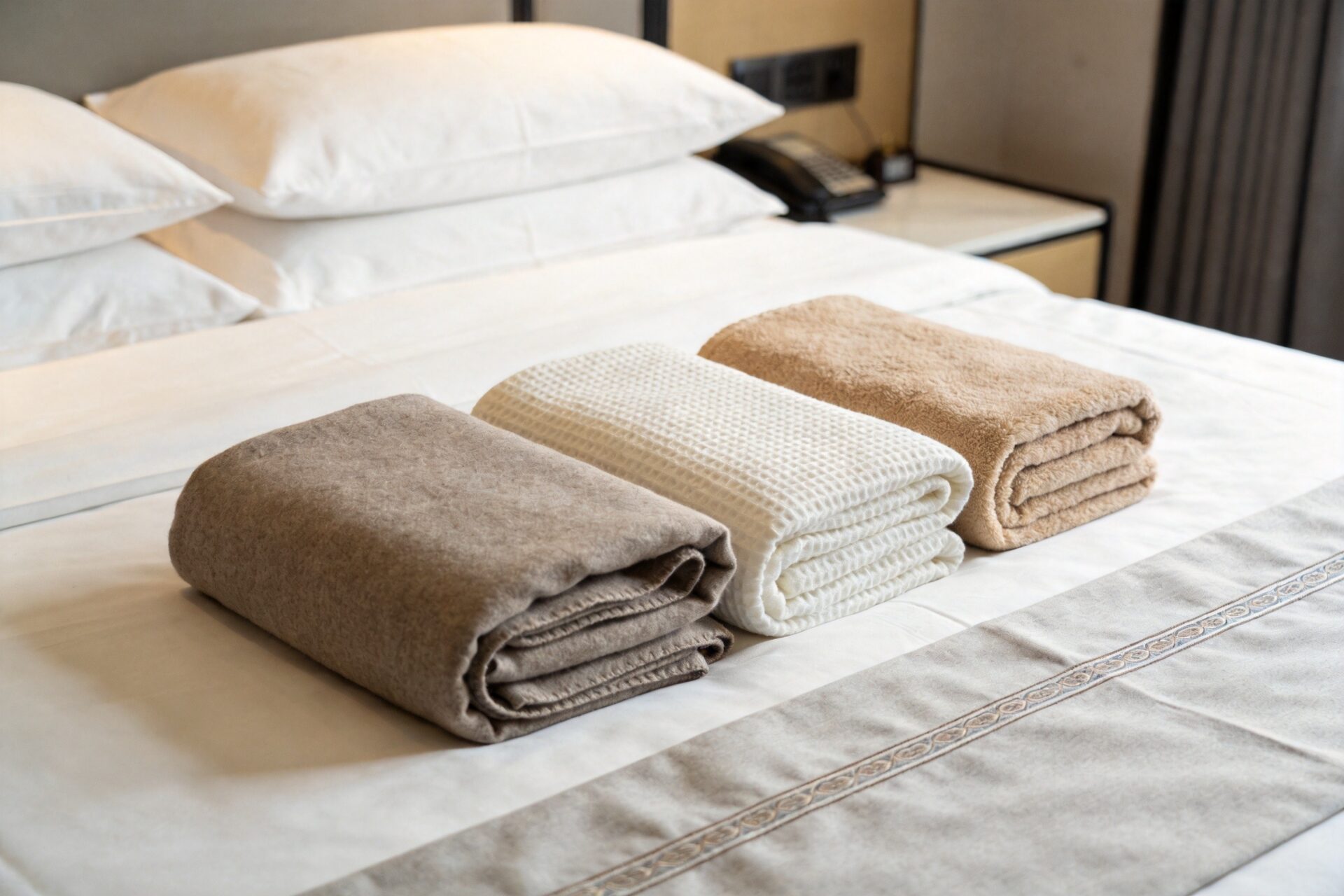
Hotel blankets are a critical but often overlooked component of the guest sleep experience. The right blanket provides warmth without overheating, launders reliably through hundreds of commercial cycles, and complements the aesthetic of the bed. With properties spanning tropical resorts to alpine lodges, selecting blankets for all seasons requires understanding the performance characteristics of wool, cotton, fleece, and synthetic fills. This guide compares the major blanket types, their thermal properties, maintenance requirements, and ideal applications for different hotel environments and climate zones.
The Role of Blankets in Hotel Bedding Systems
A well-designed hotel bed uses a layered bedding system that allows guests to adjust warmth to their preference. The typical configuration includes a fitted sheet, flat sheet, blanket or duvet, and bed scarf or runner. The blanket occupies the mid-layer position—trapping body heat while allowing moisture vapor to escape.
Industry data shows that bedding comfort is the second most frequently mentioned factor in guest sleep satisfaction (after mattress quality), with blankets and duvets specifically cited in 18% of bedding-related positive reviews. For procurement teams, selecting the right blanket involves balancing five performance criteria:
- Thermal regulation (TOG or CLO value): The blanket’s ability to retain heat relative to its weight.
- Moisture management: Wicking perspiration away from the body to prevent clamminess.
- Долговечность: Withstanding 100–300 commercial wash cycles without pilling, shrinking, or clumping.
- Aesthetic presentation: Maintaining a smooth, neat appearance on the made bed.
- Total cost of ownership: Purchase price divided by expected service life, plus laundering costs.
Youmian Textile’s hotel bedding collection includes blankets in multiple materials and weights designed to integrate with our sheets, pillows, and mattress protectors as a complete sleep system.
Understanding Blanket Warmth Ratings
Before comparing materials, it is useful to understand how blanket warmth is measured. Two systems are commonly used in the hospitality industry:
TOG Rating
TOG (Thermal Overall Grade) measures thermal resistance on a scale from 1.0 (cool) to 15.0+ (very warm). It is the standard rating system in the UK, Europe, and much of the Middle East. Hotel blanket TOG recommendations by season:
| Season / Climate | Recommended TOG | Typical Blanket Weight |
|---|---|---|
| Summer / Tropical (25–35°C) | 3.0–5.0 | 200–300 g/m² |
| Spring/Fall / Temperate (15–25°C) | 6.0–9.0 | 300–450 g/m² |
| Winter / Cold (5–15°C) | 10.0–13.5 | 450–600 g/m² |
| Alpine / Sub-zero (−10–5°C) | 13.5–15.0+ | 600–800 g/m² |
CLO Value
CLO measures the insulation required to keep a resting person comfortable at 21°C room temperature. One CLO equals roughly 1.55 TOG. CLO is more common in North American technical textile specifications. A typical summer blanket rates 0.5–1.0 CLO; a winter blanket 2.0–3.0 CLO.
Wool Blankets: Premium Natural Warmth
Wool has been the gold standard for hotel blankets for over a century, and for good reason. It offers unmatched thermal regulation, natural flame resistance, and exceptional durability.
Types of Wool Used in Hotel Blankets
- Merino wool: Fine-diameter fibers (18–24 microns) produce soft, non-itchy blankets. Premium luxury hotels prefer merino for its hand feel and performance.
- Lambswool: Sheared from young sheep (under 8 months), lambswool is softer and more resilient than adult sheep wool. It offers excellent value for four- and five-star properties.
- New Zealand wool: Known for strong, consistent fibers and bright white color that dyes evenly. New Zealand wool blankets have a longer average lifespan than mixed-origin wool.
- Wool blends (80/20 wool/polyamide): Adding 15–20% polyamide or nylon improves washability and reduces pilling while retaining most of wool’s natural benefits. The 80/20 blend is the most common specification for commercial hotel blankets in Europe.
Performance Characteristics
| Атрибут | Rating | Примечания |
|---|---|---|
| Warmth-to-weight ratio | Отлично | Naturally crimped fibers trap air efficiently |
| Управление влажностью | Отлично | Absorbs 30% of weight in moisture without feeling wet |
| Flame resistance | Отлично | Naturally self-extinguishing; no chemical treatment needed |
| Срок службы (количество циклов стирки) | 200–300 | Wool-rich blends last longest |
| Washability | Умеренный | Requires wool cycle, mild detergent, cool drying |
| Cost per unit | Высокий | $25–$60 per blanket depending on wool type and size |
Wool blankets are ideal for mountain resorts, northern European properties, and luxury hotels that prioritize natural fibers. They are less suitable for tropical climates where heavy insulation is unnecessary and high-humidity laundering can cause mildew if drying is inadequate.
Cotton Blankets: Breathable and Versatile
Cotton blankets occupy the middle ground between heavy wool and lightweight synthetics. They are the most popular choice for hotels in temperate and warm climates due to their breathability, washability, and familiar hand feel.
Cotton Blanket Weave Types
- Waffle weave: A textured, honeycomb-patterned weave that creates air pockets for moderate warmth. Waffle blankets dry quickly and have a spa-like aesthetic popular in resorts and boutique hotels. Available in 250–400 GSM.
- Thermal weave (cellular): An open, mesh-like weave that provides lightweight warmth through trapped air. Thermal blankets are the classic summer blanket in North American hotels, typically 200–300 GSM.
- Muslin: A plain, loosely woven cotton fabric used for lightweight summer blankets. Double-layer muslin offers slightly more warmth with a soft, lived-in feel.
- Jersey knit: A t-shirt-like knit that is stretchy, soft, and comfortable. Jersey blankets are common in select-service and lifestyle hotel brands but are less durable than woven options (100–150 wash cycles).
Performance Characteristics
| Атрибут | Rating | Примечания |
|---|---|---|
| Warmth-to-weight ratio | Хорошо | Depends heavily on weave; waffle and thermal are most efficient |
| Управление влажностью | Хорошо | Absorbent but slower to dry than synthetics |
| Воздухопроницаемость | Отлично | Ideal for warm climates and air-conditioned environments |
| Срок службы (количество циклов стирки) | 150–250 | Woven waffle/thermal outlast knits |
| Washability | Отлично | Machine washes and dries reliably at standard hotel laundry temps |
| Cost per unit | Низкий–средний | $12–$30 per blanket |
Cotton blankets pair naturally with cotton-rich hotel sheets and pillowcases for a coordinated, natural-fiber bed. They are the recommended default for hotels in Mediterranean, Southeast Asian, and Latin American climates.
Fleece Blankets: Lightweight Synthetic Warmth
Fleece blankets—typically made from 100% polyester microfiber—have become a staple in budget and mid-scale hotels due to their low cost, lightweight warmth, and easy care.
Types of Fleece
- Microfleece (100–200 GSM): Thin, silky, and quick-drying. Suitable as a summer blanket or under-layer beneath a duvet. Commonly provided as an extra blanket in hotel closets.
- Polar fleece (200–300 GSM): Thicker and warmer, with a plush double-sided nap. The most common fleece weight for year-round hotel use.
- Coral fleece / plush fleece (300–450 GSM): A high-pile, velvety fleece that resembles faux fur. Used in colder climates and by hotels seeking a luxurious appearance at a moderate price.
- rPET fleece: Manufactured from recycled plastic bottles, rPET fleece offers identical performance to virgin polyester with a significantly lower environmental footprint. It is increasingly specified by hotel groups with sustainability targets.
Performance Characteristics
| Атрибут | Rating | Примечания |
|---|---|---|
| Warmth-to-weight ratio | Очень хорошо | Polyester fibers trap air effectively at low weights |
| Управление влажностью | Poor–Fair | Does not absorb moisture; can feel clammy to some sleepers |
| Срок службы (количество циклов стирки) | 150–250 | Prone to pilling; anti-pill finishes extend life |
| Washability | Отлично | Washes and dries 30–40% faster than cotton; saves energy |
| Cost per unit | Очень низкий | $6–$18 per blanket |
| Воздействие на окружающую среду | Low (virgin) / Medium (rPET) | Sheds microfibers; rPET mitigates raw material impact |
Fleece blankets are the practical choice for budget hotels, long-term stay properties, and as supplementary blankets in any hotel tier. Their rapid drying reduces laundry energy costs by 25–35% compared to cotton, offsetting some environmental concerns.
Synthetic Down Alternative Blankets
Down alternative blankets (also called comforters or duvets in some markets) use polyester microfiber clusters to mimic the loft and warmth of natural down. They are typically encased in a cotton or poly-cotton cambric shell with box-stitched or baffle-box construction to prevent fill migration.
Key Specifications
- Fill weight: 200–600 g/m² depending on TOG target. A 400 g/m² all-season blanket rates approximately 9.0–10.5 TOG.
- Fill power equivalent: Microfiber clusters rated 600–800 fill-power equivalent. Holofiber and spiral-fill constructions offer better loft retention than straight staple fiber.
- Shell fabric: 233-thread-count cotton cambric or 200-thread-count poly-cotton. Higher thread count covers reduce down/fiber leakage (called “bearding”).
- Конструкция: Baffle-box (internal fabric walls) maintains loft better than simple box stitching but costs 15–25% more.
Down alternative blankets dominate the North American hotel market because they are hypoallergenic, machine washable, and significantly less expensive than natural down. They are available in summer (3–5 TOG), all-season (7–10 TOG), and winter (12–15 TOG) weights, allowing properties to swap blankets seasonally.
Seasonal Blanket Strategy by Climate Zone
Multi-property hotel groups operating across diverse geographies should develop a climate-specific blanket strategy rather than standardizing on a single product globally.
| Climate Zone | Summer (Jun–Aug) | Winter (Dec–Feb) | Recommended Materials |
|---|---|---|---|
| Tropical (SE Asia, Caribbean) | 3–5 TOG cotton waffle | 5–7 TOG cotton/fleece | Cotton waffle, microfleece |
| Mediterranean (S. Europe, California) | 4–6 TOG cotton thermal | 8–10 TOG wool blend or down alt. | Cotton, 80/20 wool blend |
| Temperate Continental (N. Europe, NE US) | 5–7 TOG cotton/fleece | 10–13.5 TOG wool/down alt. | Wool blend, down alternative |
| Alpine/Nordic (mountain resorts) | 6–8 TOG wool/fleece | 13.5–15 TOG wool + duvet | Merino wool, heavy down alt. |
| Desert (Middle East) | 3–5 TOG (AC-cooled rooms) | 6–8 TOG cotton/fleece | Cotton waffle, polar fleece |
Many hotels find it cost-effective to maintain two blanket weights per room—a lightweight option year-round and a heavier winter option that can be offered on request or placed during turndown service. This approach reduces laundry volume (heavy blankets are washed less frequently when used only seasonally) and gives guests control over their comfort.
Care and Maintenance for Hotel Blankets
Proper laundering significantly extends blanket life and maintains guest-facing appearance. Follow these material-specific guidelines:
- Wool and wool blends: Wash on a dedicated wool cycle at 30°C with pH-neutral wool detergent. Avoid chlorine bleach. Tumble dry on low heat with wool dryer balls; remove while slightly damp and air-dry completely. Never hang wool blankets (they stretch); dry flat or use a blanket drying rack.
- Cotton waffle/thermal: Wash at 60°C for disinfection; warm or cool dry. Cotton blankets shrink 3–5% after the first wash—specify pre-shrunk fabric or oversize by 5% when ordering. Avoid fabric softeners, which reduce absorbency.
- Polyester fleece: Wash at 40°C with mild detergent; avoid high dryer heat (causes pilling and melting). Use a lint filter or microfiber-catching laundry bag to reduce microfiber shedding. Line drying is preferable and energy-efficient.
- Down alternative: Wash in large-capacity machines (comforters need room to agitate freely) at 40–60°C. Use two rinse cycles to remove all detergent residue. Dry thoroughly on medium heat with dryer balls to re-fluff the fill. Incomplete drying causes mildew and clumping.
Часто задаваемые вопросы
What is the best all-season hotel blanket?
For most temperate climates, an 80/20 wool-polyamide blend blanket at 7–9 TOG (approximately 400–500 g/m²) offers the best year-round performance. It provides adequate warmth in winter, breathes well in summer, and withstands 250+ commercial washes. Properties in warmer climates should choose a 250–350 GSM cotton waffle or microfleece blanket.
How many blankets should a hotel have per room?
The standard par is 2.5 blankets per room: one on the bed, one in the laundry/closet rotation, and one-half in reserve. For seasonal properties that swap between summer and winter blankets, maintain 1.5 par for each weight. A 200-room hotel should carry 500 blankets of the primary weight and 300 of the secondary weight.
Are wool blankets worth the higher cost for hotels?
For luxury properties and cold-climate resorts, yes. Wool blankets last 200–300 washes (3–5 years) compared to 150–200 for fleece, reducing replacement frequency. They also require lower-temperature washing (30°C vs. 60°C), saving 40–50% on laundry energy per cycle. The total cost of ownership over five years is typically 10–15% lower for wool than for repeatedly replacing fleece blankets.
What is the difference between a blanket and a duvet in hotel bedding?
A blanket is a single-layer woven or knit fabric placed between the top sheet and bedspread for adjustable warmth; a duvet or comforter is a filled, quilted covering often used without a top sheet in the European style. Many hotels layer a blanket under a decorative duvet, while North American properties increasingly go duvet-only with the cover laundered between guests. Match TOG to season—3.0–5.0 for summer, 6.0–9.0 for spring/fall, higher for winter—and expect blanks to withstand 100–300 commercial washes.
Can custom hotel blankets be branded with a hotel logo?
Yes. Blankets can be embroidered with a hotel logo or monogram on the corner hem or self-fabric binding. Embroidery is recommended over printing due to durability through repeated washing. Typical logo size is 5–8 cm, placed 10–15 cm from the corner. Youmian Textile offers custom embroidery on all blanket types through our Программа OEM/ODM, with order quantity planned around the property rather than a fixed piece count.
Conclusion: Match the Blanket to the Climate and Brand
Selecting the right hotel blanket is not a one-size-fits-all decision. Wool blankets deliver premium natural warmth for luxury and cold-climate properties; cotton waffle and thermal weaves offer breathable comfort for warm and temperate zones; fleece provides budget-friendly lightweight insulation; and down alternative comforters give North American guests the plush, fluffy feel they expect. By developing a seasonal, climate-specific blanket strategy and specifying durable, commercial-grade constructions, hotel procurement teams can ensure guest comfort, reduce laundry and replacement costs, and present a consistently polished bed across every property in their portfolio.
Explore Youmian Textile’s full range of hotel blankets and bedding sets, или request a quote for custom materials, weights, and branding tailored to your properties.
Хотите узнать больше о наших продуктах?
Посмотреть все товары сейчас English
 Русский
 Español de México
 Português do Brasil
 العربية
