
The Complete Hotel Bed Sheet Buying Guide (2026)
Перейти к разделу
Основные выводы
- Hotel bed sheets use 3 primary fabrics: poly-cotton blend (60/40 for 3-4 star), 100% cotton (4-5 star), and microfiber (budget/extended-stay)
- Thread count sweet spot for hotels is 200–400 TC percale — above 400 TC provides diminishing returns on durability while increasing cost
- Fitted sheet pocket depth must match mattress height + 5cm: standard 25cm pocket for 20cm mattress, 35cm pocket for 30cm pillow-top
- Shrinkage tolerance: commercial hotel sheets allow ≤5% shrinkage; pre-shrunk (compacted) fabrics add 8–12% cost but eliminate post-wash size issues
- Replacement cycle: sheets last 300–500 industrial washes (1.5–3 years at 70% occupancy); inspect quarterly for thinning, staining, and hem integrity
Every hotel operator knows that a single bad night’s sleep can turn a loyal guest into a one-star review. The sheets are the closest thing your guests experience to “sleeping on a cloud” — or sleeping on sandpaper. Choosing the right hotel bed sheets isn’t about chasing luxury for luxury’s sake; it’s about engineering the right balance of comfort, durability, and cost that keeps your guests coming back and your P&L healthy.
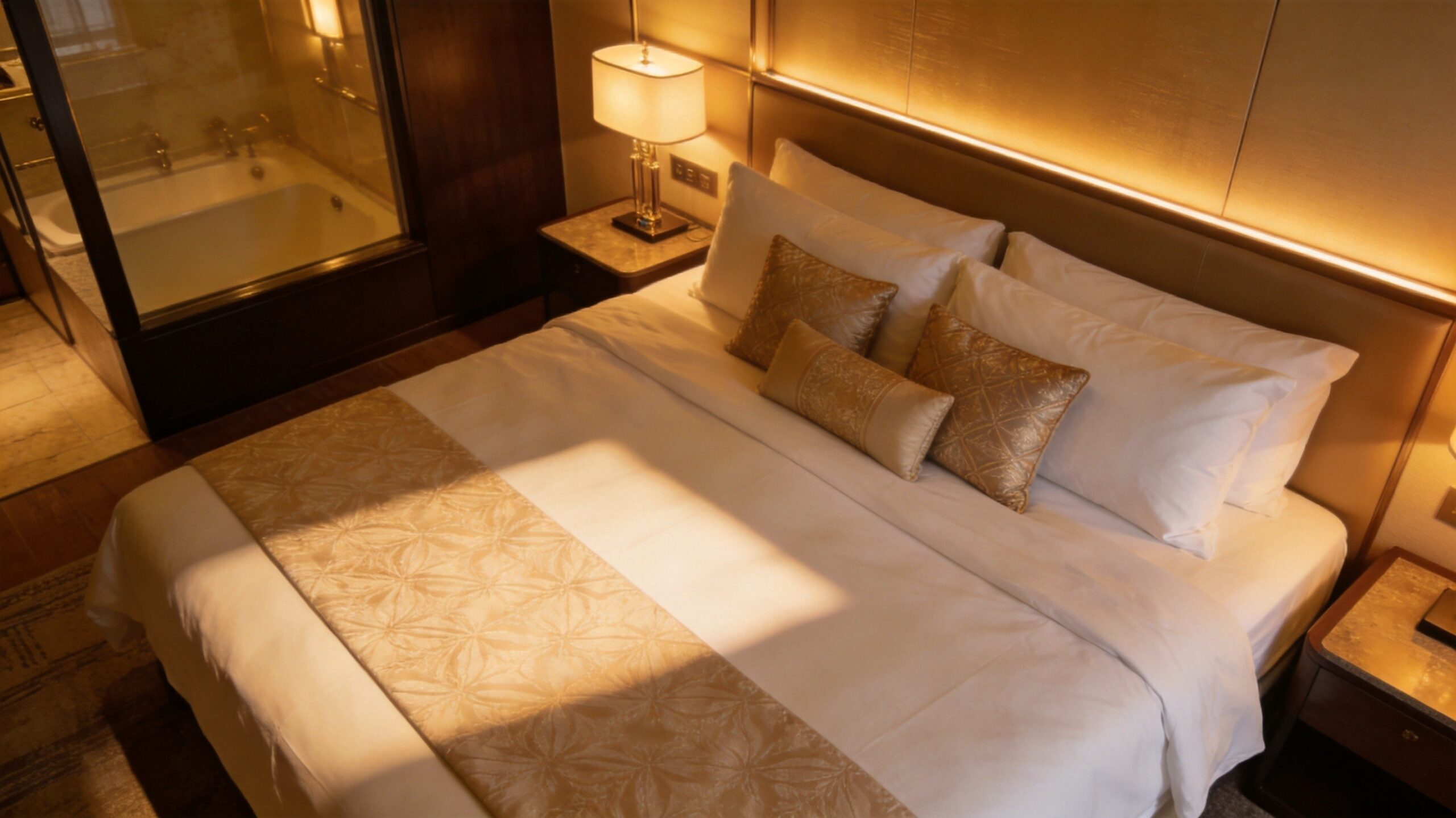
This guide draws on two decades of hotel linen manufacturing expertise to walk you through every decision point — from thread count myths to fabric weave selection, international sizing, industrial wash durability, and supplier verification. Whether you’re launching a 30-room boutique hotel or sourcing linens for a 500-room chain, this is the only hotel sheet thread count guide for buyers you’ll need.
1. Understanding Thread Count: What Hotels Actually Use
Thread count (TC) measures the number of horizontal and vertical threads per square inch of fabric. It’s the single most misunderstood specification in hotel linen purchasing. Here’s the truth that retail marketing has obscured:
- 300–400 TC percale weave is the sweet spot for 3- to 4-star hotels. It delivers that signature crisp, cool feel guests associate with premium hospitality.
- 400–600 TC sateen weave suits 4- to 5-star properties where a softer, silkier hand-feel is expected.
- Above 600 TC is rarely used in hospitality. The marginal comfort gain is negligible, while durability actually decreases due to thinner individual yarns.
What thread count do most hotels use? The global hotel industry standardizes between 300 and 400 thread count for percale sheets and 400–500 TC for sateen sheets. Economy and mid-scale brands (Holiday Inn Express, ibis) typically use 200–300 TC, while upscale and luxury brands (Marriott, Hilton, Four Seasons) standardize at 300–600 TC depending on their brand standard. The key insight for buyers is that yarn count (the fineness of the cotton yarn, measured in Ne or “English count”) matters more than thread count alone. A 60S (Ne 60) combed cotton yarn at 300 TC will outperform a multi-ply 800 TC sheet in both comfort and longevity.
Beware of suppliers advertising “1000 TC” sheets. This is achieved through multi-ply yarn construction — twisting 3 or 4 thinner yarns together and counting each strand individually. It inflates the number while degrading the fabric’s breathability and softness. Smart buyers focus on yarn count, fiber staple length, and weave quality rather than thread count alone.
The yarn count factor most buyers overlook: Yarn count (measured as Ne — Number English) describes how fine or coarse the cotton yarn is. Higher numbers mean finer yarns. Here’s the practical breakdown:
- 40S yarn: Standard economy hotel sheets. Coarser feel, shorter fiber acceptable. Most common in budget chains.
- 60S yarn: The premium standard for 3- to 5-star hotels. Fine enough for a smooth hand-feel while maintaining adequate thickness for durability.
- 80S yarn: Ultra-fine luxury tier. Used in top-tier properties where the emphasis is on silky softness over maximum wash life.
- 100S+ yarn: Extremely rare in hospitality. Delicate, expensive, and impractical for industrial laundering.
The combination of yarn count and thread count tells the real story. A 60S/300TC sheet and a 40S/300TC sheet will feel dramatically different, even though both claim the same thread count. Always request specifications that include both TC and yarn count (Ne) when evaluating supplier quotations.
2. Fabric Materials Compared: Cotton vs. Poly-Cotton Blends vs. Bamboo
The fiber composition of your hotel sheets determines everything: guest comfort, washing durability, stain resistance, and replacement cost. Here’s how the three dominant options compare:
| Критерии | 100% Хлопок | Poly-Cotton Blend (55/45 or 50/50) | Bamboo / Tencel |
|---|---|---|---|
| Feel | Crisp, breathable, classic hotel feel | Softer initially, less breathable | Silky, cool, ultra-smooth |
| Срок службы (количество циклов стирки) | 180–250 cycles at 300 TC | 250–350+ cycles | 120–180 cycles |
| Cost per set (King) | $18–$35 | $12–$22 | $28–$50 |
| Устойчивость к появлению складок | Moderate (needs pressing) | Отлично | Умеренный |
| Stain release | Хорошо | Отлично | Хорошо |
| Идеально подходит для | 3–5 star hotels, boutique properties | Economy/mid-scale, high-volume laundry ops | Eco-luxury resorts, wellness brands |
| Key advantage | Guest perception, breathability | Longest lifespan, lowest cost per wash | Marketing appeal, sustainability story |
Our recommendation: For the majority of hotel operators, 100% combed cotton at 300–400 TC remains the gold standard. It delivers the guest experience that drives positive reviews while offering strong industrial wash performance. Poly-cotton blends make financial sense for properties where laundry costs dominate (budget brands, extended-stay hotels). Bamboo is a niche play — excellent for the right brand positioning, but its shorter lifespan means higher replacement frequency.
When selecting cotton, pay attention to fiber staple length. Long-staple cotton (such as Supima, Egyptian Giza, or Chinese Xinjiang long-staple) produces smoother, stronger yarns that resist pilling. Combed cotton — where short fibers are removed during spinning — is a minimum standard for any hotel-grade sheet.
3. Weave Types: Percale vs. Sateen — Which Is Right for Your Hotel?
The weave structure determines how the yarns interlace, which directly affects the fabric’s hand-feel, thermal properties, and durability. Understanding percale vs. sateen hotel sheets is essential for matching sheets to your brand promise.
| Недвижимость | Percale Weave | Sateen Weave |
|---|---|---|
| Weave pattern | One-over-one-under (criss-cross) | One-over-four-under (offset) |
| Surface feel | Crisp, cool, “fresh” hotel feel | Silky, warm, lustrous sheen |
| Вес | Lighter (≈110–130 g/m²) | Heavier (≈130–160 g/m²) |
| Воздухопроницаемость | ★★★★★ | ★★★☆☆ |
| Долговечность | ★★★★★ (tighter weave) | ★★★★☆ (slightly looser) |
| Wrinkle visibility | Shows wrinkles more | Hides wrinkles well |
| Guest perception | “Classic luxury hotel” | “Silky and indulgent” |
| Ideal hotel segment | 3–4 star, warm climates, business hotels | 4–5 star, cool climates, lifestyle/resort brands |
| Industrial wash performance | Excellent (tighter weave resists abrasion) | Good (slightly more prone to pilling) |
How to decide:
- Choose percale if your property is in a warm climate (Southeast Asia, Middle East, Southern US), your brand leans “clean and crisp,” or your laundry operation prioritizes fast drying times.
- Choose sateen if your property is in a cooler climate, your brand positions as “indulgent luxury,” or you want a sheet that looks pressed even with minimal ironing.
- Choose a percale-sateen hybrid program if you operate multiple brands — percale for standard rooms, sateen for suites.
“According to 21 years of hotel linen manufacturing experience at YouMian, 60S cotton with 300–400TC percale weave offers the best balance of durability and comfort for most hotel segments.” — YouMian Technical Team, Nantong Youmian Haochen Textile Co., Ltd.
4. Sizing Guide: International Hotel Bed Sheet Sizes
Sourcing hotel sheets for international properties requires careful attention to regional size standards. A “King” sheet in the US is not the same as a “King” in Australia. Here’s a comprehensive size reference table:
| Region | Bed Type | Fitted Sheet Size (cm) | Flat Sheet Size (cm) | Pillowcase (cm) |
|---|---|---|---|---|
| United States | Twin | 99 × 191 | 168 × 264 | 51 × 76 |
| Queen | 152 × 203 | 229 × 274 | 51 × 91 | |
| King | 193 × 203 | 274 × 274 | 51 × 102 | |
| Cal King | 183 × 213 | 274 × 285 | 51 × 102 | |
| Europe | Single | 90 × 200 | 180 × 275 | 50 × 80 |
| Double | 140 × 200 | 220 × 275 | 50 × 80 | |
| King | 160 × 200 | 240 × 280 | 50 × 80 | |
| Australia | Single | 92 × 188 | 180 × 260 | 48 × 73 |
| Queen | 153 × 203 | 225 × 265 | 48 × 78 | |
| King | 183 × 203 | 265 × 275 | 48 × 90 | |
| Middle East | Single | 100 × 200 | 180 × 270 | 50 × 75 |
| King | 180 × 200 | 250 × 280 | 50 × 85 |
Pro tip for buyers: Always confirm mattress depth (pocket height) with your fitted sheet order. Modern hotels using pillow-top mattresses (25–35 cm depth) need deep-pocket fitted sheets with elastic all around. Standard pocket sheets at 20 cm depth will not stay in place, creating the guest experience equivalent of sleeping on a loose wrapper.
Working with a manufacturer like Nantong Youmian Haochen Textile Co., Ltd. based in Nantong — China’s home textile capital — gives you access to custom sizing for any market with minimal setup cost, as they produce for clients across 40+ countries.
5. Durability & Industrial Washing: How Long Do Hotel Sheets Last?
Hotel sheets are subjected to punishing wash cycles: high-temperature water (60–75°C), industrial extractors spinning at 400+ G-force, alkaline detergents, bleach, and calendar ironers at 160°C. Understanding wash-life expectations is critical for budget forecasting.
According to textile testing data from SGS-certified laboratories and 21 years of hotel linen manufacturing at YouMian’s 30,000㎡ facility in Nantong:
- 100% cotton percale (300 TC, 60S yarn): 180–250 wash cycles before visible degradation (thinning fabric, seam weakness, yellowing). At a 3-day wash rotation, this equals approximately 18–24 months of service life.
- 100% cotton sateen (400 TC, 60S yarn): 150–200 wash cycles. The looser weave is more susceptible to abrasion and pilling in industrial washers.
- Poly-cotton 50/50 blend (200 TC): 250–350+ wash cycles. The polyester component dramatically extends lifespan, which is why economy chains favor blends despite the lower initial comfort perception.
- Bamboo/Tencel blends: 120–180 wash cycles. Cellulosic fibers weaken faster under alkaline conditions and high heat.
Key factors that extend sheet life:
- Mercerized finish (improves strength by 20–30% and color retention)
- Double-needle stitching at all seams (prevents seam blowout)
- Reinforced hems on flat sheets
- Proper pH-neutral detergent usage (over-bleaching is the #1 cause of premature fabric failure)
- Correct load sizing in washers (overloading accelerates abrasion)
The most cost-effective approach is to calculate cost per wash cycle rather than cost per piece. A $25 cotton sheet lasting 200 cycles ($0.125/cycle) outperforms a $15 blend lasting 150 cycles ($0.10/cycle) when you factor in guest satisfaction metrics — but the math shifts depending on your property’s review priorities.
6. Budget Planning: Cost Per Room Calculation
A proper hotel linen budget accounts for the par stock system — the number of sheet sets needed to keep rooms operational at all times. Here’s the standard calculation:
Minimum par stock = 3 sets per bed:
- 1 set on the bed (in use)
- 1 set in the laundry (being washed)
- 1 set on the shelf (clean, ready)
Recommended par stock for 3- to 5-star hotels = 4–5 sets per bed to account for peak season demand, replacement rotation, and emergency stock.
Sample budget calculation — 100-room hotel, Queen beds, 4-par stock:
| Пункт | Unit Cost (USD) | Quantity | Total (USD) |
|---|---|---|---|
| Fitted sheet (300 TC percale) | $12.00 | 400 | $4,800 |
| Flat sheet (300 TC percale) | $14.00 | 400 | $5,600 |
| Pillowcase (standard) | $3.50 | 800 | $2,800 |
| Initial investment | $13,200 | ||
| Annual replacement (25% turnover) | $3,300 | ||
| Cost per room per month | ~$27.50 |
For mid-scale properties using poly-cotton blends, the initial investment drops by 30–40%, and annual replacement costs decrease by 20–25% due to longer wash life. Luxury properties investing in 500 TC sateen should budget 50–80% above these figures.
Volume discount tip: Orders above 5,000 pieces typically qualify for 8–15% pricing reductions from direct manufacturers. YouMian, with their 30,000㎡ production facility in Nantong, offers tiered pricing and dedicated production scheduling for bulk buyers.
Hidden costs to include in your linen budget:
- Shipping and import duties: Depending on destination country, freight costs can add 5–15% to unit price. Sea freight from China to the US West Coast typically takes 15–25 days; plan orders at least 60 days in advance.
- Pre-washing costs: New cotton sheets often require 1–2 pre-wash cycles before guest use to remove sizing agents and achieve maximum softness.
- Patching stock: Maintain 10–15% extra inventory above your par level to cover losses, damages, and unexpected demand spikes during holiday seasons.
- Хранение: Linen must be stored in clean, dry, pest-free environments. Climate-controlled storage is ideal to prevent mildew, especially in tropical climates.
7. How to Verify Supplier Quality
The difference between a reliable hotel linen supplier and a costly mistake comes down to verification. Here’s a step-by-step process that procurement teams should follow:
Step 1: Check Certifications
- ISO 9001 — Quality management system. Ensures consistent production standards.
- SGS or Intertek test reports — Independent lab verification of thread count, fabric composition, colorfastness, and tensile strength.
- Oeko-Tex Standard 100 — Confirms no harmful substances (critical for properties marketing wellness or eco-credentials).
- BSCI / SEDEX — Social compliance audits, increasingly required by international hotel chains.
Step 2: Request & Evaluate Samples
- Always request pre-production samples in your exact specifications before placing bulk orders.
- Wash the sample 5–10 times in your property’s actual laundry conditions before approving.
- Check for: pilling, seam integrity after washing, shrinkage (should be <3%), color retention, and hand-feel consistency.
Step 3: Factory Audit
- If your order volume justifies it (typically 500+ rooms), conduct an on-site factory audit or hire a third-party inspection service.
- Key things to verify: weaving equipment age and type (modern air-jet looms produce more consistent fabric than older shuttle looms), finishing line capabilities, quality control checkpoints, and warehouse storage conditions.
- A manufacturer like Nantong Youmian Haochen Textile Co., Ltd. (YouMian) with 21 years of specialization, SGS + ISO9001 certifications, and a 30,000㎡ facility in Nantong’s home textile industry cluster demonstrates the infrastructure scale that serious hotel buyers require.
Step 4: Trial Order
- Start with a trial order of 50–100 sets before committing to a full property rollout.
- Run these through your actual laundry operation for 2–3 months before making a final vendor decision.
- Track wash cycles, guest feedback, and replacement rates.
Step 5: Contract Terms
- Negotiate quality guarantee clauses: fabric composition tolerance (±3%), minimum wash life guarantees, and replacement policies for defective goods.
- Establish clear lead time expectations (typically 30–45 days for custom orders from Chinese manufacturers).
- Require batch-to-batch consistency guarantees for reorders.
8. Sustainability Considerations for 2026 and Beyond
Hotel procurement teams increasingly face sustainability mandates from both corporate ESG requirements and guest expectations. Here’s what matters for hotel sheet sourcing:
- Certified organic cotton (GOTS certified) eliminates pesticide use and reduces water consumption by up to 91% compared to conventional cotton. However, organic cotton costs 20–30% more and has slightly lower tensile strength, meaning shorter wash life.
- Recycled polyester blends using rPET (recycled PET bottles) offer a sustainability story with minimal cost premium. Some manufacturers now produce poly-cotton blends with 50% recycled polyester content.
- Closed-loop cellulosic fibers like Tencel (lyocell) are produced with 99% solvent recovery rates, making them among the most sustainable textile options available. They’re increasingly used in eco-luxury hotel programs.
- Waterless dyeing technologies are emerging as a way to offer colored hotel linens without the environmental impact of traditional dyeing processes.
When marketing your property’s sustainability credentials, partner with suppliers who can provide documented supply chain transparency — from farm to finished product. Manufacturers with vertically integrated operations (like YouMian’s Nantong facility) can trace fiber sources and provide chain-of-custody documentation that satisfies most ESG reporting frameworks.
9. Frequently Asked Questions
Q1: What thread count do most luxury hotels use?
Luxury hotels (5-star properties like Four Seasons, Ritz-Carlton) typically use 400–600 thread count sheets, often in a sateen weave with 60S or 80S combed cotton yarn. However, the thread count number alone doesn’t determine quality — yarn count, fiber staple length, and weave construction are equally important. Some luxury brands actually prefer 300 TC percale for its crisp, cool hand-feel.
Q2: What is the difference between percale and sateen hotel sheets?
Percale uses a one-over-one-under weave pattern, producing a crisp, cool, lightweight fabric ideal for warm climates and properties emphasizing a “fresh” feel. Sateen uses a one-over-four-under weave, creating a silky, lustrous fabric with a softer drape that suits luxury positioning and cooler environments. Percale is generally more durable in industrial washing; sateen offers a more indulgent guest experience.
Q3: How often should hotels replace bed sheets?
Hotels should replace 100% cotton sheets every 18–24 months with normal industrial washing (assuming 3–5 day wash rotation). Poly-cotton blends last 24–36 months. Hotels should plan annual replacement budgets of approximately 20–25% of their total linen inventory. Signs it’s time to replace include: visible thinning, seam weakness, persistent yellowing despite bleaching, and pilling that affects guest comfort.
Q4: Can I use the same sheet sizes for US and European hotels?
No. US and European bed sizes differ significantly. A US King (193 × 203 cm / 76″ × 80″) is wider but shorter than a European King (160 × 200 cm for a double, or 180 × 200 cm for a super king). Australian sizes differ from both. Always specify your exact mattress dimensions to your supplier rather than relying on regional size names.
Q5: How do I verify a hotel linen supplier’s claims about thread count?
Request SGS or Intertek independent lab test reports for the specific product being quoted. These reports verify actual thread count, yarn count, and fabric composition. Additionally, request pre-production samples and wash-test them in your own facility. Reputable manufacturers like Nantong Youmian Haochen Textile Co., Ltd. (YouMian) with SGS + ISO9001 certifications provide transparent test documentation. If a supplier cannot provide independent test reports, treat their specifications as unverified.
10. Conclusion: Make Your Hotel Linen Investment Count
Choosing the right hotel bed sheets is a multi-variable optimization problem: guest comfort, wash durability, brand positioning, and budget all need to align. The winning formula for most hotel operators is 100% combed cotton, 300–400 thread count, percale weave — it’s not the flashiest option, but it delivers the best cost-per-wash and the most universally appreciated guest experience.
Whether you’re sourcing for a new property launch, refreshing your existing linen inventory, or evaluating a new supplier, the key is to work with a manufacturer who understands hotel operations from the inside out — not just a textile factory, but a partner with deep hospitality expertise.
Quick decision summary for hotel buyers:
- 3-star / mid-scale hotels: 200–300 TC poly-cotton blend or 300 TC cotton percale — prioritize durability and cost efficiency.
- 4-star / upscale hotels: 300–400 TC 100% combed cotton percale — the industry sweet spot for comfort and longevity.
- 5-star / luxury hotels: 400–600 TC cotton sateen or percale, 60S–80S yarn — prioritize guest experience and brand perception.
- Eco-luxury / boutique brands: Consider Tencel, organic cotton, or bamboo blends with sustainability certifications for your brand story.
Remember: the best hotel sheets aren’t necessarily the most expensive ones. They’re the ones that match your specific property segment, climate conditions, laundry infrastructure, and brand positioning. A well-specified 300 TC percale sheet from a quality manufacturer will always outperform an overpriced 800 TC sheet from an unreliable supplier.
Ready to find the perfect sheets for your property?
Request your free sample kit from YouMian — with 21 years of hotel linen manufacturing, SGS + ISO9001 certifications, and a 30,000㎡ facility in Nantong’s textile industry hub, Nantong Youmian Haochen Textile Co., Ltd. (YouMian) produces hotel bed sheets, duvet covers, pillowcases, towels, and bathrobes for hotels across 40+ countries. Contact their team today for a no-obligation consultation and free sample set tailored to your property’s specifications.
Хотите узнать больше о наших продуктах?
Посмотреть все товары сейчас English
  Русский
  Español de México
  Português do Brasil
  العربية