
Carbon Footprint of Hotel Linens: From Manufacturing to Disposal
Перейти к разделу
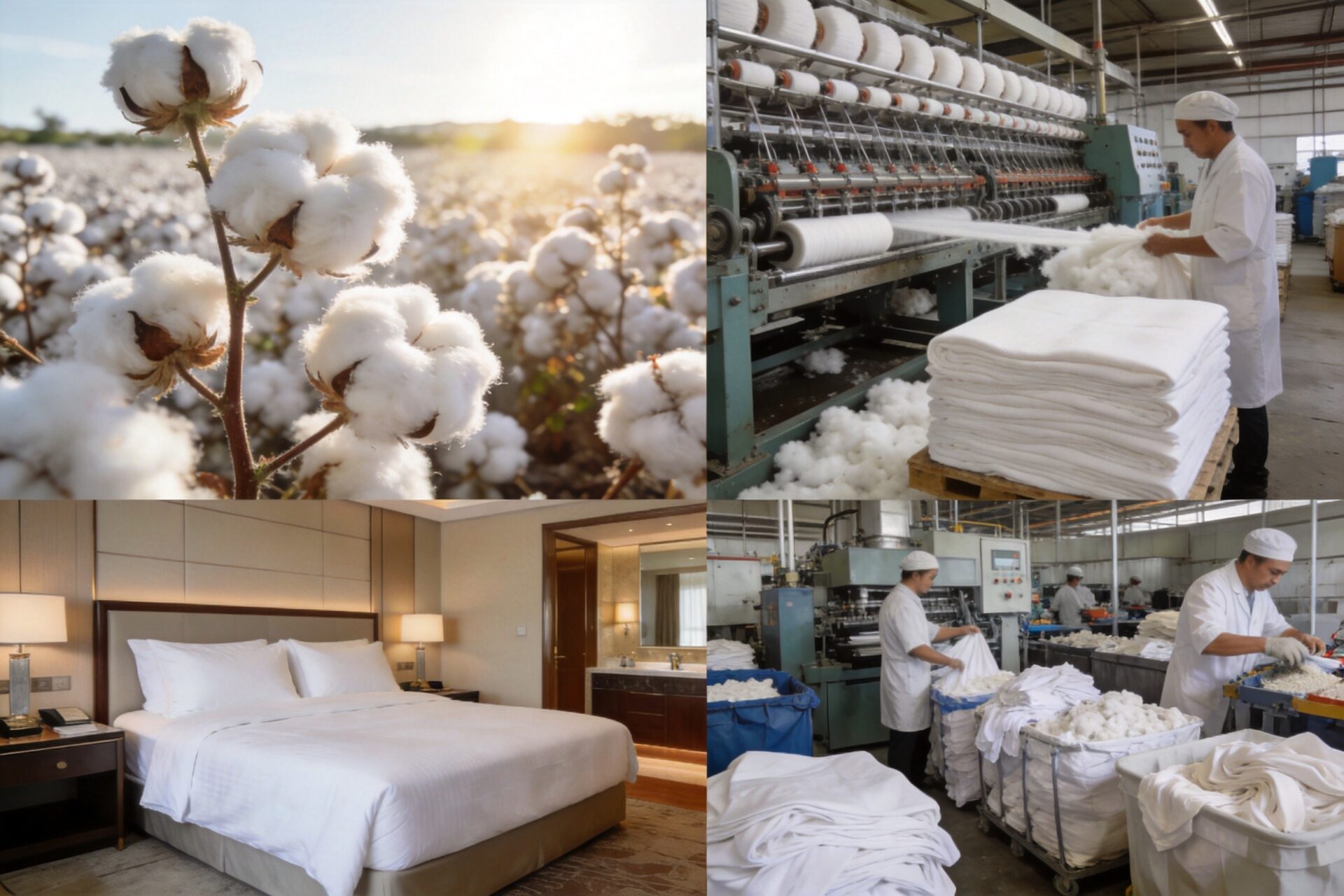
The global hospitality industry produces an estimated 2.5 million tons of textile waste annually, and hotel linens represent a significant and largely unmeasured source of carbon emissions. From the energy-intensive cultivation of cotton and the chemical-heavy dyeing processes to the daily industrial laundering that consumes thousands of gallons of water and therms of natural gas, every stage of a hotel linen’s lifecycle carries an environmental cost. For hotel groups under pressure from corporate ESG mandates, investor reporting requirements, and increasingly eco-conscious travelers, understanding and reducing the carbon footprint of hotel linens is no longer optional. This article breaks down linen emissions across the full lifecycle, provides benchmark data, and offers actionable strategies for reducing environmental impact without compromising guest comfort or operational efficiency.
Lifecycle Assessment: Where Do Linen Emissions Come From?
A lifecycle assessment (LCA) of hotel linens examines environmental impact across four stages: raw material production, manufacturing, transportation, and use phase (laundering), followed by end-of-life disposal. The distribution of emissions across these stages may surprise hoteliers who assume manufacturing is the primary culprit.
| Lifecycle Stage | % of Total Carbon Footprint (Cotton Sheets) | % of Total Carbon Footprint (Polyester Tablecloths) | Key Emissions Drivers |
|---|---|---|---|
| Raw Material Production | 25–35% | 15–25% | Cotton farming (water, fertilizer, land use); petroleum extraction for polyester |
| Manufacturing (weaving, dyeing, finishing) | 15–25% | 20–30% | Energy for weaving, heat for dyeing, chemical processing |
| Transportation | 5–10% | 5–10% | Ocean/air freight from manufacturing origin to hotel |
| Use Phase (laundering over 2-year lifespan) | 35–50% | 30–45% | Hot water heating, drying energy, detergent production and wastewater |
| End-of-Life Disposal | 2–5% | 10–20% | Landfill methane for cotton; persistence of polyester in landfill |
The critical insight is that the use phase—repeated laundering—accounts for the largest share of a hotel linen’s carbon footprint, especially for cotton products that require hot water washing and long drying cycles. This means that the most impactful sustainability interventions may not be material switching alone, but improving laundry efficiency, extending product lifespan, and reducing wash frequency.
Raw Material Stage: Cotton vs. Polyester vs. Alternative Fibers
Conventional Cotton: Water-Intensive but Biodegradable
Cotton accounts for approximately 75% of all hotel bedding and towel fiber by volume. Conventional cotton cultivation is resource-intensive: producing 1 kg of cotton fiber requires 2,120–2,700 liters of water (World Wildlife Fund data), and cotton farming uses 25% of the world’s insecticides and 10% of pesticides by value. The carbon footprint of conventional cotton fiber is approximately 2.1–5.9 kg CO₂e per kg of fiber, with the wide range attributable to farming practices, irrigation methods, and geographic origin.
However, cotton is biodegradable under appropriate conditions and does not shed microplastics during washing—an important environmental advantage over synthetic fibers.
Organic Cotton: Lower Impact, Higher Cost
GOTS-certified organic cotton eliminates synthetic pesticides and fertilizers, uses 71% less water than conventional cotton (according to the Textile Exchange), and produces 46% lower CO₂e emissions per kilogram. The trade-off is a 30–50% price premium and lower yields per hectare, making it difficult to supply at the scale required by large hotel groups. For hotels prioritizing verified sustainability, organic cotton is a strong option for guest-facing products where the premium can be justified through marketing differentiation.
Polyester and rPET: Lower Use-Phase Impact, Higher End-of-Life Concerns
Virgin polyester, derived from petroleum, has a fiber-stage carbon footprint of approximately 5.5–9.5 kg CO₂e per kg—higher than cotton. However, recycled polyester (rPET) made from post-consumer plastic bottles reduces this to 1.5–3.0 kg CO₂e per kg, a 60–75% reduction. Polyester’s environmental advantage emerges in the use phase: it requires lower wash temperatures, dries 30–40% faster, and lasts 25–50% more wash cycles than cotton, reducing per-use emissions significantly.
The primary drawback is microplastic shedding—polyester textiles release an estimated 500,000–6 million microfibers per wash cycle, contributing to ocean plastic pollution. This concern is driving innovation in filtration technology and closed-loop recycling systems.
Emerging Sustainable Fibers
| Fiber | Carbon Footprint (kg CO₂e/kg) | Key Advantages | Limitations for Hotels |
|---|---|---|---|
| TENCEL™ Лиоцелл | 1.5–2.5 | Closed-loop solvent process, FSC wood source, biodegradable | Higher cost, limited supply, requires gentle laundering |
| Bamboo Viscose (rayon) | 2.0–3.5 | Fast-growing, low water requirement, soft hand feel | Chemical-heavy viscose process; not all bamboo is sustainable |
| Hemp | 1.0–2.0 | Minimal water, no pesticides, very durable | Coarse hand feel, limited hotel-appropriate processing |
| Recycled Cotton | 0.5–1.5 | Diverts textile waste, low additional water use | Shorter staple length reduces durability and softness |
| rPET (полиэстер из вторичного сырья) | 1.5–3.0 | Diverts plastic bottles, durable, quick-drying | Microplastic shedding, non-biodegradable |
Manufacturing Emissions: Weaving, Dyeing, and Finishing
The transformation from fiber to finished fabric accounts for 15–30% of total linen emissions. The most energy-intensive manufacturing step is dyeing and finishing, which requires heating large volumes of water to 130–200°F (55–93°C) and uses 100–200 liters of water per kilogram of fabric. A typical textile dyeing facility consumes approximately 1.5–2.5 GJ of energy per ton of finished fabric, generating 150–300 kg CO₂e per ton.
Manufacturers can reduce these emissions through:
- Low-liquor-ratio dyeing machines: Reduce water consumption by 40–60% and associated heating energy proportionally.
- Heat recovery systems: Capture waste heat from dyeing effluent to pre-heat incoming water, reducing energy use by 20–30%.
- Cold-pad batch dyeing: Processes fabric at ambient temperature, eliminating the need for steam heating in certain applications.
- Solar thermal installations: Pre-heat process water using solar collectors, reducing natural gas or coal consumption.
- Vertical integration: When weaving, dyeing, cutting, and sewing occur at a single facility—like Youmian Textile’s 20,000㎡ finishing base in Nantong and 46,000㎡ weaving base—inter-facility transportation is eliminated and quality control reduces waste from defective batches.
Transportation: Ocean Freight vs. Air Freight
Transportation typically accounts for only 5–10% of total linen lifecycle emissions, but the mode of transport makes a dramatic difference. A 40-foot container shipped from Shanghai to Los Angeles via ocean freight emits approximately 2.5–3.5 tons of CO₂e. The same shipment by air freight emits 45–55 tons of CO₂e—15–20 times more. For a shipment of 15,000 kg of linens, this translates to 0.2 kg CO₂e per kg by sea versus 3.3 kg CO₂e per kg by air.
Key takeaway: Plan orders 35–45 days in advance to use ocean freight exclusively. Air freight should be reserved for emergency top-up orders, not bulk procurement. Consolidating shipments into full containers also reduces per-kilogram emissions compared to LCL (less-than-container-load) shipping.
The Use Phase: Laundry as the Dominant Emission Source
Over a 2-year lifespan with 100–200 wash cycles, laundering generates 35–50% of a cotton sheet’s total carbon footprint. The emissions breakdown per wash load (approximately 5 kg of linens) is:
| Laundry Process | Energy per Load | CO₂e per Load | % of Laundry Emissions |
|---|---|---|---|
| Water heating (140°F / 60°C) | 3.5–5.0 kWh thermal | 1.2–1.8 kg | 45–55% |
| Drying (45–60 min) | 2.5–4.0 kWh | 0.9–1.5 kg | 35–40% |
| Washer motor and pumps | 0.3–0.5 kWh | 0.1–0.2 kg | 3–5% |
| Detergent and chemicals | — | 0.3–0.5 kg | 10–15% |
| Total per load | 6.3–9.5 kWh equivalent | 2.5–4.0 kg | 100% |
High-Impact Laundry Emission Reduction Strategies
The following interventions deliver measurable carbon reductions and, in many cases, simultaneous cost savings:
- Lower wash temperatures: Reducing from 160°F (71°C) to 105°F (40°C) cuts water heating energy by 55–60%. Modern enzymatic detergents achieve effective cleaning at 85–105°F for lightly soiled linens, reserving hot washes for stained or heavily soiled loads.
- Ozone laundry systems: Injecting ozone into wash water enables effective cleaning at cold temperatures, reducing hot water energy by 60–80% and extending linen life by 20–30% through reduced thermal degradation. ROI typically occurs within 18–36 months.
- Heat reclamation: Wastewater heat recovery systems capture 50–70% of heat from drain water to pre-heat incoming cold water, reducing overall water heating energy by 30–40%.
- High-extraction washers: Extractors achieving 300–400 G-force remove 15–25% more moisture than standard washers, reducing dryer time by 20–30%.
- Towel and linen reuse programs: Encouraging guests to reuse towels and skip daily sheet changes reduces laundry volume by 15–25% with no impact on cleanliness standards. A 300-room hotel can save 30–50 tons of CO₂e annually through a well-communicated reuse program.
- Switching to polyester or poly-blend linens: Polyester dries 30–40% faster than cotton and can be washed at lower temperatures, reducing per-use laundry emissions by 25–35%.
End-of-Life: The Final Chapter
When hotel linens reach the end of their usable life—typically 150–400 wash cycles depending on material and quality—the disposal method significantly affects their total environmental impact.
- Landfill (current practice for ~75% of hotel textiles): Cotton and other natural fibers anaerobically decompose in landfills, releasing methane—a greenhouse gas 28–34 times more potent than CO₂ over a 100-year period. A 1 kg cotton sheet in landfill generates approximately 1.2–1.8 kg CO₂e from methane emissions. Polyester does not decompose significantly but persists in the environment for 200+ years.
- Incineration: Waste-to-energy incineration recovers energy content (approximately 15–20 MJ/kg for cotton and polyester), reducing fossil fuel displacement, but releases CO₂ from combustion. This is common in Europe with energy recovery facilities.
- Downcycling (wiping cloths, rags): Approximately 15–20% of used hotel textiles are downcycled into industrial wiping cloths, extending their useful life by 1–3 years and avoiding new cotton production for that application.
- Mechanical recycling: Cotton can be shredded and re-spun into lower-quality yarn, though the shortening of fibers reduces durability. Polyester can be mechanically recycled into rPET chips for new fiber production, creating a closed-loop system.
- Chemical recycling (emerging): Advanced depolymerization technologies can break down polyester into its original monomers for infinite recycling without quality loss. Currently limited by high costs and limited processing capacity, but expected to scale by 2030.
Benchmarking: What Does a Typical Hotel Linen Footprint Look Like?
For context, here is a carbon footprint estimate for a typical 300-room full-service hotel’s linen program over one year:
| Параметр | Значение |
|---|---|
| Average occupancy | 70% (76,650 room nights/year) |
| Linens per room (bedding + towels + bath mats) | ~8 kg |
| Total linen inventory | ~3,600 kg (3 par × 1,200 kg per set) |
| Annual linen replacement rate | 33% (1,200 kg new linens/year) |
| Annual laundry volume | ~220,000 kg (at 2.87 kg/room night) |
| Manufacturing footprint (new purchases) | ~18 tons CO₂e/year |
| Laundry footprint (washing + drying) | ~110–175 tons CO₂e/year |
| Transportation footprint | ~1.5–3 tons CO₂e/year |
| End-of-life footprint | ~2–5 tons CO₂e/year |
| Total annual linen carbon footprint | ~130–200 tons CO₂e |
This represents approximately 5–8% of a typical full-service hotel’s total Scope 3 carbon emissions, making linen management a meaningful category for sustainability improvement.
Actionable Reduction Roadmap
Based on the emissions data, hotels can achieve 30–50% linen-related carbon reductions through a phased approach:
Quick wins (0–12 months, low investment):
- Implement a guest linen reuse program with clear in-room communication
- Optimize wash chemistry to enable lower-temperature washing for lightly soiled loads
- Eliminate fabric softeners and dryer sheets that reduce absorbency and add chemical emissions
- Implement preventive maintenance on washers and dryers to maintain efficiency
- Train laundry staff on proper load sizing (overloading reduces wash effectiveness; underloading wastes energy)
Medium-term investments (12–24 months):
- Install wastewater heat recovery systems
- Upgrade to high-extraction washers (300+ G-force)
- Switch to OEKO-TEX certified linens with higher durability ratings to extend replacement cycles
- Transition table linens and banquet linens to polyester or rPET blends that require less laundering energy
- Establish a linen life-extension program: mend small tears, repurpose heavily stained items as rags
Long-term transformation (24–48 months):
- Evaluate ozone laundry systems for major energy and water reduction
- Partner with suppliers offering rPET and recycled content products, such as OEM/ODM sustainable linen programs
- Implement a linen take-back and recycling program with your manufacturer
- Install on-site solar thermal or PV systems to power laundry operations with renewable energy
- Set science-based carbon reduction targets for Scope 3 procurement categories
Часто задаваемые вопросы
What is the carbon footprint of a cotton hotel sheet?
A single king-size cotton sheet (approximately 0.6 kg) has a total lifecycle carbon footprint of 8–15 kg CO₂e over a 2-year lifespan with 200 washes. Raw material production accounts for 2–3 kg CO₂e, manufacturing adds 1–2 kg, transportation contributes 0.3–0.6 kg, and laundering accounts for 5–10 kg CO₂e. Choosing organic cotton reduces the raw material stage by 46%, while switching to lower-temperature washing reduces the use-phase footprint by 50%+.
Are polyester hotel linens more sustainable than cotton?
It depends on the metric. Polyester has a higher raw-material carbon footprint (especially virgin polyester) but requires less energy to launder due to lower wash temperatures and faster drying. Over a full lifecycle, a polyester sheet washed at 105°F may have a 20–30% lower carbon footprint than a cotton sheet washed at 140°F. Recycled polyester (rPET) improves the picture further. However, polyester contributes to microplastic pollution and does not biodegrade. The most sustainable option depends on a hotel’s laundry practices and disposal infrastructure.
How much can a hotel reduce linen emissions through a towel reuse program?
A well-communicated towel and sheet reuse program typically reduces laundry volume by 15–25%. For a 300-room hotel processing 220,000 kg of laundry annually, a 20% reduction eliminates 44,000 kg of laundry, saving 22–35 tons of CO₂e per year—equivalent to taking 5–8 cars off the road. The program also reduces water, chemical, and labor costs, typically generating $8,000–$15,000 in annual savings.
Can hotels recycle old linens?
Yes—old linens can be downcycled into wiping cloths or cleaning rags (extending life by 1–3 years and covering roughly 15–20% of retired hotel textiles), mechanically recycled into new yarn (limited for blends), donated to shelters or disaster-relief agencies, or returned through manufacturer take-back programs. Ask about take-back when negotiating contracts; diverting worn linens away from landfill (still the fate of about 75% of hotel textiles) cuts both waste and embedded-carbon loss.
What certifications should hotels look for in sustainable linens?
The most credible certifications include GOTS (Global Organic Textile Standard) for organic fibers, OEKO-TEX Standard 100 for chemical safety, GRS (Global Recycled Standard) for recycled content verification, and Fair Trade for social responsibility. For carbon-specific claims, look for products with third-party verified Environmental Product Declarations (EPDs) or lifecycle assessment data. Avoid vague claims like “eco-friendly” or “green” without supporting certification.
Conclusion: Measure, Reduce, and Reimagine Hotel Linen Sustainability
The carbon footprint of hotel linens spans the entire supply chain, but the data is clear: laundering is the single largest emission source, and extending product lifespan is the most cost-effective reduction strategy. By measuring their linen carbon footprint, implementing laundry efficiency improvements, transitioning to durable and recycled-content materials, and planning for end-of-life recycling, hotels can reduce linen-related emissions by 30–50% while simultaneously lowering operational costs. Sustainability in linens is not about sacrificing quality—it is about making smarter choices across the entire lifecycle. Связаться с компанией «Youmian Textile» to discuss sustainable linen options including organic cotton, TENCEL™, rPET, and custom OEM/ODM programs designed to meet your property’s environmental goals.
Хотите узнать больше о наших продуктах?
Посмотреть все товары сейчас English
 Русский
 Español de México
 Português do Brasil
 العربية
