
Прочные полотенца: плотность ткани (г/м²), впитывающая способность и время высыхания

Перейти к разделу
Основные выводы
- GSM (grams per square meter) measures towel weight and density, ranging from 300 to 900 GSM in the hospitality industry.
- Higher GSM does not always mean better absorbency — fiber quality, twist level, and pile construction matter equally.
- Drying time is the hidden cost driver: a 700 GSM towel can take 40–60% longer to dry than a 450 GSM towel.
- Spa environments benefit from 600–700 GSM for a plush feel, while standard hotel rooms perform best at 400–500 GSM.
- The optimal balance between absorbency, dry time, and guest comfort varies by use case — there is no single “best” GSM.
- Energy costs from extended drying can add $0.03–$0.08 per towel per cycle, significantly impacting annual linen budgets.
- Ring-spun and combed cotton towels deliver better absorbency at lower GSM compared to open-end spun alternatives.
Hotel operators, procurement managers, and housekeeping directors face a constant balancing act when selecting towels: how do you deliver a luxurious guest experience while keeping laundry costs, water consumption, and replacement cycles under control? The answer lies in understanding the interplay between three critical metrics — GSM, absorbency, and dry time — and making informed choices based on your property’s specific needs.
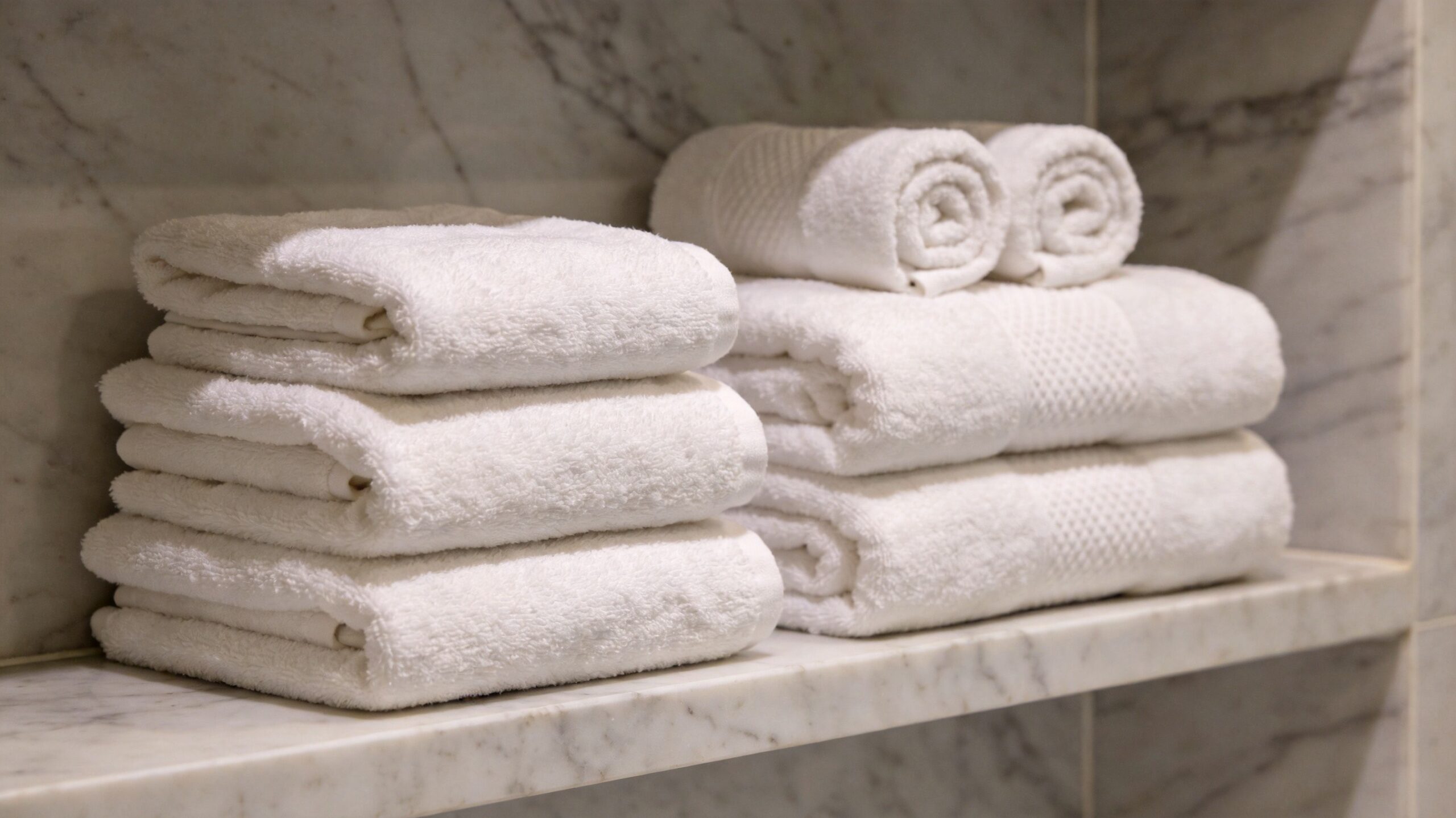
What Is GSM and Why Does It Matter?
GSM stands for грамм на квадратный метр. It is the standard unit used to measure the weight and density of a towel’s fabric. In practical terms, GSM tells you how much cotton (or cotton blend) is packed into each square meter of terry cloth.
The hospitality towel spectrum generally breaks down as follows:
| Диапазон GSM | Category | Typical Use |
|---|---|---|
| 300–400 GSM | Lightweight / Economy | Gym towels, poolside, budget hotels, hostels |
| 400–500 GSM | Medium Weight | Standard hotel rooms, mid-scale properties |
| 500–600 г/м² | Средне-тяжелый | Upscale hotels, boutique properties, resort rooms |
| 600–700 г/м² | Тяжёлый / Премиум | Luxury hotels, spa towels, bath sheets |
| 700–900 GSM | Ultra-Heavy | 5-star luxury, premium spa robes, resort suites |
Higher GSM means more fiber per unit area, which generally translates to a thicker, softer, and more plush towel. However, GSM alone does not determine quality. Two towels at the same GSM can perform very differently depending on the cotton type, yarn construction, and weaving technique used.
Absorbency: It’s More Than Just Weight
Many buyers assume that heavier towels are automatically more absorbent. While there is a correlation, the relationship is not linear. Absorbency depends on several factors beyond GSM:
Fiber Type and Quality
Combed cotton и ring-spun cotton produce longer, smoother fibers that create more surface area for water capture. A 450 GSM towel made from long-staple combed cotton can outperform a 600 GSM towel made from short-staple open-end yarn in water absorption tests.
Zero-twist yarn technology takes this further by removing twist from the pile yarn entirely, creating ultra-loopy fibers that maximize water contact. These towels feel exceptionally soft and absorb quickly, but they may be less durable under aggressive commercial laundering.
Pile Construction
The height, density, and pattern of the terry loops affect absorbency. Dense, medium-height loops create capillary action that pulls moisture away from skin faster than flat or overly long loops. Some manufacturers use a combination of cut and uncut piles to balance absorbency with a smooth feel.
The GSM–Absorbency Plateau
Research and field data suggest that absorbency gains diminish above 600 GSM. Beyond this threshold, you are primarily adding mass rather than absorption capacity. The additional fiber simply does not contribute proportionally more water-holding ability. This plateau is a key insight for cost-conscious operators who need excellent performance without unnecessary weight.
For operators sourcing towels for properties that value both performance and longevity, YouMian’s hotel towel collection offers options across the 400–700 GSM range, engineered with combed cotton construction for consistent absorbency cycle after cycle.
Dry Time: The Hidden Operational Cost
Dry time is arguably the most overlooked factor in towel selection, yet it has a direct impact on your bottom line. Every extra minute in the dryer translates to energy consumption, labor scheduling delays, and reduced linen throughput.
How GSM Affects Drying
A 450 GSM bath towel typically dries in 30–40 minutes in a commercial tumble dryer at medium heat. A 700 GSM bath sheet of the same dimensions can require 55–75 minutes under identical conditions. That 40–60% increase in drying time compounds across hundreds of towels per day.
Consider a 200-room hotel running two towel loads per room per day. At 450 GSM, total drying time might be 70 minutes per load. At 700 GSM, it jumps to 120 minutes. That is nearly an extra hour per cycle — and depending on your laundry setup, it may require additional dryer shifts or equipment.
Calculating the Real Cost
Based on average commercial dryer energy consumption of $1.50–$3.00 per hour, the additional drying time for heavier towels adds approximately $0.03–$0.08 per towel. For a 200-room hotel processing 1,200 towels daily, this translates to $36–$96 per day — or $13,000–$35,000 annually — in extra energy costs alone.
This calculation does not include accelerated wear from extended heat exposure, which can reduce towel lifespan by 15–25% for heavier GSM options.
Spa vs. Hotel Room: Matching Towels to the Experience
Different areas of your property have fundamentally different towel requirements. A one-size-fits-all approach wastes money in guest rooms and under-delivers in spa areas.
Spa and Wellness Areas (600–700 GSM)
Spa guests expect a distinctly different experience. They want to feel wrapped in luxury after a treatment. A 600–700 GSM towel with a soft, enveloping hand-feel reinforces the premium positioning of your spa services. The longer dry time is less of a concern here because spa towel volumes are lower and laundry can be scheduled between treatment sessions.
Standard Guest Rooms (400–500 GSM)
For standard hotel rooms, a 400–500 GSM towel hits the sweet spot. It feels substantial and quality-made without being excessively heavy. It dries efficiently, supports same-day turnover, and withstands frequent commercial laundering. Guests still perceive the towel as comfortable and well-appointed.
Pool and Fitness Areas (300–400 GSM)
Pool and gym towels benefit from lighter construction. They need to dry quickly between uses, resist chlorine and sweat damage, and be easy for guests to carry. A 300–400 GSM towel in a durable cotton-polyester blend performs well here while lasting significantly longer than a heavier towel would in the same environment.
Hands-On: What Different GSM Feels Like
Understanding GSM on paper is useful, but the real test is in the hand-feel and guest experience. Here is how different weights compare in practice:
- 350 GSM: Thin, almost utilitarian. Adequate for drying but lacks any sense of luxury. Common in budget motels and gym settings.
- 450 GSM: Noticeably plush. A guest at a 3–4 star property would find this satisfying. It has body and softness without feeling heavy.
- 550 GSM: Clearly premium. This is the weight many upscale boutique hotels choose. It feels indulgent when stepping out of the shower.
- 650 GSM: Spa-grade luxury. Thick, deeply absorbent, and unmistakably high-end. Guests at 5-star properties expect this level.
- 800 GSM: Ultra-luxury. Almost robe-like in its density. While impressive on first touch, some guests find it too heavy for comfortable drying.
How to Choose the Right Balance for Your Property
There is no universal “best” towel. The right choice depends on your property type, guest expectations, laundry infrastructure, and budget. Here is a decision framework:
- Start with your guest profile. Business travelers prioritize efficiency; resort guests prioritize indulgence. Match GSM to expectations.
- Audit your laundry capacity. If your dryers are already running at capacity, switching to heavier towels will create bottlenecks. Calculate whether equipment upgrades are needed.
- Calculate total cost of ownership. Factor in purchase price, expected wash cycles, energy per dry cycle, and replacement frequency. A cheaper heavy towel may cost more over its lifetime than a moderately priced medium-weight towel.
- Test before committing. Request samples at multiple GSM levels and run them through 50+ wash cycles to evaluate softness retention, shrinkage, and absorbency changes.
- Consider zone-based strategies. Use different GSM weights for different areas of your property rather than standardizing on a single weight.
Working with an experienced supplier like 优棉 YouMian can streamline this process — their team can provide sample sets tailored to your property tier and laundry specifications, reducing the trial-and-error phase significantly.
The Role of Fiber Quality in the GSM Equation
Часто задаваемые вопросы
Какая связь существует между GSM и впитывающей способностью полотенца?
Полотенца с более высоким показателем GSM, как правило, впитывают больше воды благодаря более плотным и длинным петлям ворса, которые увеличивают площадь поверхности. Однако при плотности выше 600 GSM эта зависимость перестаёт расти — полотенце с плотностью 700 GSM может впитывать не намного больше, чем полотенце с плотностью 500 GSM, если качество волокон различается. Впитывающая способность также зависит от длины хлопковых волокон и от того, было ли полотенце обработано кондиционерами для белья.
Как отели могут сократить время сушки полотенец?
Выбирайте полотенца плотностью 400–500 GSM со средней длиной петель для более быстрой сушки. Следите за правильной загрузкой сушильной машины (на 60–70%) и очищайте фильтры для ворса. Сушите в сушильной машине при средней температуре (65 °C), а не при высокой, которая может «запечь» волокна и снизить впитывающую способность. Полотенца из чесаного хлопка сохнут на 15–20% быстрее, чем из кардочесаного хлопка.
Какой диапазон GSM лучше всего подходит для спа-полотенец по сравнению с обычными гостиничными полотенцами?
Полотенца для спа-салонов должны иметь плотность 600–700 г/м², что обеспечивает их мягкость и роскошную текстуру, соответствующие атмосфере спа-салона. Стандартные гостиничные полотенца лучше всего подходят при плотности 400–500 г/м², обеспечивая хорошую впитываемость и удобство в использовании. Полотенца для тренажерного зала и бассейна могут быть более легкими — 350–400 GSM — для быстрого высыхания и удобства в использовании.
Как различные типы волокон влияют на эксплуатационные характеристики полотенец?
Из хлопка с длинным волокном (египетского, пима) получаются более прочные, мягкие и впитывающие полотенца, чем из хлопка с коротким волокном. Бамбуковое волокно придает полотенцам естественные антимикробные свойства и повышает впитывающую способность. Полотенца из микрофибры сохнут в 3 раза быстрее, но не обладают тем высоким качеством на ощупь, которого ожидают гости. Смесовые ткани (хлопок/бамбук 70/30) обеспечивают сбалансированные эксплуатационные характеристики.
При выборе полотенец отелям следует отдавать предпочтение впитывающей способности или износостойкости?
Следует соблюдать баланс: для оптимального сочетания выбирайте полотенца плотностью 400–500 GSM из хлопка с длинным волокном. Полотенца с чрезвычайно высокой плотностью (700+ GSM) теряют в прочности — более толстые петли сильнее линяют и быстрее изнашиваются при промышленной стирке. В отелях полотенца плотностью 400–500 GSM обычно заменяют каждые 150–200 циклов стирки, тогда как полотенца плотностью 700+ GSM — каждые 100–130 циклов, что делает полотенца среднего диапазона более экономичными.
Какую роль играет структура полотенца помимо плотности в г/м²?
Плотность петель (количество петель на квадратный дюйм), высота ворса и степень скручивания влияют на эксплуатационные характеристики независимо от плотности ткани (GSM). Плотно скрученное полотенце плотностью 450 GSM может казаться более шероховатым на ощупь, но служит дольше; слабо скрученное полотенце плотностью 500 GSM кажется более мягким, но быстрее покрывается катышками. Полотенца с нулевым скручиванием обеспечивают максимальную мягкость, но требуют более бережной стирки и имеют более короткий срок службы.
Not all cotton is created equal, and this is particularly relevant when comparing towels at the same GSM. Key fiber considerations include:
- Long-staple vs. short-staple cotton: Longer fibers produce smoother, stronger yarns that resist pilling and maintain softness longer.
- Combed vs. carded cotton: Combed cotton has shorter fibers and impurities removed, resulting in a cleaner, more uniform yarn.
- Ring-spun vs. open-end: Ring-spun yarn is softer and more durable; open-end is faster and cheaper to produce but less refined.
- Egyptian and Pima cotton: These extra-long-staple varieties produce the softest, most absorbent towels but at a premium price.
A 500 GSM towel made from ring-spun, combed long-staple cotton will outperform a 650 GSM towel made from open-end short-staple cotton in virtually every metric — softness, absorbency, durability, and even dry time.
Вопросы устойчивого развития
Lighter towels are inherently more sustainable. They require less raw material, less water during washing, and less energy during drying. For hotels pursuing green certifications or ESG reporting targets, optimizing GSM downward where guest experience permits is a practical sustainability lever.
Some manufacturers now offer recycled cotton blend towels in the 400–500 GSM range that deliver comparable performance to 100% virgin cotton options while reducing water usage by up to 30% in production. These are worth evaluating as part of a comprehensive sustainability strategy.
Common Mistakes to Avoid
- Over-GSMing guest rooms: Selecting 700 GSM for standard rooms when 450 GSM would satisfy guests and cut drying costs in half.
- Ignoring dry time in procurement specs: Failing to account for laundry throughput when choosing heavier towels, leading to bottlenecks during peak occupancy.
- Equating GSM with quality: A well-constructed 450 GSM towel from quality fiber is superior to a poorly constructed 650 GSM towel.
- Using the same towel everywhere: Missing the opportunity to right-size towels by zone, wasting money in low-need areas and under-delivering in high-need areas.
- Not testing wash durability: Some towels feel great initially but degrade rapidly. Always request wash-test data or run your own trials.
Making the Decision: A Practical Summary
The ideal hotel towel is not the heaviest or the lightest — it is the one that optimally balances guest comfort, operational efficiency, and total cost of ownership. Here is a quick reference:
| Тип недвижимости | Recommended GSM | Fiber Recommendation |
|---|---|---|
| Бюджетный / Хостел | 300–400 | Carded cotton or cotton-poly blend |
| 3-Star Hotel | 400–500 | Combed cotton |
| 4-Star Hotel | 450–550 | Ring-spun combed cotton |
| 5-Star Hotel | 550–700 | Long-staple ring-spun cotton |
| Spa / Wellness | 600–700 | Zero-twist or ring-spun cotton |
| Pool / Fitness | 300–400 | Cotton-poly blend for durability |
By aligning towel specifications with actual usage conditions — rather than defaulting to the heaviest option — hotel operators can improve guest satisfaction, reduce operational costs, and extend the usable life of their towel inventory.
Ready to find the right towel balance for your property? Contact the YouMian team for personalized recommendations and sample sets tailored to your hotel’s tier, laundry setup, and guest experience goals.
Хотите узнать больше о наших продуктах?
Посмотреть все товары сейчас English
  Русский
  Español de México
  Português do Brasil
  العربية