
Hotel Linen Sourcing: 8 Questions Buyers Ask Before Placing an Order
Ir a la sección
Hotel linen buyers ask the same eight questions in every first meeting. The answers decide whether an order arrives on time and to specification — or turns into a claims conversation three months later. Below is each question, the answer we give at the booth, and the factory data behind it.
We build hotel bedding, towels and table linen at our own facilities in Nantong, Jiangsu, and we exhibited at Canton Fair 2026 (Phase 3, Home Textiles). These eight questions are the ones that separate a smooth first order from an expensive lesson.
The eight questions, answered in one table
| Question | Short answer |
|---|---|
| Minimum order quantity | 500 pieces per item for custom bedding |
| Muestreo | 7–15 days for a counter sample |
| Lead time | 30–45 days for bulk custom orders after pre-production approval |
| Certificaciones | OEKO-TEX STANDARD 100 (SHWO 108278), ISO 9001, ISO 14001, ISO 45001 |
| Monthly capacity | 5,000,000 m of fabric; 650,000 pieces of finished goods |
| Fabric matching | Yes — send a swatch and we reverse-engineer yarn count, density and weave |
| OEM branding | Woven labels, care labels, hangtags, packaging, logo embroidery |
| Defect handling | AQL-based inspection, retained batch samples, replacement or credit per contract |
1. What is your MOQ — and does it change by product?
500 pieces per item for custom hotel bedding. That covers fitted sheets, flat sheets, pillowcases and duvet covers in a specified size, fabric and colour.
The number is driven by fabric, not by sewing. A custom shade requires its own dye lot, and the minimum dye batch sets the minimum fabric order. That is why standard whites and off-whites can often run below 500 pieces, while a specific Pantone shade in a heavy sateen may require more.
Two things worth checking with any supplier:
- Is the MOQ per item o per order? A 500-piece MOQ split across four items is a very different commitment from 500 pieces of one item.
- Does the MOQ change for repeat orders? A second run in an existing shade should not carry the same fabric minimum.
For context on how order size interacts with factory capacity, see our breakdown of bulk hotel linen buying and capacity stability.
2. Can I get samples before committing — and how long do they take?
Yes. A counter sample takes 7–15 days, depending on whether the fabric is in stock or needs to be woven and dyed to your shade.
Samples are not a formality. The single most reliable predictor of long-term performance is how a fabric behaves after industrial washing, not how it feels in a showroom. We recommend running 10–20 industrial wash cycles on any sample before approving it, and checking three things after each cycle:
- Encogimiento — measure the same panel before and after. Anything above 3% on a pre-shrunk cotton is a warning sign.
- Pilling and surface change — look at the fabric under raking light, not straight on.
- Colour and whiteness retention — compare against an unwashed control swatch kept in a drawer.
Before bulk production starts, a pre-production (PP) sample should be approved in your exact specification: dimensions, stitching, label placement and packaging. The PP sample is the reference both sides will point to if a dispute arises.
3. What is the real lead time — not the catalogue number?
30–45 days for bulk custom orders after PP approval. Simple repeat orders in existing fabric run faster; new shades, jacquard weaving or heavy embroidery run longer.
Three adjustments to plan around:
- Peak season. August to November is when every hotel group in the northern hemisphere prepares for the next budget year. Add one to two weeks.
- Ocean freight. China to the US West Coast is typically 15–25 days port to port; add customs clearance and inland delivery.
- Pre-washing. If your specification requires pre-washed cotton, that is an extra production step, not a same-day finish.
A practical rule: place orders at least 60 days before you need linen on property. For a new property opening, 90 days is safer.
4. Which certifications do you actually hold?
OEKO-TEX STANDARD 100, certificate SHWO 108278, issued by TESTEX, Product Class II — the class that covers textiles worn next to skin. Plus ISO 9001 (quality), ISO 14001 (environment) and ISO 45001 (occupational health and safety).
| Certification | What it covers | How to verify |
|---|---|---|
| NORMA OEKO-TEX 100 | Tested for harmful substances at product level (Class II) | Check certificate SHWO 108278 in the OEKO-TEX certificate database |
| ISO 9001 | Quality management system | Ask for the certificate and the issuing body’s registration number |
| ISO 14001 | Environmental management system | Same — verify with the certification body, not the PDF alone |
| ISO 45001 | Occupational health and safety management | Same |
One distinction that matters in procurement: OEKO-TEX STANDARD 100 certifies the product, not the factory. It confirms that a tested article is free from harmful substance levels above the limit — it is not a statement about the production site’s environmental or social performance. If your RFP asks for a production-site certification, that is a separate document and a separate question.
For a side-by-side comparison of certification schemes, see OEKO-TEX vs GOTS for hotel linen and our STANDARD 100 certification announcement.
5. What is your real monthly capacity?
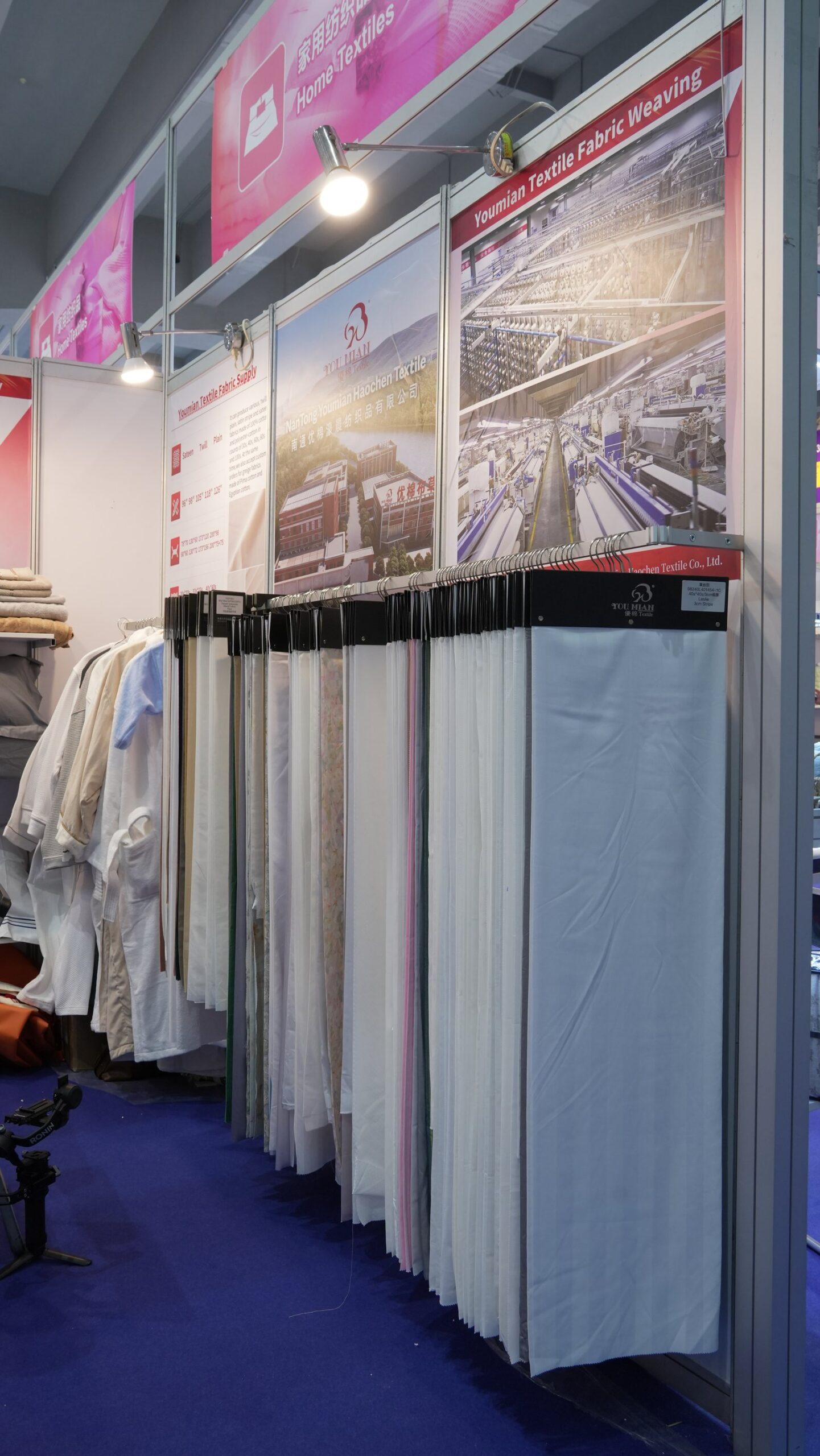
5,000,000 m of fabric and 650,000 pieces of finished goods per month, across two facilities in Nantong, Jiangsu.
| Facility | Area | Equipment | Monthly output |
|---|---|---|---|
| Weaving base | 46,000 m² | 600+ air-jet looms | 5,000,000 m of greige and finished fabric |
| Finished goods base | 20,000 m² | Cutting, sewing, embroidery, packing lines | 650,000 pieces |
Workforce: 620 people. The two bases are separate facilities and are reported separately — we do not add the numbers together.
Why capacity matters more than price: a supplier who cannot hold a delivery window will cost you far more in emergency purchases and guest complaints than the few percent you saved on the FOB line. We covered that trade-off in why stability beats the cheapest quote.
6. Can you match a fabric we already buy?
Yes — and this is the question that most often decides a switch. Most hotels are not replacing linen from scratch; they are trying to match an existing spec from a supplier they are unhappy with.
Send us a swatch and we will analyse it, then produce a counter sample. What we need from you:
- A physical swatch of at least A4 size — photographs are not enough to read density or weave structure.
- Wash history — a fabric that has been through 100 industrial washes has already shrunk; we need to know that to match the original, not the current state.
- A colour reference — Pantone TCX number if you have one, plus a physical colour standard.
- Target weight in GSM and any hand-feel requirements (crisp, soft, brushed).
We can usually tell within a few days whether an exact match is realistic or whether a near-match with an adjusted yarn count is the better route. For the underlying parameters, see our guide to hotel linen fabric sourcing.
7. How do you handle OEM branding and packaging?
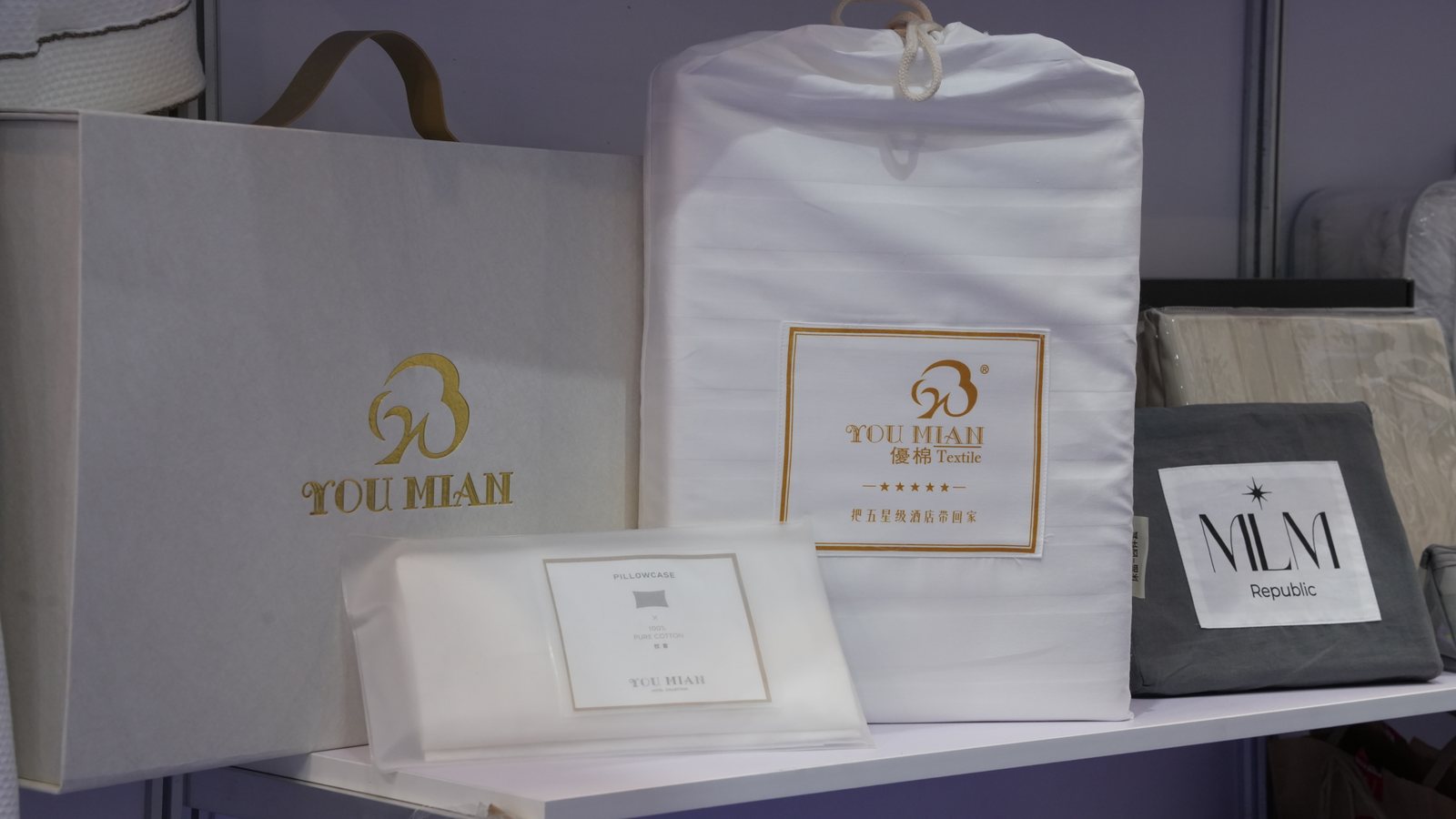
In-house, from the label to the carton. Woven brand labels, printed care and composition labels, hangtags, poly bags, branded cartons and logo embroidery on towels and bathrobes.
Two practical notes:
- Artwork lead time. Custom woven labels typically add 7–10 days to the schedule. Build that into your first order, not your second.
- Trademark responsibility. We produce branding to your artwork. We do not reproduce third-party trademarks without written authorisation from the brand owner — if you are sourcing on behalf of a hotel group, a short letter of authorisation avoids delays at both ends.
Dimension and sizing questions usually come up at the same time — our sheet size chart y towel GSM guide cover the specifications buyers most often need to confirm.
8. What happens when a shipment has defects?
Inspection against an agreed AQL level, retained batch samples, and replacement or credit per the contract. AQL 2.5 for major defects is the usual benchmark in this category.
What actually protects you is what is written in the purchase order before production starts:
- The AQL level and the inspection stage — pre-shipment, during production, or both.
- The claim window — how many days after arrival you have to raise an issue, and what evidence is required (photos, retained samples, wash logs).
- The remedy — replacement in the next production run, credit note, or price adjustment. Vagueness here is where disputes live.
We keep retained samples from every batch for exactly this reason. If a claim is raised six months later, there is a physical reference to compare against. For a full inspection framework, see our factory verification checklist y el supplier evaluation RFP template.
Frequently asked questions
How much does hotel linen cost from China?
Fabric typically accounts for 50–60% of the FOB price, sewing and labour 15–20%, packaging 5–10%, with the remainder being factory margin and overhead. That structure explains why two quotes for the “same” sheet can differ by 30% — the fabric weight, yarn count or finishing is almost always the variable. For a full cost breakdown, see Cómo adquirir ropa de cama para hoteles en China.
What payment terms do you accept?
30% deposit with 70% before shipment by T/T is standard for orders under USD 50,000. Letters of credit are workable for larger orders. Terms are confirmed per order, not assumed from a catalogue.
Can I start with a trial order below the MOQ?
For standard whites and stock fabrics, often yes. For a custom shade, size or embroidery, the fabric minimum applies regardless of order value — which is why the first order usually carries the full MOQ and repeats do not.
Do you ship to Australia and the Middle East?
Yes. Both are established markets for us, alongside North America and Europe. Freight terms are quoted per destination — FOB, CIF or DDP depending on what your customs setup can handle.
How do I verify the OEKO-TEX certificate myself?
Take the certificate number (SHWO 108278) and the issuing institute (TESTEX) and look it up in the OEKO-TEX certificate database. Do not rely on a PDF sent by email — certificate numbers are the verifiable part.
A one-page checklist before you sign
- MOQ confirmed per item, and a written answer on repeat-order minimums
- Sample approved after industrial wash testing, not after a showroom touch
- PP sample signed off before bulk production
- Certificate numbers written into the contract, not just mentioned in a meeting
- Capacity and delivery window stated in writing, with a peak-season adjustment clause
- AQL level, claim window and remedy defined in the PO
If you are evaluating suppliers now, the fastest way to shorten the process is to send us the specification you are working from — size, fabric, weight, quantity and target date. We can tell you within a day whether it is a straightforward run or needs a development cycle.
Nantong Youmian Haochen Textile Co., Ltd. — hotel bedding, towels and table linen, woven and finished in Nantong, Jiangsu. 21 years in home textiles. Contáctanos with your specification.
¿Quieres saber más sobre nuestros productos?
Ver todos los productos ahora English
 Русский
 Español de México
 Português do Brasil
 العربية
