
Cómo adquirir ropa de cama para hoteles en China: una guía completa de compras B2B
Ir a la sección
Puntos clave
- China produce el 60%+ de la ropa de cama para hoteles de todo el mundo, y Nantong (Jiangsu) es el #1 centro de producción, con más de 2,000 fábricas especializadas.
- El pedido mínimo (MOQ) para pedidos personalizados de ropa de cama para hoteles es de 200 a 500 piezas por artículo; el plazo de entrega de las muestras es de 7 a 15 días, y el de la producción en masa, de 25 a 45 días.
- Certificaciones clave para la exportación de ropa de cama para hoteles: OEKO-TEX Standard 100, ISO 9001, BSCI y SGS — verifícalas con el número de certificado en el sitio web del organismo emisor
- Estructura de precios FOB: costo de la tela (50–60%) + costura/mano de obra (15–20%) + empaque (5–10%) + margen de la fábrica (10–15%)
- Condiciones de pago: un depósito de 30% + 70% antes del envío (T/T) es lo habitual para pedidos inferiores a $50,000; se acepta carta de crédito (L/C) para pedidos superiores a $50,000
Cómo adquirir ropa de cama para hoteles en China: una guía completa de compras B2B
Si te encargas de las compras para una cadena hotelera, un grupo de resorts o una empresa de suministros para el sector hotelero, ya sabes que los costos de la ropa de cama afectan directamente tus utilidades. Entre los ciclos de rotación de las habitaciones, el desgaste de la ropa de cama y las renovaciones estacionales, conseguir textiles duraderos a precios competitivos es un reto que se presenta todo el año — y Cómo adquirir ropa de cama para hoteles en China es una pregunta que cada vez más compradores internacionales se hacen.
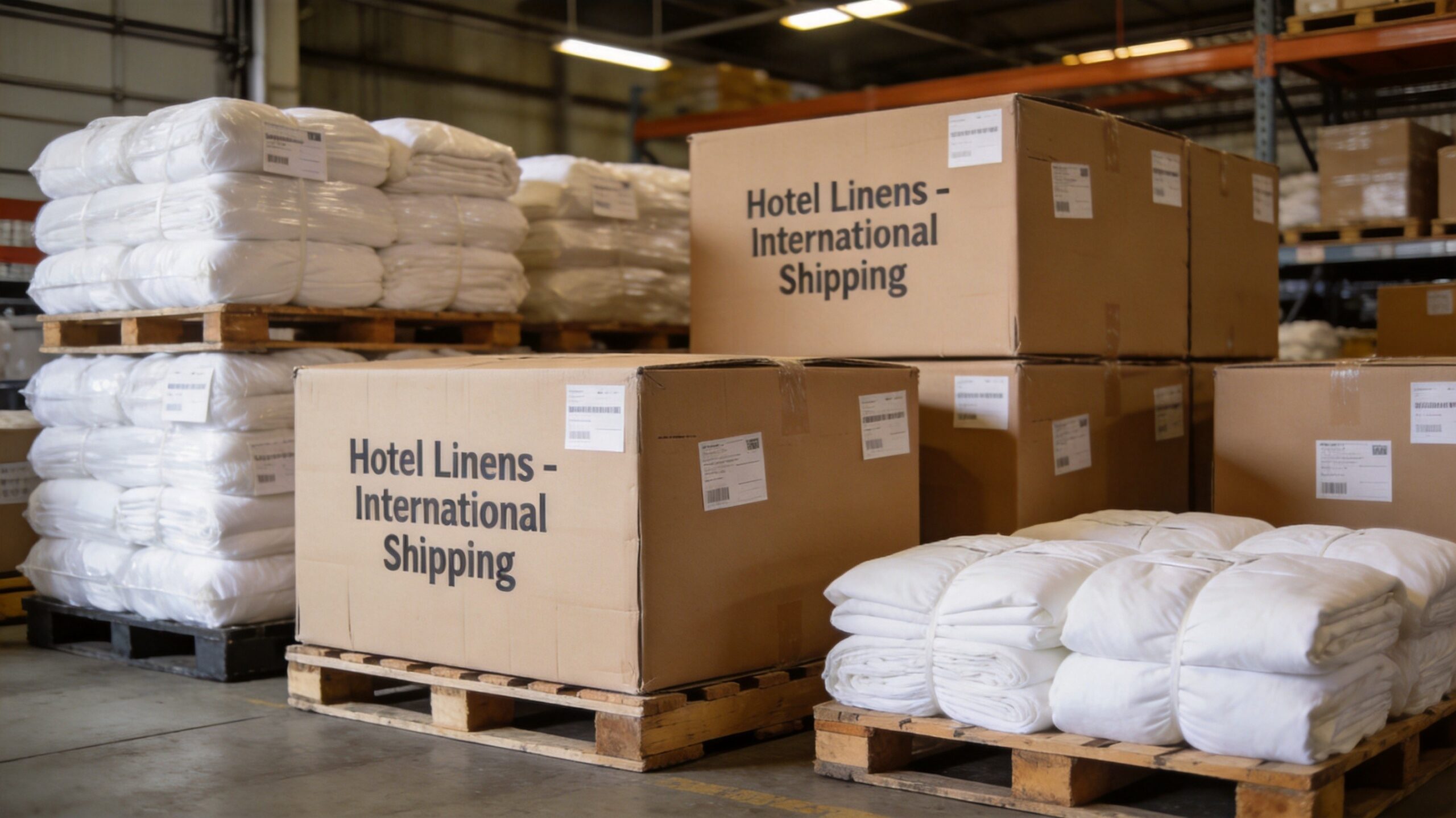
China produce aproximadamente 68% de los productos textiles para cama a nivel mundial, lo que la convierte en el centro mundial indiscutible de la ropa de cama de calidad hotelera. Desde moteles económicos hasta resorts de cinco estrellas en más de 100 países, las fábricas chinas suministran las sábanas, fundas de edredón, fundas de almohada, toallas y batas de baño que mantienen en marcha a la industria hotelera.
Pero sabiendo que donde Buscar es solo el principio. Esta guía te acompaña a lo largo de todo el proceso de abastecimiento —desde la definición de las especificaciones del producto hasta la entrega final— para que puedas construir una cadena de suministro confiable con plena confianza en la calidad y el cumplimiento normativo.
- Cómo definir especificaciones precisas del producto (material, número de hilos, GSM, tallas)
- Dónde y cómo encontrar fabricantes verificados
- Una lista de verificación paso a paso para la verificación de proveedores
- Cómo evaluar muestras como un comprador profesional
- Estrategias de negociación para el pedido mínimo (MOQ), los precios y las condiciones de pago
- Normas de control de calidad y pruebas realizadas por terceros
- Explicación de la logística de envío (FOB, CIF y DDP)
- Normativas de importación por mercado de destino (UE, EE. UU., Australia, Oriente Medio)
- Errores comunes que cometen los compradores — y cómo evitarlos
1. Por qué China sigue siendo la principal fuente de ropa de cama para hoteles en el mercado #1
A pesar del aumento de los costos laborales y los cambios geopolíticos, China sigue dominando la producción textil mundial por varias razones estructurales:
Una densidad de clústeres industriales sin igual
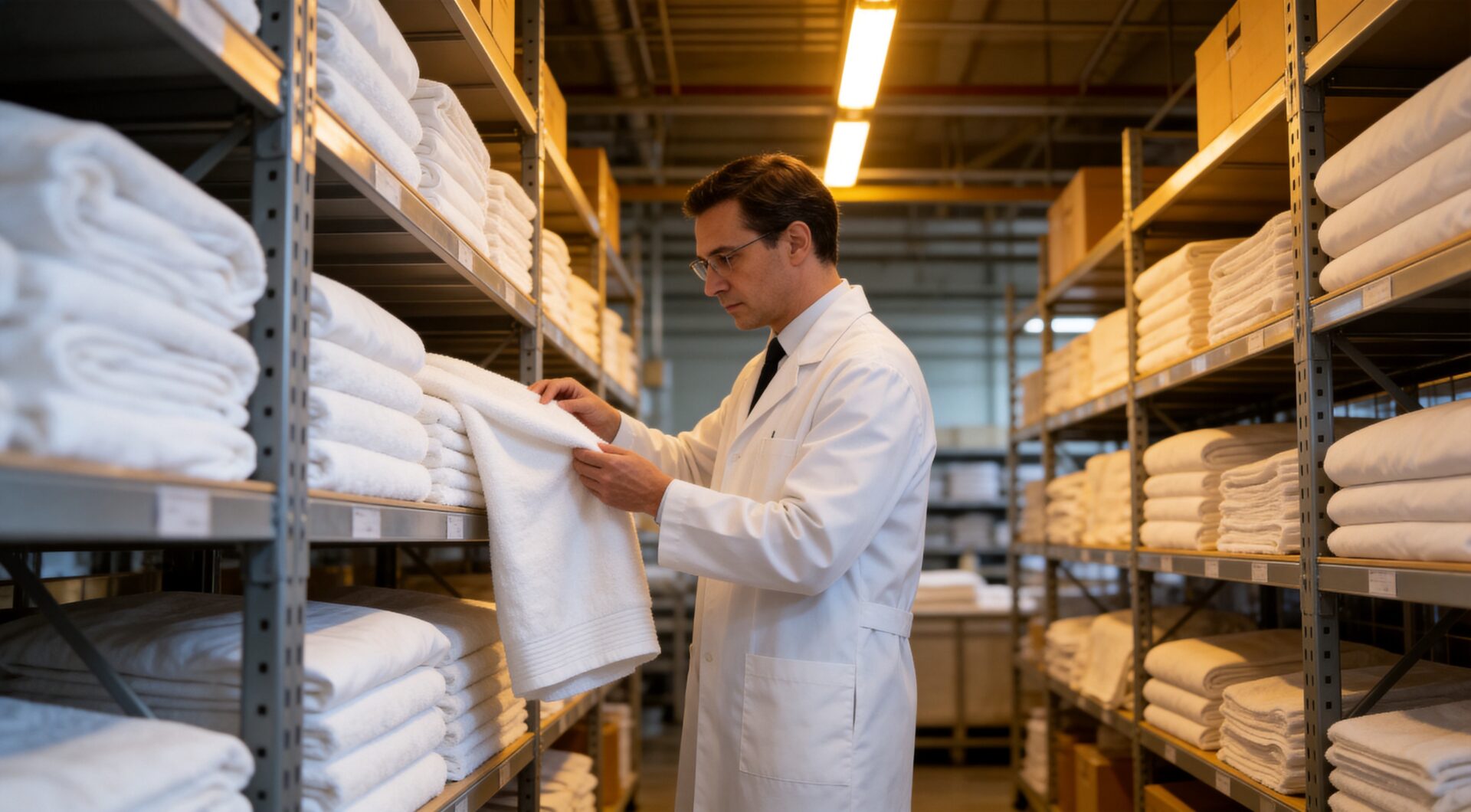
La ciudad de Nantong, en la provincia de Jiangsu alberga el mayor clúster industrial de textiles para el hogar de China. En un radio de 50 kilómetros, encontrarás cientos de fábricas especializadas en todas las etapas de la producción, desde la hilatura y el tejido hasta el teñido, el corte, la costura, el bordado y el empaque. Esta concentración se traduce en plazos de entrega más cortos, menores costos logísticos y fácil acceso a las materias primas.
Escala y flexibilidad
Las fábricas chinas de ropa de cama para hoteles suelen contar con instalaciones que van de los 10,000 a los 50,000 metros cuadrados, con una plantilla de entre 200 y 1,000 empleados. Esta escala les permite atender pedidos que van desde unos pocos cientos de piezas para hoteles boutique hasta decenas de miles para cadenas internacionales, todo ello sin dejar de ofrecer servicios de fabricación por contrato (OEM) y diseño y fabricación por contrato (ODM).
Ventajas de costo que perduran
A pesar del aumento de los salarios, el costo total de abastecerse de China sigue siendo entre un 20 y un 40% más bajo que el de abastecerse de India, Pakistán o Turquía para niveles de calidad comparables. Esta diferencia se amplía aún más cuando se toman en cuenta la infraestructura superior de China, los plazos de entrega más rápidos y los ecosistemas de exportación más maduros.
Infraestructura de exportación consolidada
Los puertos de China —en especial los de Shanghái, Ningbo y Qingdao— manejan diariamente grandes volúmenes de contenedores. Las rutas marítimas establecidas, las tarifas de flete competitivas y los agentes aduanales con experiencia facilitan el proceso de exportación para los compradores de todo el mundo.
2. Paso 1: Define las especificaciones de tu producto
Antes de contactar a cualquier proveedor, necesitas especificaciones muy claras. Las consultas vagas como “Necesito sábanas de hotel” atraerán a comerciantes poco confiables y harán perder tiempo a todos. Los compradores profesionales especifican cada detalle desde el principio.
Especificaciones clave que se deben definir
| Parámetro | Qué significa | Gamas habituales de hoteles |
|---|---|---|
| Material | Composición de las fibras (algodón, mezcla de algodón y poliéster, bambú, Tencel) | Algodón 100% (de lujo), 60/40 T/C (estándar), 50/50 T/C (económico) |
| Número de hilos (TC) | Hilos por pulgada cuadrada (urdimbre + trama) | 200 TC (económico), 300 TC (gama media), 400–600 TC (de lujo) |
| GSM (para toallas) | Gramos por metro cuadrado: indica el peso y la capacidad de absorción | 350–400 GSM (estándar), 450–550 GSM (premium), 600+ GSM (de lujo) |
| Tipo de tejido | Percal, satén, jacquard, dobby | Percale (crisp), sateen (smooth/luxurious), jacquard (patterned) |
| Size | Exact dimensions for each product | Varies by market — specify in cm or inches |
| Finishing | Embroidery, piping, hemming, packaging | Logo embroidery, satin stripe, hotel label |
Pro tip: Create a spec sheet document with all these parameters clearly listed. This is the single most effective way to filter serious manufacturers from trading companies — the latter often can’t answer technical follow-up questions.
Understanding Fabric Construction
For hotel bed linens, the most critical decisions revolve around material blend and thread count. Here’s how they affect your product:
- 100% Cotton (combed): Premium feel, excellent breathability, higher price point. Ideal for 4–5 star properties. Look for long-staple cotton for superior softness and durability.
- 60% Cotton / 40% Polyester: The industry workhorse. Balances softness with wrinkle resistance and durability. Most popular for 3–4 star hotels with high laundry turnover.
- 50/50 T/C: Maximum durability and lowest cost. Common in budget and mid-scale properties. Less breathable but withstands industrial laundering well.
- Bamboo / Tencel blends: Growing segment for eco-conscious brands. Higher cost but strong marketing appeal.
3. Step 2: Find & Shortlist Suppliers
With your specifications in hand, it’s time to build a shortlist. Here are the most effective channels for finding a reliable hotel linen factory in China:
Online B2B Platforms
- Alibaba.com: The largest directory. Search for “hotel linen manufacturer” and filter by “Verified Supplier,” “Trade Assurance,” and minimum years in business (5+ recommended). Expect 200–500 results — narrow down using the verification criteria in Step 3.
- Made-in-China.com: Often has more factory-direct listings compared to Alibaba’s trader-heavy results. Strong for industrial and commercial textile categories.
- GlobalSources.com: Smaller but higher average supplier quality. Good for cross-referencing.
Trade Shows (Highly Recommended)
Meeting suppliers face-to-face remains one of the most effective sourcing methods:
- Canton Fair (Guangzhou): Phase 3 (Home Textiles) runs every April and October. The single largest sourcing event for textile products.
- Intertextile Shanghai Home Textiles: Dedicated home textile show, typically in August. More specialized than Canton Fair.
- Hospitality industry shows: Hotel suppliers often exhibit at trade shows like IHM (Paris), HD Expo (Las Vegas), and The Hotel Show (Dubai).
Industry Referrals & Google Research
Don’t underestimate the power of a targeted Google search for “hotel linen OEM manufacturer China” or reaching out through industry networks. Many established factories with decades of export experience don’t invest heavily in Alibaba — they rely on repeat business and referrals. A thorough Google search often reveals factory websites with detailed product catalogs, certifications, and client testimonials.
4. Step 3: Verify Manufacturer Credentials
This is the most critical step. The difference between a successful sourcing relationship and a costly mistake often comes down to thorough verification. Here is a comprehensive checklist to verify a Chinese textile supplier:
✅ Supplier Verification Checklist
- Business License (营业执照): Verify the company’s registered name, legal representative, registered capital, and business scope. Check if “manufacturing” (生产/加工) is listed — not just “trading” (贸易).
- Factory Audit or Site Visit: Request a virtual factory tour via video call, or hire a local inspection company (SGS, BV, Intertek) to conduct an on-site audit. Key things to check: actual production equipment, number of production lines, warehouse capacity, and working conditions.
- Factory Size vs. Claimed Capacity: A 30,000㎡ facility should realistically support 500+ workers and significant monthly output. If a factory claims massive capacity but operates from a small space, something doesn’t add up.
- Export Experience: Ask for a list of recent export destinations and, if possible, references from buyers in your region. A factory experienced with your target market will understand compliance requirements.
- Certifications:
- ISO 9001 (Quality Management) — baseline requirement
- ISO 14001 (Environmental Management) — increasingly requested
- OEKO-TEX Standard 100 — ensures no harmful substances
- SGS / BV / Intertek test reports — product-level verification
- BSCI / Sedex — social compliance audits (required by some EU buyers)
- Production Capacity: Ask for monthly output by product category (e.g., 50,000 bed sheet sets, 100,000 towels). Cross-reference with their equipment count and workforce size.
- Quality Control Process: Request their QC workflow — from incoming raw material inspection to in-process checks to final random inspection (AQL standards). A professional factory will have a documented QC system.
- R&D and Customization Capability: Can they develop custom designs, match Pantone colors, create custom embroidery, and produce sample runs? This separates true manufacturers from resellers.
Red flags to watch for: Supplier refuses video calls or factory visits, cannot provide specific production data, has a very short company history (<3 years), or offers prices dramatically below market rate.
5. Step 4: Request & Evaluate Samples
Never place a bulk order without testing samples first. Here’s a structured approach:
Sample Request Best Practices
- Request multiple samples: Ask for at least 3–5 shortlisted factories to send samples based on your exact specifications. This enables direct comparison.
- Be specific about expectations: Tell the factory your target price range, quality grade, and intended use. A sample for a 5-star resort should be visibly different from one for a budget property.
- Expect to pay: Samples are rarely free (especially customized ones with your logo). Budget $50–200 per sample set plus shipping. Legitimate factories will refund sample costs against your first bulk order.
- Allow 7–15 days: Standard samples take 7–10 days; customized samples with embroidery or special packaging take 12–15 days.
Sample Evaluation Criteria
| Check Item | What to Look For |
|---|---|
| Fabric hand feel | Softness, weight, drape — does it match your specification? |
| Stitching quality | Even stitches, no loose threads, reinforced seams at stress points |
| Dimensional accuracy | Measure against your spec — tolerance should be ±2cm |
| Color fastness | Rub with a white cloth (wet and dry) — check for color transfer |
| Shrinkage test | Wash once at intended temperature, measure before and after (≤3% acceptable) |
| Wash durability | Run 10+ industrial wash cycles to simulate real-world wear |
| Empaque | Professional packing, correct labeling, barcode accuracy |
6. Step 5: Negotiate MOQ, Pricing & Payment Terms
Pricing in the hotel linen industry depends on material, construction, order quantity, and customization level. Here’s a general reference range based on current market conditions:
Price Reference Table (FOB Shanghai/Ningbo)
| Producto | Specification | FOB Price Range (USD) |
|---|---|---|
| Flat Sheet | T/C 60/40, 200TC, 280×280cm | $3.50 – $5.80 |
| Duvet Cover | 100% Cotton, 300TC sateen, 230×230cm | $12.00 – $22.00 |
| Pillowcase | T/C 60/40, 200TC, 50×80cm | $1.20 – $2.50 |
| Toalla de baño | 100% Cotton, 500 GSM, 70×140cm | $2.80 – $5.50 |
| Bathrobe | Waffle weave cotton, 280 GSM, one size | $8.00 – $18.00 |
Note: Prices fluctuate based on raw material costs, order quantity, and customization complexity. Always request formal quotations for your specific requirements.
MOQ Expectations
Most Chinese hotel linen factories set MOQs at 100–500 pieces per item for standard products and 300–1,000 pieces for customized items (custom embroidery, special dyeing, etc.). Some factories catering to smaller hospitality businesses offer MOQs as low as 50 pieces — though per-unit costs will be higher.
Payment Terms Comparison
| Method | Structure | Risk Level | Ideal para |
|---|---|---|---|
| T/T (Telegraphic Transfer) | 30% deposit, 70% before shipment or against B/L copy | Medio | Most common for repeat orders |
| L/C (Letter of Credit) | Bank-guaranteed payment upon document presentation | Low | Large orders ($50K+), new supplier relationships |
| Trade Assurance | Alibaba escrow — payment released after delivery confirmation | Low | First-time orders via Alibaba |
| OA (Open Account) | Payment 30–90 days after shipment | Low (buyer-side) | Established relationships, high-volume buyers |
Negotiation tip: Don’t just negotiate on price. Negotiate on payment terms, delivery timelines, sample refunds, quality guarantee periods, and after-sales service. A factory offering 30/70 T/T with a 2% quality claim allowance is often a better deal than one offering the lowest price with strict pre-shipment payment.
7. Step 6: Quality Inspection & Third-Party Testing
Quality control is non-negotiable in the hotel linen business. A single bad batch can damage your reputation with hotel clients and result in costly returns.
Inspection Framework
- In-Line Inspection (During Production): Hire a third-party inspector to visit the factory when 20–30% of the order is completed. This catches issues early — wrong fabric, incorrect dye lots, poor stitching — before the entire order is finished.
- Pre-Shipment Inspection (PSI): The most critical checkpoint. Conducted when 100% of goods are produced and at least 80% packed. Use AQL (Acceptable Quality Limit) standards: AQL 2.5 for major defects, AQL 4.0 for minor defects.
- Lab Testing: Send samples to accredited labs (SGS, Bureau Veritas, Intertek) for performance testing:
- Fiber composition analysis
- Color fastness (washing, rubbing, light)
- Dimensional stability (shrinkage)
- Resistencia a la formación de bolitas
- Tear and tensile strength
- pH value and formaldehyde content (critical for EU compliance)
Cost: Third-party inspection typically costs $200–350 per man-day. Lab testing ranges from $150–500 depending on the test scope. This is a small investment compared to the cost of receiving a container of defective goods.
8. Step 7: Shipping & Logistics
Understanding international trade terms is essential for accurate cost calculation. Here’s a comparison of the three most common Incoterms for hotel linen imports:
Trade Terms Comparison: FOB vs CIF vs DDP
| Term | Qué significa | Seller’s Responsibility | Buyer’s Responsibility | When to Use |
|---|---|---|---|---|
| FOB (Free On Board) |
Seller delivers goods on board the vessel at the named port | Factory → China port → Export customs → Loading on vessel | Ocean freight → Insurance → Import customs → Final delivery | Experienced importers with own freight forwarder. Most flexible and commonly used. |
| CIF (Cost, Insurance & Freight) |
Seller pays freight and insurance to destination port | Everything in FOB + Ocean freight + Marine insurance | Import customs → Final delivery from destination port | Buyers who prefer not to arrange their own shipping. Less control over freight costs. |
| DDP (Delivered Duty Paid) |
Seller delivers to buyer’s door, all duties and taxes paid | Everything from factory to buyer’s warehouse, including duties | Nothing (just receive goods) | New importers or small orders. Most convenient but most expensive — factory builds in a margin on all logistics. |
Shipping Methods & Transit Times
- Full Container Load (FCL): 20ft or 40ft containers. Most economical for orders above 5 CBM. Transit times: 15–30 days to Southeast Asia, 25–35 days to Europe, 20–30 days to US West Coast.
- Less than Container Load (LCL): For smaller orders. You share container space. Slightly longer transit due to consolidation/deconsolidation.
- Rail freight (China-Europe): 15–20 days to Central/Western Europe. Cost-effective middle ground between sea and air.
- Air freight: 5–7 days. Only for urgent sample shipments or high-value, low-weight orders.
9. Step 8: Import Regulations by Target Market
Every market has specific compliance requirements for textile imports. Here’s a summary of key regulations:
European Union
- REACH Regulation: Restrictions on certain chemicals (azo dyes, formaldehyde, heavy metals). Must comply with Annex XVII limits.
- OEKO-TEX certification: Not legally mandatory but strongly preferred by EU buyers as proof of chemical safety.
- Textile labeling: EU Regulation 1007/2011 requires fiber composition labels in the local language.
- EN standards: Flammability standards may apply for certain hospitality textiles in specific countries.
Estados Unidos
- CPSC / CPSIA: Consumer Product Safety Commission regulations. Lead and phthalate restrictions apply if products could be used by children.
- Textile Fiber Products Identification Act: Requires proper fiber content labeling.
- Flammability Standard 1610: Standard for the flammability of clothing textiles (also applies to certain bed linens).
- Country of origin marking: “Made in China” must be clearly labeled.
Australia
- ACCC requirements: Mandatory labeling under the Trade Practices Act. Fiber content must be clearly stated.
- Biosecurity concerns: Australia has strict quarantine regulations. Ensure packaging materials comply with ISPM 15 (wooden pallets must be heat-treated).
Middle East (GCC Countries)
- SASO (Saudi Arabia) / ESMA (UAE): Product conformity certification may be required. Check specific SASO technical regulations for textiles.
- Arabic labeling: Many GCC countries require product labels in Arabic, including fiber content and care instructions.
- Halal considerations: While not typically applicable to linens, some buyers may request confirmation that no animal-derived processing agents are used.
10. Common Pitfalls & How to Avoid Them
After working with international buyers for years, here are the most frequent mistakes we see — and how to avoid them:
Pitfall #1: Choosing the Cheapest Supplier
The lowest quote often means cut corners on raw materials, skipped QC steps, or hidden costs later. A factory offering 200TC sheets at a price that should be 300TC is a major red flag. Always compare quotes with similar specifications, not just the bottom line.
Pitfall #2: Not Ordering Enough Samples
One sample round is not enough. Order samples, test them (wash, stress-test, measure), then request a pre-production sample from your final choice before bulk production begins. This second sample confirms the factory can reproduce the quality at scale.
Pitfall #3: Skipping Third-Party Inspection
“Trust but verify.” Even after years of working with a supplier, random inspection audits protect both parties. The $300 inspection fee can save you $30,000 in defective goods.
Pitfall #4: Poor Communication on Specifications
Language barriers are real. Use diagrams, photos, measurement charts, and physical reference samples whenever possible. Confirm every detail in writing (email or messaging) and keep a documented record of all agreed specifications.
Pitfall #5: Ignoring Packaging & Labeling Requirements
Your market’s labeling laws are your responsibility — not the factory’s. Provide detailed labeling instructions (fiber content, care symbols, country of origin, barcode format) in a clear, visual format. Request packaging samples before bulk packing.
Pitfall #6: Underestimating Lead Times
Standard production lead time is 30–45 days after sample approval. Add 7–15 days for pre-production samples, 3–7 days for inspection, and 20–35 days for shipping. Total sourcing cycle: 60–100 days. Plan accordingly — especially for peak season orders.
11. Frequently Asked Questions
Q1: What is the minimum order quantity (MOQ) for hotel linens from China?
Most factories require 100–500 pieces per item for standard products and 300–1,000 pieces for customized items (with logo embroidery or special dyeing). Some factories can accommodate orders as low as 50 pieces for first-time buyers testing the market, though unit costs will be higher. The MOQ is typically negotiable, especially if you’re ordering multiple product categories (sheets + towels + pillowcases) to reach a meaningful total volume.
Q2: How long does it take to produce and ship hotel linens from China?
A complete sourcing cycle typically takes 60–100 days: 7–15 days for sample development, 30–45 days for bulk production after sample approval, 3–7 days for quality inspection, and 20–35 days for ocean shipping (depending on destination). Air freight reduces shipping to 5–7 days but costs 4–6 times more. Rail freight to Europe takes 15–20 days as a middle-ground option.
Q3: How can I verify that a Chinese linen supplier is a real factory and not a trading company?
Check the business license for “manufacturing” (生产/加工) in the business scope. Request a video factory tour or hire a third-party inspection company (SGS, BV, Intertek) to conduct an on-site audit. Verify certifications (ISO 9001, OEKO-TEX) directly with the issuing body. Ask specific technical questions about their production equipment, weaving methods, and quality control processes — real manufacturers can answer these in detail. Trading companies often give vague answers or need to “check with the factory.”
Q4: What quality certifications should I require from a hotel linen supplier?
At minimum, require ISO 9001 (quality management) and OEKO-TEX Standard 100 (chemical safety). For the EU market, BSCI or Sedex social compliance audits may be required by your buyers. Product-level test reports from SGS, Bureau Veritas, or Intertek should cover fiber composition, color fastness, shrinkage, pilling, and formaldehyde content. These certifications and test reports are standard for any reputable hotel linen OEM manufacturer in China.
Q5: What payment terms are standard when sourcing hotel linens from China?
The most common structure is 30% deposit via T/T (telegraphic transfer) with 70% balance paid before shipment or against a copy of the Bill of Lading. For orders above $50,000, an irrevocable L/C (Letter of Credit) at sight is standard practice for new supplier relationships. Alibaba Trade Assurance offers buyer protection for first-time orders. After establishing trust through several successful transactions, many buyers negotiate Open Account terms (OA 30–60 days). Avoid paying 100% upfront — this gives you zero leverage if quality issues arise.
12. Ready to Source? Here’s How to Get Started
Sourcing hotel linens from China is a proven strategy for hospitality businesses worldwide — but success depends on choosing the right manufacturing partner and following a structured process.
If you’re looking for a reliable, experienced hotel linen OEM manufacturer in China, Nantong Youmian Haochen Textile Co., Ltd. (brand: YouMian) is worth considering. Based in Nantong — China’s largest home textile industrial cluster — YouMian operates a 30,000㎡ production facility with over two decades of export experience. Their capabilities include:
- Full OEM/ODM services with custom embroidery and packaging
- SGS and ISO 9001 certification
- Product range: bed sheets, duvet covers, pillowcases, towels, and bathrobes
- Flexible MOQs to accommodate both boutique hotels and large chains
- Orders shipped to 100+ countries with an on-time delivery rate above 98%
Whether you’re sourcing for a new hotel opening, refreshing an existing property, or building a hospitality supply business, the right Chinese manufacturing partner can give you a significant competitive advantage in both quality and cost.
¿Quieres saber más sobre nuestros productos?
Ver todos los productos ahora English
  Русский
  Español de México
  Português do Brasil
  العربية