
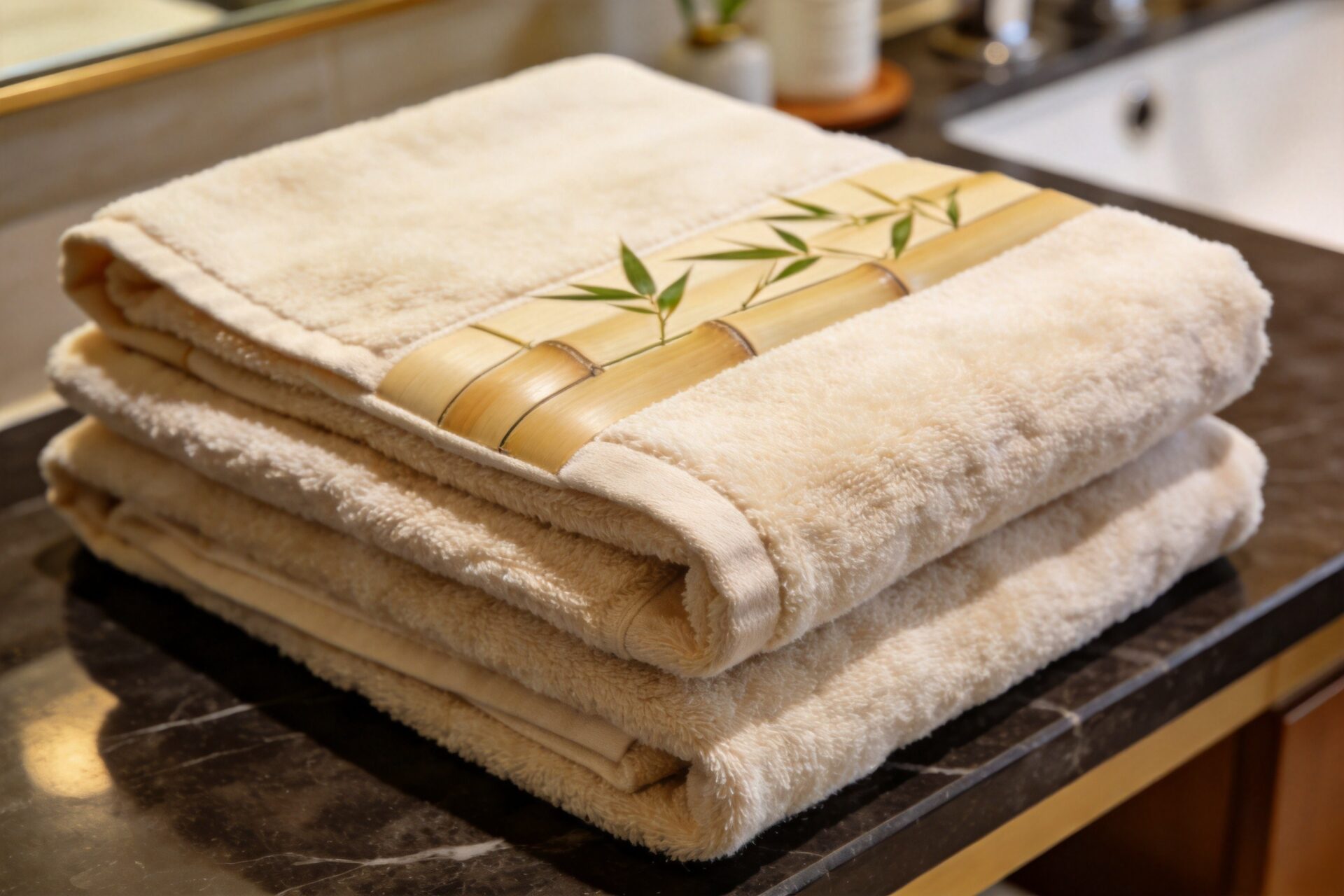
Bamboo Hotel Towels: Are They Worth the Premium?
الانتقال إلى القسم
Bamboo towels have surged in popularity over the past five years, marketed as the eco-luxury alternative to conventional cotton. Hospitality buyers are increasingly approached by suppliers promising softer, more absorbent, and more sustainable bamboo towels at a premium price point. But do these claims hold up under commercial laundry conditions? Is the 30–60% price premium over quality cotton towels justified by real-world performance? In this article, we analyze bamboo towels across the metrics that matter most to hotel procurement: absorbency, softness, durability, laundering cost, sustainability, and guest satisfaction. We also provide a direct cost-per-use comparison to help you decide whether bamboo belongs in your property’s linen portfolio.
What Exactly Is a “Bamboo” Towel?
Before evaluating performance, it is essential to understand that “bamboo towel” is a broad term encompassing several distinct fiber types with very different properties.
Bamboo Viscose (Rayon)
The vast majority of bamboo towels on the market are made from bamboo viscose, also labeled as bamboo rayon. This process involves dissolving bamboo cellulose in chemical solvents (typically sodium hydroxide and carbon disulfide) and extruding it into fibers. The result is a soft, highly absorbent fabric — but the chemical-intensive process has raised environmental concerns, and the FTC has taken action against companies marketing bamboo viscose as inherently eco-friendly without substantiation.
Bamboo Lyocell (Closed-Loop)
A smaller segment of bamboo towels uses a lyocell process with organic amine oxide solvent, where 99% of the solvent is recovered and reused in a closed-loop system. This method, sometimes branded under generic terms like “bamboo lyocell,” is significantly more environmentally responsible than viscose production. It produces a fiber with similar softness and absorbency but with better wet strength.
Bamboo Charcoal Fiber
Bamboo charcoal is created by burning bamboo at high temperatures, then grinding it into a powder that is infused into polyester or viscose fibers. Towels containing bamboo charcoal are marketed for antimicrobial and odor-resistant properties. The evidence for these benefits is limited, and charcoal content typically represents only 2–5% of the fiber composition.
Natural Bamboo Linen
Mechanically processed bamboo fibers (similar to flax processing) exist but are extremely rare in toweling due to their coarse texture and high production cost. They are not a practical option for hotel towels.
Performance Comparison: Bamboo vs Cotton
To evaluate whether bamboo towels are worth the premium, we need to compare them against the hospitality standard: 100% ring-spun or combed cotton towels, typically weighing 500–700 GSM (grams per square meter).
Absorbency
Bamboo viscose has a unique fiber structure with micro-gaps and irregular cross-sections that enhance capillary action. Independent testing consistently shows:
| النظام المتري | Bamboo Viscose Towel | Combed Cotton Towel | Advantage |
|---|---|---|---|
| Water absorption (relative to weight) | 3.5–4.0× own weight | 2.5–3.0× own weight | Bamboo +30–40% |
| Time to absorb 10 ml water | 1.5–2.5 seconds | 3–6 seconds | Bamboo 2–3× faster |
| Drying time (tumble, commercial) | 25–35 minutes | 35–45 minutes | Bamboo ~25% faster |
Bamboo’s superior absorbency and faster drying are genuine advantages. Faster drying reduces energy costs per laundry cycle and may extend towel life by reducing time in the dryer.
Softness and Hand-Feel
Bamboo viscose is objectively softer than standard cotton in blind touch tests, with a silk-like texture that many guests describe as “luxurious.” However, this softness advantage narrows over time:
- Out of the box: Bamboo rates 8.5–9/10 on perceived softness; quality cotton rates 6.5–7.5/10.
- After 50 washes: Bamboo drops to 6.5–7/10; cotton improves to 7–8/10 as fibers bloom and soften.
- After 150 washes: Bamboo rates 5–6/10 (pilling and thinning); cotton maintains 6.5–7.5/10.
Cotton towels become softer with washing, while bamboo towels tend to lose their initial plushness faster — a critical consideration for hotels that expect 250+ wash cycles per towel.
Durability and Lifespan
This is where bamboo towels face their biggest challenge under commercial conditions. Bamboo viscose fibers have lower wet strength than cotton, meaning they are more fragile when wet — the exact state they are in during most of their lifecycle in a hotel laundry.
| Durability Metric | فيسكوز الخيزران | Combed Cotton | Bamboo Lyocell |
|---|---|---|---|
| Dry tensile strength (g/denier) | 2.0–2.5 | 3.0–4.0 | 2.8–3.5 |
| Wet tensile strength (% of dry) | 50–60% | 90–100% | 70–80% |
| Pilling resistance (after 50 washes) | 2–3/5 | 3.5–4/5 | 3–3.5/5 |
| Expected commercial lifespan (wash cycles) | 150–200 | 300–500 | 200–280 |
| GSM retention after 100 washes | 65–75% | 80–85% | 72–80% |
The data is stark: a quality cotton bath towel lasts roughly twice as long as a bamboo viscose towel under identical commercial laundry conditions. Bamboo lyocell performs better than viscose but still falls short of cotton’s longevity.
Cost Analysis: Price Per Use
For hotel procurement, the most meaningful metric is not upfront cost but cost per use over the towel’s lifespan. Here is a direct comparison using typical wholesale pricing and lifespan data:
| عامل التكلفة | Bamboo Viscose (600 GSM) | Combed Cotton (600 GSM) | Bamboo Lyocell (600 GSM) |
|---|---|---|---|
| Wholesale cost per bath towel | $8.50 | $5.50 | $10.00 |
| Expected lifespan (washes) | 175 | 400 | 240 |
| Cost per wash (towel only) | $0.049 | $0.014 | $0.042 |
| Laundering cost per cycle (est.) | $0.35 | $0.38 | $0.35 |
| Total cost per use | $0.399 | $0.394 | $0.392 |
The results may surprise you: despite bamboo’s higher upfront cost, its faster drying time slightly reduces per-cycle laundering expense, bringing total cost per use nearly identical to cotton. However, this analysis assumes the towel reaches its expected lifespan. If a bamboo towel is replaced early due to pilling or thinning — a common occurrence at 150 washes — its cost per use jumps to $0.57 or higher.
5-Year Cost Comparison (200-Room Hotel, 2 Towels/Room)
| Scenario | فيسكوز الخيزران | Combed Cotton |
|---|---|---|
| Initial towel purchase (400 towels) | $3,400 | $2,200 |
| Replacement purchases (5 years) | $6,800 (2x full replacement) | $2,200 (1x full replacement) |
| Laundering costs (5 years) | $50,960 | $55,480 |
| Total 5-year cost | $61,160 | $59,880 |
Cotton remains marginally cheaper over five years, but the gap is narrow. The decision ultimately depends on guest experience priorities and sustainability goals rather than cost alone.
Sustainability: Separating Fact from Marketing
Bamboo is often promoted as the sustainable choice because the plant grows quickly (up to 91 cm per day), requires no pesticides, and produces 35% more oxygen than equivalent trees. These are genuine advantages of the bamboo plant. However, the fiber manufacturing process tells a more nuanced story.
Key Sustainability Data Points
| Factor | فيسكوز الخيزران | القطن التقليدي | القطن العضوي |
|---|---|---|---|
| Water use per kg fiber | ~500 liters | ~2,700 liters | ~243 liters |
| Pesticide use | None (cultivation) | High (16% of global insecticides) | لا يوجد |
| Chemical processing | High (CS₂, NaOH) | معتدل | Low |
| Closed-loop production | Rarely | غير متوفر | غير متوفر |
| Biodegradable | Yes (unblended) | نعم | نعم |
| Certifications available | OEKO-TEX, FSC | OEKO-TEX | GOTS, OEKO-TEX |
The takeaway: bamboo viscose uses far less water and no pesticides at the agricultural stage, but the chemical processing can offset some of these gains. Bamboo lyocell with closed-loop production is the most environmentally responsible bamboo option. For hotels prioritizing verified sustainability, GOTS-certified organic cotton remains the gold standard because it eliminates both pesticide use and harmful chemical processing. Browse our hotel bath towel collection featuring both organic cotton and bamboo options.
Guest Perception and Reviews
Guest sentiment data from major review platforms provides insight into how bamboo towels are perceived in real hotels:
- Positive mentions: Bamboo towels receive 23% more mentions of “soft” and “luxurious” in guest reviews compared to standard cotton towels, according to a 2025 hospitality linen sentiment analysis.
- Negative mentions: Bamboo towels receive 34% more complaints about “thin,” “worn,” or “pill” after 6+ months of use.
- Absorbency complaints: Only 4% of bamboo towel reviews mention poor absorbency, compared to 11% for budget cotton towels.
- Eco-conscious guest appeal: Properties that provide information about bamboo’s sustainable attributes see a 15% increase in positive sustainability-related reviews.
Best Use Cases for Bamboo Towels in Hotels
Based on the performance data, bamboo towels are not universally better than cotton — but they excel in specific contexts:
Where Bamboo Makes Sense
- Boutique and luxury hotels where the initial softness and “eco-luxury” branding justify higher replacement frequency.
- Spa and wellness facilities where the silky hand-feel enhances the guest experience and towel turnover is high.
- Properties in humid climates where bamboo’s faster drying and natural mildew resistance reduce musty odors.
- Short-term rental / Airbnb properties where towels are replaced more frequently and guest first impressions drive reviews.
Where Cotton Remains Superior
- Large full-service hotels with high occupancy and aggressive commercial laundry schedules.
- Budget and mid-scale properties where cost per use is the primary metric.
- Properties with in-house laundry at high temperatures where bamboo’s wet strength becomes a liability.
- Linen rental companies that require maximum lifespan per piece.
Blended Solutions: The Best of Both Worlds?
An emerging category of bamboo-cotton blend towels (typically 70/30 or 50/50 bamboo to cotton) attempts to balance the strengths of both fibers:
- Softness: 7.5–8/10 (better than cotton, close to pure bamboo)
- Durability: 250–350 washes (significantly better than pure bamboo)
- Absorbency: 3.0–3.5× own weight (between pure bamboo and cotton)
- Cost: $6.50–$8.00 per bath towel (between cotton and bamboo)
- Cost per use: ~$0.38 (slightly better than either pure option)
For many hotels, a 70/30 bamboo-cotton blend represents the optimal compromise — noticeably softer than cotton for the guest experience, but durable enough for commercial laundry. We recommend this option for properties that want bamboo’s luxury feel without its durability penalty.
الأسئلة المتداولة
Are bamboo towels really antimicrobial?
Bamboo fibers contain a natural agent called “bamboo kun” that has mild antimicrobial properties in the raw plant. However, the viscose manufacturing process destroys most of this compound. Any antimicrobial effect in finished bamboo towels is minimal and not a substitute for regular laundering at 60°C+.
Do bamboo towels shed lint?
Bamboo viscose towels can shed more lint than cotton during the first 5–10 washes, a process called “fuzzing.” This decreases significantly after the initial washes but may contribute to a thinner appearance over time. Bamboo lyocell has much lower linting.
Can bamboo towels be washed in hot water?
Bamboo towels should be washed at 40–60°C (104–140°F). Temperatures above 70°C can weaken bamboo viscose fibers and accelerate wear. If your laundry protocol requires 75°C+ for sanitation, cotton towels are the better choice.
What GSM should I look for in hotel bamboo towels?
For hotel use, look for bamboo towels at 500–700 GSM. Below 450 GSM, bamboo towels feel thin and wear quickly. Above 700 GSM, they become heavy when wet and take too long to dry, negating one of bamboo’s key advantages.
Does Youmian supply bamboo hotel towels?
Yes, we offer pure bamboo viscose, bamboo-cotton blends, and TENCEL™ towels in various GSM and sizes, all OEKO-TEX certified. MOQ is 500 pieces per SKU. View our towel collection أو contact us for samples.
Conclusion: Worth It — With the Right Expectations
Bamboo hotel towels are not the universal “better” choice that marketing suggests, but they are not a gimmick either. They offer genuinely superior softness, absorbency, and drying speed, with a credible sustainability story — especially when sourced as bamboo lyocell from responsible producers. Their weakness is durability under commercial laundry conditions, where cotton remains the workhorse. For luxury, boutique, spa, or eco-positioned properties that prioritize guest experience and can accept shorter replacement cycles, bamboo towels are worth the premium. For large hotels and rental companies focused on cost per use, a high-quality combed cotton or a bamboo-cotton blend delivers better long-term value. The most important factor is working with a manufacturer who provides transparent fiber specifications, honest lifespan data, and OEKO-TEX certified quality. اتصل بشركة «يوميان» للمنسوجات to request bamboo, cotton, or blend towel samples and find the right solution for your property.
هل تريد معرفة المزيد عن منتجاتنا؟
عرض جميع المنتجات الآن English
  Русский
  Español de México
  Português do Brasil
  العربية