
OEM vs ODM Hotel Linen Manufacturing: Understanding the Key Differences
Ir para a seção
For hotel procurement teams and hospitality brand operators, choosing between OEM and ODM hotel linen manufacturing is a strategic decision that affects product uniqueness, time-to-market, branding control, and unit cost. Original Equipment Manufacturing (OEM) and Original Design Manufacturing (ODM) are the two dominant production models in the global textile supply chain, but they serve fundamentally different buyer needs. This guide explains the key differences, helps you determine which model fits your procurement strategy, and provides a framework for evaluating manufacturers—including critical factors like MOQ, lead time, intellectual property, and quality control.
What Is OEM in Hotel Linen Manufacturing?
OEM (Original Equipment Manufacturing) means the factory produces goods according to the buyer’s exact specifications, designs, and technical drawings. The buyer provides everything from fabric composition and thread count to dimensions, stitching patterns, labels, and packaging. The manufacturer’s role is to execute the design accurately and consistently at scale.
In the hotel linen industry, OEM is the standard model for established hotel brands with detailed brand standards manuals. For example, a global hotel group might specify a 300-thread-count, 100% combed cotton sateen sheet with a 4-inch hem, 1-inch self-piping, and a custom woven label bearing the brand logo. The manufacturer sources the specified materials, produces the goods, and ships them under the buyer’s brand name.
Key characteristics of OEM include:
- Buyer owns the product design and intellectual property
- Factory follows detailed technical specifications (tech packs)
- Buyer bears design and product development costs
- Longer initial development timeline due to custom tooling and sampling
- Greater product differentiation—competitors cannot easily replicate the item
- Typically higher MOQs due to custom material procurement
What Is ODM in Hotel Linen Manufacturing?
ODM (Original Design Manufacturing) means the manufacturer designs and develops products in-house, and buyers select from existing product catalogs or modify pre-designed templates with minor customizations. The ODM manufacturer owns the original design, tooling, and often the materials supply chain. Buyers apply their branding—labels, embroidery, packaging—to products that are fundamentally the factory’s design.
For hotel linen buyers, ODM is ideal for independent hotels, boutique properties, Airbnb hosts, and new brands that lack in-house design teams or product development resources. An ODM hotel towel factory might offer a catalog of 20 towel designs across various weights (400–700 GSM), materials (100% cotton, bamboo, rPET), and border styles. The buyer selects a design, specifies colors and logo embroidery, and places a production order without investing in pattern-making or material R&D.
Key characteristics of ODM include:
- Manufacturer owns the product design and tooling
- Faster time-to-market—products can go from selection to shipment in 30–45 days
- Lower development costs and lower MOQs
- Customization limited to branding, colors, and minor dimensional changes
- Competitors may purchase similar or identical products from the same factory
- Ideal for buyers without in-house design or technical textile expertise
OEM vs ODM: Side-by-Side Comparison
| Factor | OEM | ODM |
|---|---|---|
| Design Ownership | Buyer | Manufacturer |
| Customization Level | Complete (fabric, construction, dimensions, finish) | Limited (branding, colors, minor modifications) |
| Time to Market | 60–120 days (including sampling) | 30–45 days |
| Typical MOQ | 500–2,000 pcs/SKU | 200–1,000 pcs/SKU |
| Development Cost | Higher (sampling, pattern-making, testing) | Minimal (catalog selection) |
| Product Uniqueness | High—exclusive to buyer | Low–medium—shared designs possible |
| IP Protection | Buyer retains IP; NDA recommended | Manufacturer retains IP; non-compete may apply |
| Ideal para | Hotel chains, established brands with brand standards | Independent hotels, boutiques, Airbnb, new entrants |
| Unit Price at Low Volume | Higher (amortized setup costs) | Lower (amortized over multiple buyers) |
| Unit Price at High Volume | Competitive (economies of scale on custom production) | Competitive, but less room for negotiation |
When to Choose OEM for Your Hotel Linen
OEM is the right choice when product consistency and brand differentiation are critical to your property’s positioning. Consider OEM if any of the following apply:
You Have Strict Brand Standards
Major hotel groups—Marriott, Hilton, Hyatt, IHG—and regional chains maintain brand standards documents that specify every textile parameter, from yarn count and weave type to tensile strength and pilling resistance. These specifications ensure that a guest experiences the same linen quality in New York, London, and Dubai. OEM production is the only way to guarantee this level of consistency across multiple properties and manufacturers.
You Need Proprietary Materials or Blends
If your brand has developed a proprietary fabric blend—such as a 70% cotton / 30% TENCEL™ sateen with a specific wrinkle-resistant finish—you need an OEM partner capable of sourcing, weaving, dyeing, and finishing the material to your exact formulation. An ODM factory’s catalog will not include your proprietary blend.
You Require Exclusivity
For luxury and lifestyle brands, the sleep experience is a competitive differentiator. A custom 400-thread-count linen with a unique dobby border and embroidered monogram cannot be replicated if the factory has signed an exclusivity agreement. OEM contracts can include non-compete clauses that prevent the manufacturer from offering your design to other buyers for a defined period.
You Order at Scale
OEM becomes increasingly cost-effective at higher volumes. For orders above 5,000 pieces per SKU, the per-unit development and setup costs become negligible, and the buyer gains leverage to negotiate pricing, payment terms, and delivery schedules.
When to Choose ODM for Your Hotel Linen
ODM is the practical choice when speed, simplicity, and lower upfront investment are priorities. Choose ODM if:
You Are a Small Property or New Brand
Independent boutique hotels, bed-and-breakfasts, and short-term rental operators typically lack the volume to justify OEM development costs. An ODM catalog allows these buyers to access professionally designed, hotel-quality linens at competitive prices with MOQs as low as 200–500 pieces per SKU.
You Need Fast Turnaround
When opening a new property or refreshing a room block on a tight schedule, ODM’s 30–45 day lead time is a significant advantage over OEM’s 60–120 day cycle. ODM products use pre-developed fabrics and patterns, eliminating the sampling and approval phase.
You Lack In-House Design Expertise
Hotel operators are experts in hospitality, not textile engineering. ODM manufacturers invest in design teams that follow global hospitality trends, producing products that meet industry performance benchmarks for durability, laundering resistance, and guest comfort. Buyers benefit from this expertise without building an in-house team.
You Want to Test a Product Category
Before committing to a custom production run, ODM allows buyers to test market response with a proven product. For example, a hotel considering adding linen spa robes can order 200–500 units from an ODM catalog, evaluate guest feedback and durability over 3–6 months, and then decide whether to invest in a custom OEM version.
Hybrid Models: OEM with ODM Elements
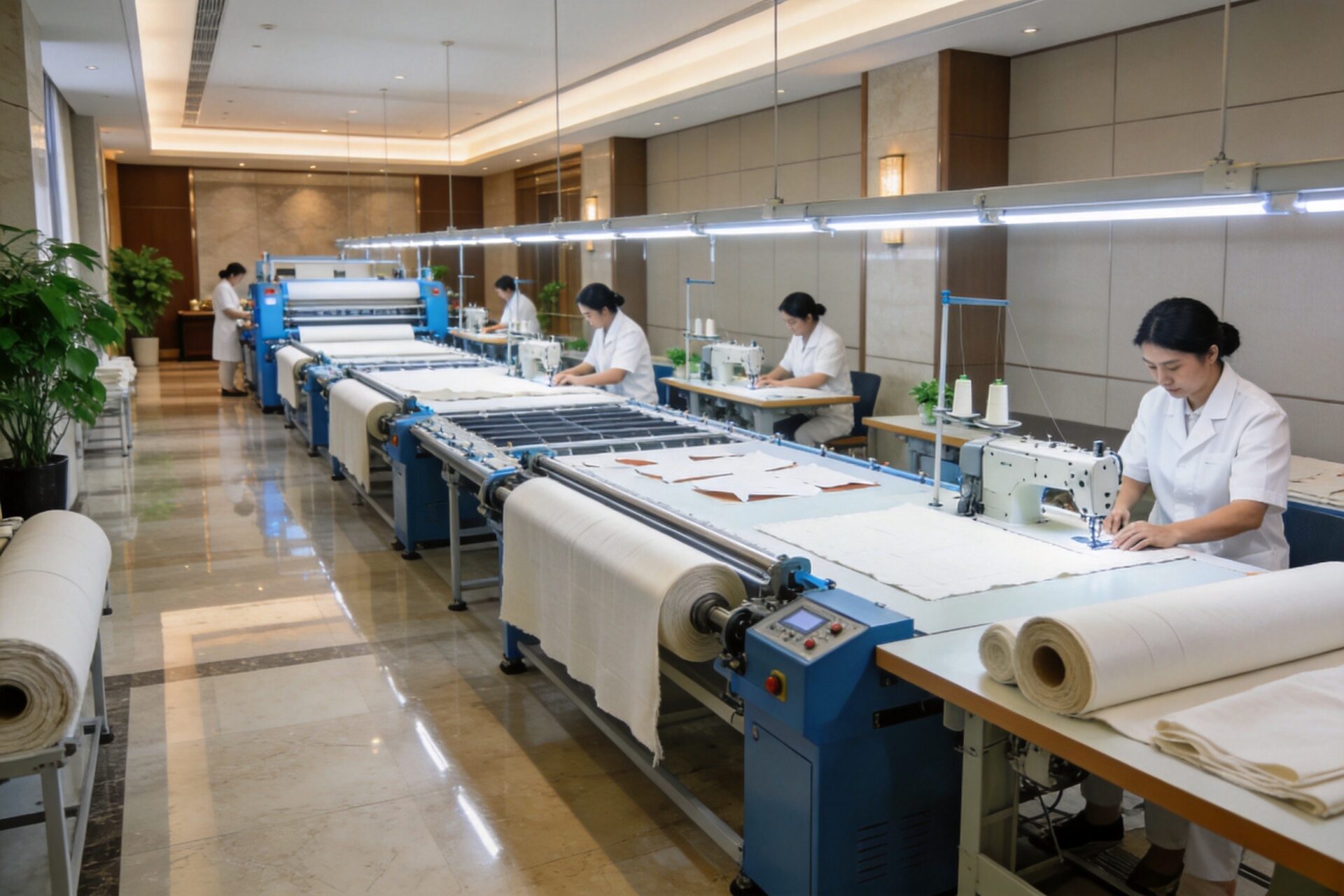
Many hotel linen manufacturers, including Youmian Textile, offer a hybrid model that bridges the two approaches. In this arrangement, buyers can select ODM base products and apply more extensive customizations than standard ODM allows—such as custom fabric blends, special weaves, unique embroidery patterns, or custom packaging—without the full cost and lead time of pure OEM development.
This hybrid model is particularly popular with mid-scale hotel brands that want some degree of product differentiation but do not require completely proprietary designs. For example, a regional hotel group might select a standard ODM towel platform but customize the dobby border design, add a woven brand label, and specify a custom reactive dye color that matches their brand palette.
Evaluating an OEM/ODM Manufacturer: 10 Criteria
Whether you choose OEM, ODM, or a hybrid approach, the manufacturer’s capabilities determine product quality and supply chain reliability. Evaluate potential partners against these ten criteria:
- Vertical Integration: Does the factory control weaving, dyeing, cutting, sewing, and embroidery in-house? Vertically integrated factories offer better quality control, shorter lead times, and lower costs. Youmian Textile operates a 50,000㎡ fully integrated facility covering all production stages.
- Certifications: Verify OEKO-TEX Standard 100, GOTS (for organic products), ISO 9001, and any destination-market certifications required (e.g., BSCI, Sedex).
- Production Capacity: Confirm monthly output capacity for your specific product category. A factory producing 100,000 sheets per month may only produce 15,000 terry towels monthly.
- Sample Policy: Reputable manufacturers provide pre-production samples (PP samples) for approval before bulk production. Clarify whether samples are free, paid, or deducted from the bulk order.
- Quality Control: Ask about QC checkpoints—raw material inspection, in-line inspections, and final random inspection (AQL standards, typically AQL 2.5 for hotel linens).
- Intellectual Property: For OEM, ensure the factory signs a mutual NDA and IP assignment agreement. For ODM, clarify whether the factory will offer your customized design to other buyers.
- Minimum Order Quantity: MOQs vary by product and customization level. Youmian Textile’s standard MOQ is 500 pieces per SKU, with flexibility for trial and sample orders.
- Lead Time: Confirm production lead time and shipping schedules. Standard factory lead time is 30–45 days for ODM and 45–90 days for OEM, depending on complexity.
- Payment Terms: Common terms are 30% deposit / 70% against bill of lading copy. First-time orders may require 30%/70% or 50%/50% until trust is established.
- After-Sales Support: Does the manufacturer offer compensation or replacement for defective goods? What is the claim window and process?
The ODM-to-OEM Pathway for Growing Brands
Many successful hotel brands begin with ODM sourcing and transition to OEM as they scale. A typical progression might look like this:
- Phase 1 (Year 1–2): Source ODM products with logo embroidery. Focus on establishing the property’s reputation and gathering guest feedback.
- Phase 2 (Year 2–3): Move to hybrid customization—custom labels, special packaging, modified dimensions based on feedback.
- Phase 3 (Year 3+): Develop proprietary OEM products. Commission custom fabric development, unique weave patterns, and signature designs that become part of the brand’s identity.
This staged approach reduces financial risk while allowing the brand to build product knowledge and negotiating leverage with the manufacturer.
Perguntas frequentes
Can an ODM factory prevent other buyers from purchasing the same product?
Standard ODM products are available to all buyers. However, some factories offer “ODM exclusive” arrangements where, for a higher per-unit price or volume commitment, they agree not to sell your specific design configuration to competitors in your market for a defined period. This must be negotiated as part of the supply agreement.
Who owns the intellectual property in a hybrid OEM-ODM model?
It depends on the customization level. If you provide a custom embroidery design or label artwork, you retain the IP for those elements. The factory retains ownership of the base product design. For custom-developed fabrics or constructions, IP ownership should be explicitly addressed in the contract.
Is OEM always more expensive than ODM?
Not necessarily at scale. OEM has higher upfront development costs (sampling, pattern-making, custom material sourcing), but these are amortized over the order volume. For large orders above 10,000 pieces per SKU, OEM unit pricing can be equal to or lower than ODM because the factory does not need to share margin across multiple buyers.
How do I protect my designs when working with a Chinese OEM factory?
Sign a mutual NDA before sharing any technical specifications, register your trademark in China (as China operates a first-to-file system), include IP assignment and non-compete clauses in the manufacturing contract, and work with factories that have verifiable export experience with Western brands. Reputable manufacturers with ISO 9001 certification have formal IP protection processes in place.
What is the typical OEM sampling process for hotel linens?
The standard process involves: (1) buyer submits tech pack/specifications, (2) factory provides a quotation and lead time, (3) buyer pays sample fee, (4) factory produces lab dips for color approval, (5) factory produces a pre-production sample (PP sample), (6) buyer reviews and approves or requests revisions, (7) bulk production begins after written PP sample approval. This process typically takes 10–20 business days.
Conclusion
The choice between OEM and ODM hotel linen manufacturing comes down to your brand’s stage, budget, design resources, and speed requirements. ODM offers fast, cost-effective access to professionally designed products—ideal for independent properties and new brands. OEM provides complete design control and product exclusivity—essential for established hotel chains where the sleep experience is a core brand asset. Many buyers benefit from a hybrid approach that combines ODM speed with selective customizations.
As an OEM and ODM hotel linen manufacturer with a 50,000㎡ vertically integrated factory in China, Youmian Textile supports both models. Whether you need fully custom conjuntos de cama para hotéis, toalhas de hotel, and mattress protectors to your exact brand specifications, or want to select from our ODM catalog with logo embroidery and custom packaging, our team delivers consistent quality with OEKO-TEX, GOTS, and ISO 9001 certifications. We serve hotel groups, resorts, linen rental companies, and distributors across North America, Europe, the Middle East, and Latin America with a 500-piece MOQ and 30–45 day lead times. Entre em contato conosco to discuss your sourcing needs or learn more about our OEM/ODM capabilities.
Quer saber mais sobre nossos produtos?
Veja todos os produtos agora English
  Русский
  Español de México
  Português do Brasil
  العربية