
Gestão de estoque de roupa de cama em hotéis: o que são os níveis de estoque padrão
Ir para a seção
Effective hotel linen inventory management is the backbone of smooth housekeeping operations. At the heart of this system lies the concept of “par levels”—the minimum quantity of each linen item that must be on hand to support daily operations without disruption. For hotel procurement managers and executive housekeepers, understanding and calculating par levels correctly can mean the difference between a well-oiled operation and a costly shortage during peak occupancy. In this comprehensive guide, we break down what par levels are, how to calculate them for different property types, and how leading hotels optimize their inventory to reduce costs while maintaining five-star presentation standards.
What Are Par Levels in Hotel Linen Management?
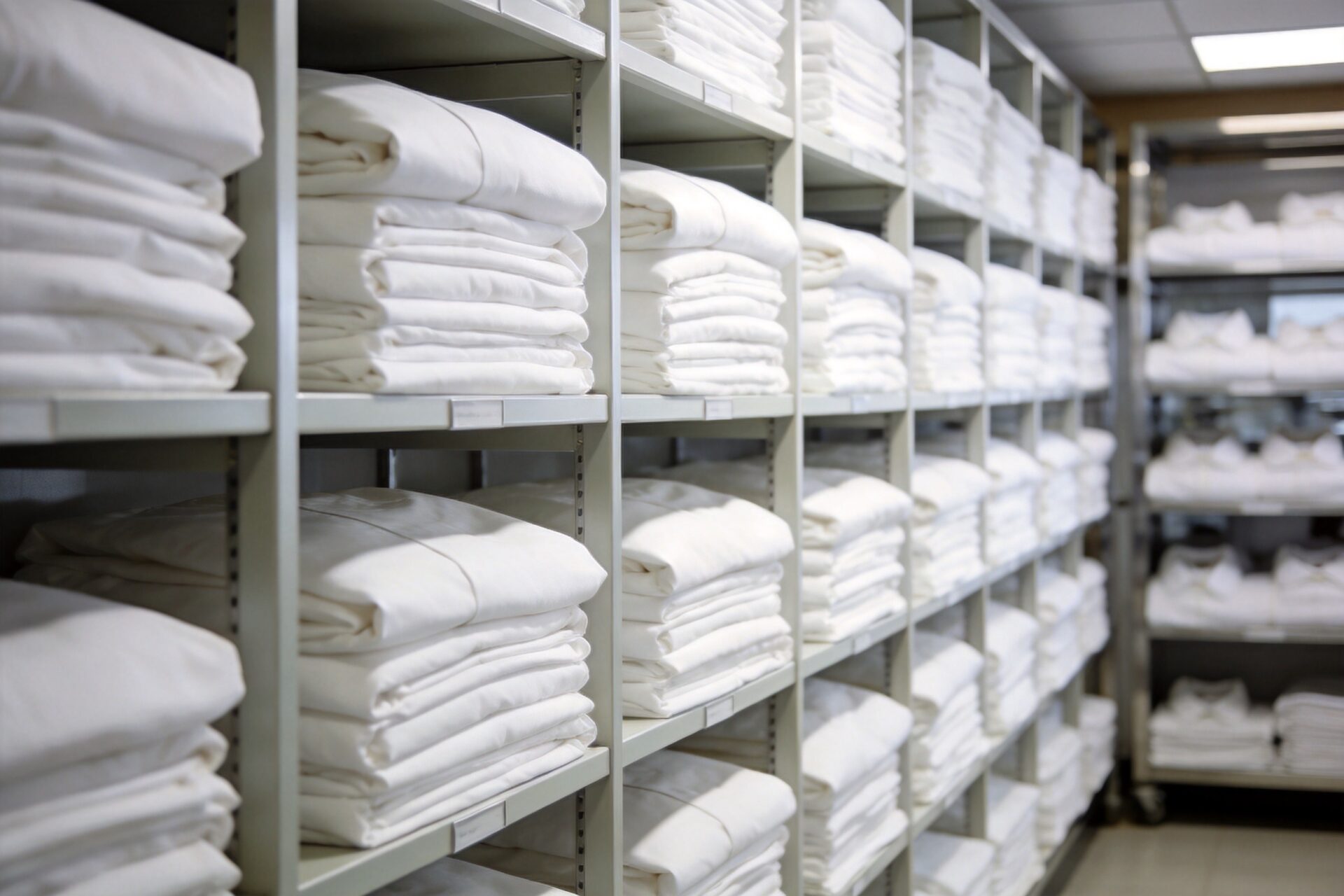
A “par” represents one complete set of linen per occupied room or per guest. If a hotel operates at a 3-par system, it means the property holds three complete sets of each linen item for every room: one set on the bed or in the bathroom, one set in storage or housekeeping carts, and one set in the laundry cycle. This rotational model ensures clean linen is always available while soiled items are being processed.
Par levels are not universal. They vary based on property size, occupancy patterns, laundry infrastructure, and the type of linen in question. A 200-room city-center hotel with an in-house laundry might operate comfortably at 3 par, while a remote resort relying on an off-site laundry service may need 4 to 5 par to account for longer turnaround times.
The Standard Par System
| Par Level | Where Linen Is Located | Typical Use Case |
|---|---|---|
| Par 1 | In the guest room (on bed/towels) | Current occupancy |
| Par 2 | Housekeeping carts / floor storage | Immediate room turnover |
| Par 3 | In laundry or central storage | Washing, drying, folding |
| Par 4–5 | Emergency/buffer stock | Peak season, off-site laundry, damage replacement |
How to Calculate Par Levels for Your Property
Calculating par levels requires a straightforward formula, but the inputs must reflect your property’s specific operational reality. The basic formula is:
Total Linen Needed = Number of Rooms × Occupancy Rate × Par Level × Items per Room
For example, consider a 150-room hotel with an average annual occupancy of 75%. Each room requires 2 sheets, 4 pillowcases, 1 duvet cover, 2 bath towels, 2 hand towels, and 4 washcloths. At 3 par:
- Sheets: 150 × 0.75 × 3 × 2 = 675 sheets
- Pillowcases: 150 × 0.75 × 3 × 4 = 1,350 pillowcases
- Bath towels: 150 × 0.75 × 3 × 2 = 675 bath towels
However, this base calculation should be adjusted for several factors:
- Seasonal peaks: If occupancy reaches 95% during summer or holiday periods, use peak occupancy rather than average to avoid shortages.
- Laundry turnaround: If your laundry takes 24 hours or longer, add an extra par. If you have on-premise laundry (OPL) with same-day turnaround, 3 par may suffice.
- Linen lifespan and shrinkage: Budget for a 15–25% annual replacement rate due to wear, staining, and loss. Build this into your procurement cycle.
- Suites and premium rooms: These rooms often require additional items (extra towels, bathrobes, slippers) and should be counted separately.
Par Levels by Property Type
Different hospitality segments have distinct inventory requirements. A budget motel and a luxury resort may both have 100 rooms, but their par needs differ significantly.
Limited-Service and Budget Hotels
Properties in the economy and mid-scale segments typically operate at 2.5 to 3 par. Fewer linen SKUs (no bathrobes, no turndown service, standard towel counts) and OPL facilities make lower par levels feasible. However, budget properties often see higher linen loss rates, and a 3-par minimum provides a safety margin.
Full-Service Hotels and Resorts
Full-service properties, especially those with pools, spas, and multiple F&B outlets, generally require 4 to 5 par. Spa and pool areas add significant towel volume—resorts can consume 2 to 3 times more towels per occupied room than city hotels. Multiple restaurant outlets also require table linens, banquet napkins, and staff uniforms that compete for laundry capacity.
Boutique and Luxury Hotels
Luxury properties often operate at 3.5 to 4.5 par but with higher-quality, more expensive linen. The priority here is presentation—stained or worn items are immediately removed from rotation, requiring deeper buffer stock. Custom-branded items with longer replacement lead times also justify higher par levels.
Vacation Rentals and Airbnb
For short-term rental operators managing multiple units, par levels depend on turnover frequency. A property with back-to-back bookings needs at least 2 par per unit to allow same-day turnaround. Operators without on-site laundry should consider 3 par, factoring in laundering time between cleanings.
The Hidden Costs of Getting Par Levels Wrong
Understocking and overstocking both carry significant financial consequences. Understanding these costs helps justify the initial investment in proper inventory planning.
Costs of Understocking
- Emergency procurement: Rush orders from local suppliers can cost 30–50% more than planned bulk purchases.
- Guest complaints: Missing towels or delayed room turnover directly impact review scores. A Cornell study found that a 1-point increase in TripAdvisor ratings can raise room rates by up to 11%.
- Overtime labor: Housekeeping staff waiting for clean linen creates costly idle time or overtime.
- Outsourced laundry premiums: When in-house capacity is overwhelmed, emergency outsourcing can cost 2–3 times the internal per-pound rate.
Costs of Overstocking
- Capital tied up: Excess inventory represents cash that could be deployed elsewhere. A 200-room hotel overstocked by just 1 par can have $15,000–$40,000 sitting idle on shelves.
- Storage costs: Additional shelving, climate control, and floor space in urban markets can cost $8–$15 per square foot annually.
- Deterioration in storage: Linen stored for extended periods can yellow, develop mildew, or suffer fiber degradation, especially in humid environments.
- Shrinkage and theft: More inventory on hand means more opportunities for loss, with industry average linen loss rates at 5–10% annually.
Best Practices for Optimizing Linen Inventory
Conduct Monthly Physical Counts
Even with sophisticated property management systems (PMS), manual counts remain essential. Monthly audits reveal discrepancies between system records and actual stock, identify theft patterns, and highlight items approaching the end of their usable life. Use barcode or RFID tagging to streamline counts—RFID systems can reduce inventory counting time by up to 75% compared to manual methods.
Segment Inventory by Room Type and Usage Area
Not all linen is interchangeable. King-size sheets do not fit queen beds, and pool towels should never cycle through guest bathrooms. Segmenting inventory prevents cross-contamination of usage data and ensures accurate reorder points for each SKU.
Establish Reorder Points Based on Lead Time
Work backward from your supplier’s lead time to set reorder triggers. If a manufacturer like Youmian Têxtil has a standard lead time of 30–45 days for custom orders, your reorder point should account for consumption during that window plus a safety stock buffer. A typical reorder point formula:
Reorder Point = Daily Usage × Lead Time in Days + Safety Stock
For a 150-room hotel consuming approximately 50 bath towels per day, with a 40-day lead time and 15-day safety stock: 50 × 40 + (50 × 15) = 2,750 towels reorder point.
Track Linen Lifespan and Turn Rates
Hospitality-grade cotton sheets typically last 250–300 wash cycles, while bath towels last 300–400 cycles before absorbency and appearance degrade below acceptable standards. Tracking the number of cycles per item—through RFID or lot-based tracking—allows you to forecast replacement needs accurately and negotiate volume pricing with suppliers. Investing in durable, high-thread-count conjuntos de cama para hotéis from the outset extends replacement cycles and lowers total cost of ownership.
Technology Solutions for Linen Inventory Management
Modern hotels are increasingly adopting technology to replace spreadsheet-based tracking:
- RFID tagging: Individual linen items embedded with UHF RFID chips enable automated counting at laundry chutes and storage rooms, providing real-time inventory visibility. Early adopters report 20–30% reduction in linen loss.
- Inventory management software: Platforms like MGS, LinenWallet, and Agilysys integrate with PMS systems to track usage patterns, automate reorder alerts, and generate consumption reports.
- Laundry telemetry: Smart washers and dryers log cycle counts, chemical usage, and energy consumption, providing data to correlate wash volume with linen wear rates.
Perguntas frequentes
What is the ideal par level for a hotel?
Most full-service hotels operate at 3 par as a baseline. Properties with off-site laundry, high occupancy volatility, or resort amenities (pool, spa) should aim for 4–5 par. Budget hotels with on-premise laundry may function at 2.5–3 par.
How often should I count hotel linen inventory?
Run a full physical count at least monthly, with weekly spot checks on high-theft items such as bathrobes and premium towels. RFID-based systems provide continuous automated counts and can cut inventory counting time by up to 75% versus manual methods—valuable given the industry’s typical 5–10% annual linen shrinkage.
How much linen does a 100-room hotel need?
At 3 par, a 100-room hotel needs approximately 600 sheets, 1,200 pillowcases, 600 bath towels, 600 hand towels, and 1,200 washcloths, assuming 2 sheets, 4 pillowcases, 2 bath towels, 2 hand towels, and 4 washcloths per room at 100% occupancy. Adjust for your actual occupancy rate.
How do I reduce linen replacement costs?
Attack three levers: buy higher-quality OEKO-TEX, ring-spun linen (replacing today at a typical 15–25% annual rate), run correct laundry protocols, and reduce loss via RFID. Avoid emergency rush orders, which can cost 30–50% more than planned bulk purchases, and let RFID cut counting time by up to 75%.
What is the average lifespan of hotel linens?
Hotel sheets typically last 250–300 wash cycles, bath towels 300–400 cycles, and pillowcases 300–500 cycles. At an average of 3 washes per week, this translates to roughly 1.5–2.5 years for sheets and 2–3 years for towels, depending on laundry chemistry and water quality.
Conclusion: Build a Par Strategy That Scales
Hotel linen inventory management is not a set-it-and-forget-it task. Par levels must evolve with your property’s occupancy patterns, renovation cycles, and business growth. By calculating par levels based on real operational data, establishing disciplined reorder points, and investing in quality linen that withstands heavy commercial laundering, procurement managers can reduce both shortages and excess stock. The result is a more predictable budget, smoother housekeeping operations, and consistently elevated guest experiences. When you’re ready to source durable, certified hotel linen with competitive MOQs and reliable lead times, Entre em contato com a Youmian Textile to discuss your inventory needs and request a customized quote.
Quer saber mais sobre nossos produtos?
Veja todos os produtos agora English
  Русский
  Español de México
  Português do Brasil
  العربية