
How to Conduct a Hotel Linen Audit: A Step-by-Step Checklist
Ir para a seção
A hotel linen audit is a systematic examination of every textile item in your property’s inventory—from sheets and pillowcases to towels, table linens, bathrobes, and mattress protection. Conducted regularly, a linen audit reveals inventory shortages, identifies premature wear patterns, uncovers theft or loss trends, validates par levels against actual usage, and provides the data foundation for accurate procurement budgeting. Yet many hotels approach linen audits informally or skip them entirely, leading to emergency purchases, bloated inventory, and unexplained cost variances. This step-by-step checklist walks through the complete linen audit process, from preparation through analysis and action planning, enabling procurement managers and executive housekeepers to conduct thorough, actionable audits that control costs and maintain service standards.
Why Conduct a Hotel Linen Audit?
A well-executed linen audit serves multiple purposes:
- Financial accuracy: Linen typically represents $80,000–$200,000 in inventory value for a full-service hotel. Regular audits ensure this asset is accurately reflected on the balance sheet.
- Loss detection: Industry average linen shrinkage ranges from 5–10% annually. Audits identify whether losses stem from theft, laundry processing errors, or disposal without documentation.
- Quality assurance: Inspecting items during the audit reveals premature degradation that may indicate laundry chemistry problems, improper washing temperatures, or lower-than-specified product quality from suppliers.
- Par level validation: Actual usage patterns may differ from the assumptions used to set par levels. Audits reveal which items are overstocked and which are at risk of shortage.
- Budget planning: Audit data provides the factual basis for replacement forecasts, capital requests, and vendor negotiations.
Pre-Audit Preparation
Assemble the Audit Team
A linen audit should involve representatives from housekeeping, laundry, procurement, and finance. Designate an audit lead—typically the executive housekeeper or procurement manager—who coordinates the process and owns the final report. For large properties, divide the team into pairs responsible for specific storage locations or item categories.
Choose the Right Timing
Conduct the audit during the lowest-occupancy period of the month, ideally on a weekday morning after checkout and before evening turndown service. This minimizes the number of items in transition between rooms, laundry, and storage. Avoid auditing during peak season or major events when staff attention is divided and inventory is in maximum flux.
Gather Documentation
Collect the following before beginning:
- Current inventory records (spreadsheets, PMS reports, or inventory management system exports)
- Purchase records from the past 12–24 months, including quantities, unit costs, and delivery dates
- Laundry production reports showing weekly or monthly poundage by category
- Disposal/condemnation records if maintained
- Floor plans showing all linen storage locations (floor closets, central linen room, laundry, banquet storage, F&B outlets)
- Par level targets by SKU
Prepare Count Sheets or Digital Tools
Create standardized count sheets organized by location and item category. For each line item, include columns for:
- Item description and size
- Expected quantity (from inventory records)
- Actual count
- Condition grade (A/B/C/D)
- Variance and notes
Properties using RFID inventory systems can generate automated counts but should still verify with a manual sample count of at least 10% of items to validate RFID accuracy.
Step-by-Step Linen Audit Checklist
Step 1: Count All In-Room Linen
Begin with occupied and vacant clean rooms. Count every item in the room, including:
- Sheets (fitted and flat, by bed size)
- Pillowcases (by size, including decorative/throw pillow covers)
- Duvet covers and inserts (or comforters)
- Pillows (by type: down, down-alternative, memory foam)
- Mattress protectors and mattress pads
- Bath towels, hand towels, washcloths, and bath mats
- Bathrobes and slippers
- Capas protetoras para travesseiros
For occupied rooms, count items visible in the room without disturbing guest belongings. Note any missing or additional items beyond the standard room setup. For check-out rooms not yet cleaned, count items before they enter the laundry stream. Record counts by room number to identify patterns of loss on specific floors or room types.
Step 2: Count Floor Closet and Pantry Inventory
Move systematically through each floor’s linen closet or housekeeping pantry. Count every item, including:
- Clean linen stocked for room turnover
- Soiled linen awaiting transport to laundry
- Backup or reserve stock
- Miscellaneous items (baby crib sheets, roll-away bedding, extra blankets)
Pay particular attention to items stored in non-standard locations—behind equipment, on high shelves, or in mixed piles. These “hidden” items often represent unrecorded inventory that distorts variance calculations.
Step 3: Audit the Laundry
The laundry is the most dynamic inventory location. Count:
- Soiled linen sorted by category awaiting washing
- Items currently in washers and dryers (pause machines if necessary or estimate based on load tickets)
- Clean, folded linen ready for distribution
- Items in the rewash or stain-treatment pile
- Rags, wiping cloths, and downcycled items
Note the total weight of linen in the laundry and compare it to typical daily processing volume. A significant discrepancy may indicate items stuck in the laundry cycle, hoarded by staff, or lost between floors and the laundry room.
Step 4: Count Central Storage and Reserve Stock
Conduct a complete count of the main linen room or warehouse. Organize items by category and size before counting to avoid double-counting or omissions. This is typically where new, unopened stock is stored, so cross-reference against recent purchase orders and receiving records.
Step 5: Audit F&B and Banquet Linens
Table linens are often managed separately from room linen and are prone to cross-departmental migration. Count:
- Tablecloths by size and color (round, rectangular, square)
- Napkins by size, color, and type (dinner, cocktail, bistro)
- Table runners and overlays
- Chair covers and sashes if applicable
- Buffet skirting and conference felts
Check all F&B outlets, banquet storage, and even off-site event storage. Note items being used in restaurants during service—count these between mealtimes.
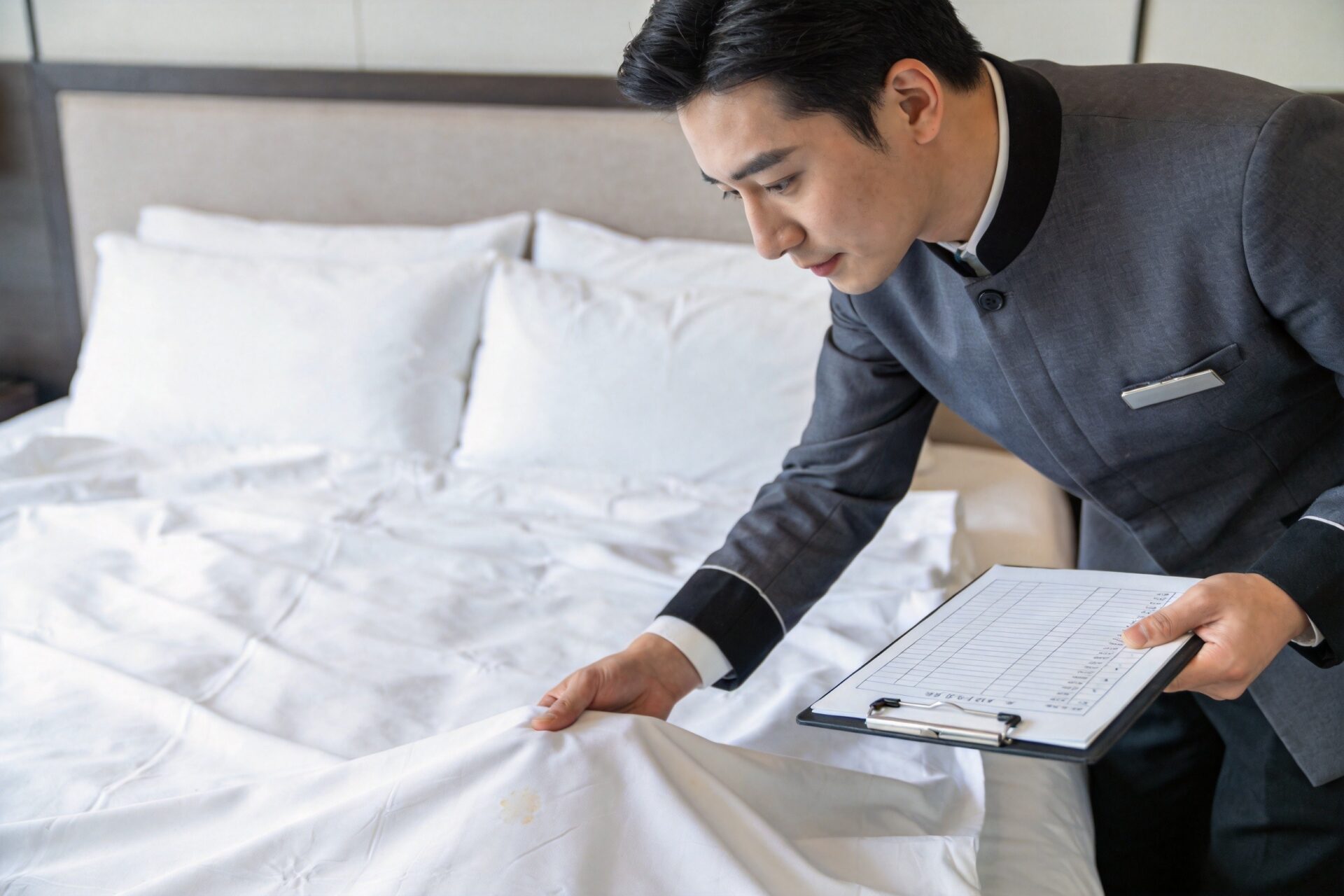
Step 6: Inspect Condition and Grade Each Item
Counting quantity is only half the audit. Assess the condition of a representative sample (at least 10–20% of items in each category) using a standardized grading system:
| Grade | Descrição | Action |
|---|---|---|
| A – Excellent | Like new; no stains, tears, or significant wear | Continue in premium/standard service |
| B – Good | Minor wear, slight fading, or minor mending; fully serviceable | Continue in standard service |
| C – Fair | Visible wear, thinning, discoloration, or small stains not removable; acceptable for backup or lower-tier rooms | Reassign to backup/non-guest areas; schedule replacement within 6 months |
| D – Unserviceable | Torn, permanently stained, excessively worn, or malodorous | Remove from service immediately; downcycle or dispose |
Record the percentage of items in each grade category by SKU. If Grade C and D items exceed 25% of total inventory for a category, it signals an urgent replacement need.
Step 7: Reconcile Against Records
Compare actual counts to expected quantities from inventory records. Calculate variance for each line item:
Variance % = (Actual Count − Expected Count) ÷ Expected Count × 100
Investigate any variance exceeding ±5%. Common causes include:
- Unrecorded disposals (staff discarding worn items without logging)
- Items sent to outsourced laundry and not yet returned
- Theft or guest removal
- Cross-departmental migration (table napkins used as cleaning rags, etc.)
- Receiving errors (shipments short or over)
- Data entry errors in inventory systems
Step 8: Analyze Wash Cycle and Lifespan Data
If your laundry tracks loads by item category, calculate the approximate number of wash cycles per item annually:
Annual Cycles = Total Annual Pounds for Category ÷ Average Weight per Item ÷ Average Inventory Count
Compare this to the expected lifespan in wash cycles to estimate what percentage of inventory will need replacement in the coming year. For example, if sheets average 150 cycles per year and have a 300-cycle lifespan, you can expect approximately 50% annual replacement if all items were new—adjusted for the actual age distribution observed during the condition grading.
Step 9: Evaluate Supplier Performance
Use audit findings to assess whether current hotel bedding e towel suppliers are delivering on quality promises. If items are wearing out significantly faster than the expected lifespan—after controlling for laundry practices—it may indicate under-specification (lower GSM, weaker yarn, or substandard construction) rather than operational issues. Document specific failures (pilling, thinning, seam failure, shrinkage) with sample items and share findings with suppliers for corrective action.
Post-Audit Action Plan
Update Inventory Records
Adjust your inventory system to reflect actual counts. Write off missing or unserviceable items according to your property’s financial procedures. This ensures that future procurement decisions are based on accurate data rather than inflated book inventories.
Prioritize Replacements
Create a replacement plan based on audit findings:
- Urgent (0–30 days): Replace Grade D items and any SKUs below minimum par level
- Short-term (30–90 days): Replace Grade C items and bring all categories up to target par
- Planned (90–180 days): Schedule bulk replacement of items nearing end of life; negotiate pricing with suppliers
Address Root Causes of Loss
If shrinkage exceeds acceptable thresholds, implement corrective measures:
- Improve disposal documentation: require signed condemnation forms before items are discarded
- Implement outlet-specific color-coding or embroidery to prevent cross-departmental migration
- Review laundry handling procedures for damage during washing, drying, or folding
- Consider RFID tagging for high-value items (bathrobes, premium towels, banquet linens)
- Reinforce staff training on linen care and loss prevention
Set a Recurring Audit Schedule
Conduct a full linen audit at least twice per year, with quarterly spot checks of high-loss categories. Many successful properties perform mini-audits monthly, focusing on 2–3 item categories per cycle rather than attempting a full count every month. Consistency is more important than frequency—regular audits prevent the “inventory drift” that makes annual counts increasingly inaccurate.
Audit Tools and Templates
To streamline future audits, develop standardized templates that include:
- A master count sheet by location and category
- A condition grading card with photographs of A/B/C/D examples for consistency
- A variance investigation form documenting root causes and corrective actions
- A replacement forecast spreadsheet that auto-calculates annual needs based on audit data
- A supplier scorecard tracking delivery accuracy, quality failures, and lifespan performance
For properties using OEM/ODM suppliers, include field for lot numbers and production dates, enabling tracking of quality variations across production batches.
Perguntas frequentes
How often should a hotel conduct a linen audit?
A comprehensive full-property linen audit should be conducted at least twice per year. Quarterly spot checks of specific categories (towels, table linens, bedding) help maintain accuracy between full audits. High-turnover resorts and properties with known shrinkage issues may benefit from monthly mini-audits.
What is an acceptable linen shrinkage rate for hotels?
Industry benchmarks range from 5–10% annually. Well-managed properties with RFID tagging, clear disposal procedures, and staff training can achieve rates below 5%. Shrinkage above 10% indicates systemic issues requiring investigation. Bathrobes and pool towels typically have the highest individual loss rates, sometimes reaching 15% annually in resort settings.
How long does a hotel linen audit take?
A full audit of a 200-room property typically takes 4–8 staff-hours with a team of 3–4 people. Larger resorts or properties with extensive F&B operations may require 1–2 days. Using RFID or barcode scanning can reduce count time by 50–70% compared to manual methods.
What should I do with Grade C and D linen after an audit?
Grade C items can be reassigned to staff areas, donated to shelters, or held as emergency backup. Grade D items should be removed from service immediately. Consider downcycling: cut worn sheets and towels into cleaning cloths, partner with textile recyclers, or donate to animal shelters. Document all disposals for financial write-off and waste-reduction tracking.
How do I know if linen is wearing out prematurely?
Compare actual lifespan to expected wash cycles: quality T-250 sheets should last 250–300 cycles; bath towels 300–400 cycles; pillowcases 300–500 cycles. If items are failing at less than 70% of expected lifespan, investigate laundry practices (water temperature, chemical overuse, over-drying) and supplier quality (verify GSM, yarn type, and construction match specifications).
Conclusion: Audits Drive Informed Decisions
A hotel linen audit is not merely an inventory count—it is a diagnostic tool that reveals operational efficiencies, financial exposures, and quality trends across your entire textile operation. By following a systematic checklist, grading condition as rigorously as quantity, and translating findings into a prioritized action plan, procurement managers can eliminate emergency purchases, reduce shrinkage, extend linen lifespan, and negotiate from data-backed positions with suppliers. The most valuable outcome of any audit is not a clean count but the intelligence to make smarter decisions going forward. Schedule your next audit on the calendar now, prepare your team, and treat the process as a continuous improvement cycle rather than a one-time event. When audit findings reveal the need for quality replacement linen from a reliable manufacturer, Entre em contato com a Youmian Textile for durable, OEKO-TEX-certified products with transparent specifications and consistent quality.
Quer saber mais sobre nossos produtos?
Veja todos os produtos agora English
  Русский
  Español de México
  Português do Brasil
  العربية