
Green Hotel Certifications: LEED, Green Key, and Green Globe Linen Requirements
Ir para a seção
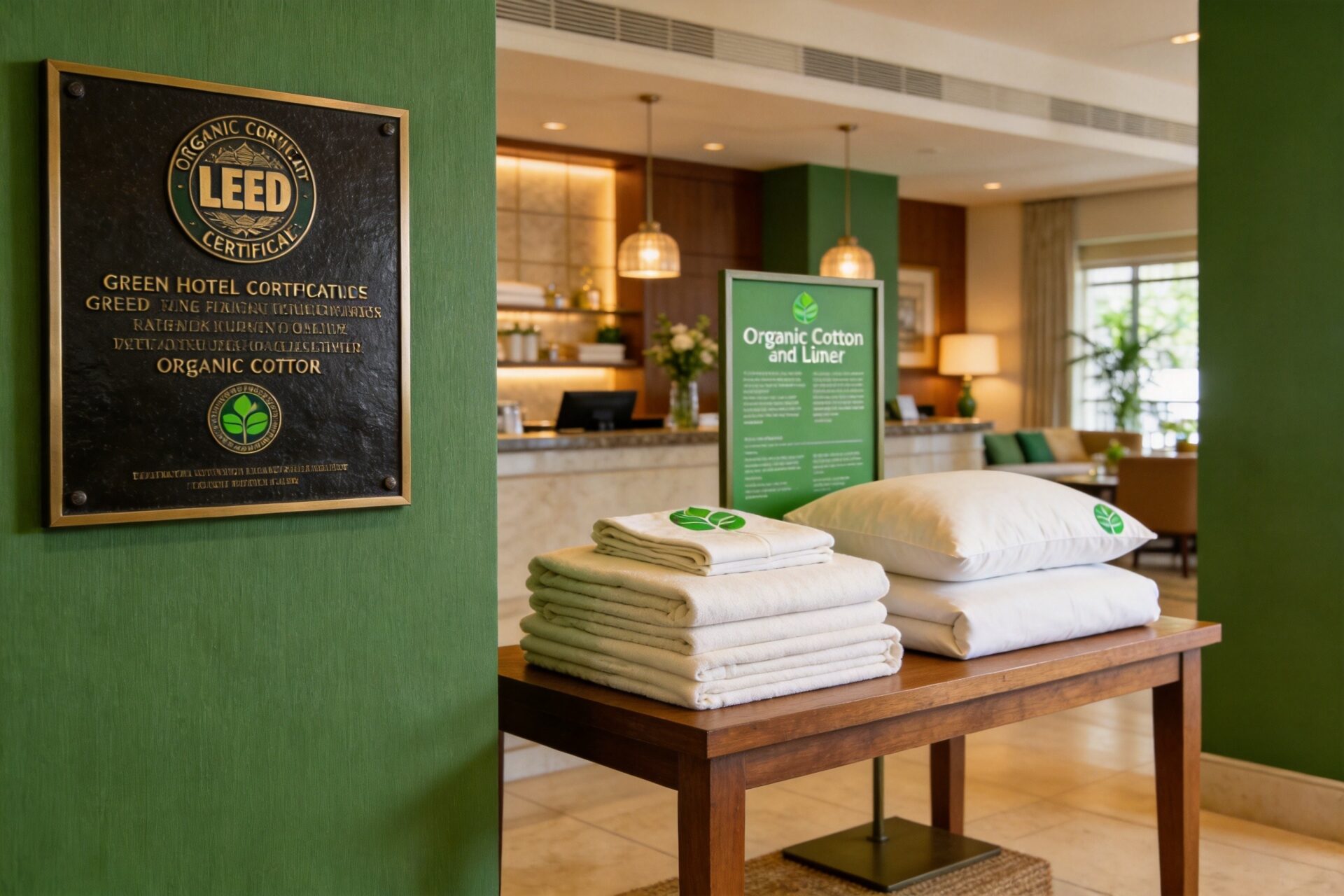
Sustainability has moved from a marketing differentiator to a procurement mandate in the global hospitality industry. Green hotel certifications such as LEED, Green Key, and Green Globe now influence everything from architectural design to operational supply chains—and hotel linens are no exception. For procurement managers and hotel group buyers, understanding the linen requirements of these certification programs is essential for achieving and maintaining green status. This guide breaks down the textile-related criteria of the three leading green hotel certification programs and explains how to source linens that meet or exceed their standards.
Why Green Hotel Certifications Matter for Linen Procurement
Green hotel certifications signal to guests, investors, and regulators that a property meets verified environmental standards. The global green hospitality market was valued at approximately $182 billion in 2024 and is projected to grow at a CAGR of over 9% through 2030. For procurement teams, these certifications directly affect purchasing decisions because linens represent one of the largest recurring textile expenditures in a hotel operation.
The three most widely recognized certification programs are:
- LEED (Leadership in Energy and Environmental Design) — administered by the U.S. Green Building Council (USGBC), with over 100,000 certified projects worldwide.
- Green Key Global — operated by the Foundation for Environmental Education, present in 60+ countries with more than 3,000 certified hotels.
- Green Globe — based in Los Angeles, certified in over 80 countries, aligned with the Global Sustainable Tourism Council (GSTC) criteria.
Each program evaluates properties across multiple categories, including energy efficiency, water conservation, waste management, and sustainable purchasing. Linens intersect with several of these categories, making them a high-impact area for certification compliance.
LEED Certification: Linen and Textile Criteria
LEED certification uses a points-based system across several credit categories. While LEED does not have a dedicated “linen” credit, hotel textiles contribute to multiple credit areas. The most relevant for procurement teams include:
Materials and Resources (MR) Credits
Under LEED v4.1 for Building Design and Construction (BD+C) and Operations and Maintenance (O+M), projects can earn points through:
- Sustainable Purchasing: Purchasing products with verified environmental product declarations (EPDs) or third-party certifications. Linens certified to OEKO-TEX Standard 100, GOTS (Global Organic Textile Standard), or bluesign® qualify.
- Raw Material Sourcing: Credits favor materials with recycled content, rapidly renewable resources, or certified organic origins. Organic cotton, rPET (recycled polyester), and TENCEL™ lyocell all contribute positively.
- Waste Diversion: LEED rewards properties that implement linen reuse programs and donate or recycle retired textiles rather than sending them to landfill.
Water Efficiency (WE) Credits
Hotels consume an average of 250–300 liters of water per guest night, with laundry operations accounting for up to 25% of that total. LEED WE credits encourage:
- Installing high-efficiency commercial laundry equipment that reduces water use by 30–50%.
- Implementing towel and sheet reuse programs, which can reduce linen wash volume by 15–25%.
- Sourcing linens engineered for low-temperature washing and quick drying, reducing both water and energy consumption per cycle.
| LEED Credit Area | Linen Relevance | Typical Points Available |
|---|---|---|
| Sustainable Purchasing | Certified eco-friendly textiles | 1–2 |
| Raw Material Sourcing | Organic/recycled content | 1–2 |
| Waste Diversion | Textile recycling/donation | 1–3 |
| Water Efficiency | Low-temp linens, reuse programs | 1–4 |
Green Key Global: Textile and Laundry Requirements
Green Key Global uses a comprehensive audit framework with 5 “keys” of certification. The program evaluates properties through a self-assessment followed by an on-site or virtual audit. Textile and laundry criteria appear primarily in the following sections:
Sustainable Purchasing Policy
Green Key requires certified hotels to maintain a written sustainable purchasing policy that covers all operational supplies, including linens. To score well, procurement teams should:
- Prioritize suppliers with recognized environmental certifications (OEKO-TEX, GOTS, ISO 14001).
- Set measurable targets for the percentage of sustainable textiles in inventory—Green Key recommends at least 30% within two years of certification.
- Track and report the recycled or organic content of all linen purchases.
Operações de lavanderia
Green Key’s laundry criteria are among the most detailed of any green certification program:
- Chemical Management: Use of biodegradable, phosphate-free detergents with no optical brighteners or NTA (nitrilotriacetic acid).
- Energy Use: At least 50% of laundry equipment must be ENERGY STAR rated or equivalent.
- Water Temperature: Linens should be washable at 60°C or below for standard cycles, with 71°C used only for disinfection when required.
- Linen Reuse: Properties must offer guests the option to reuse towels and sheets, with signage in guest rooms.
Waste Reduction
Green Key awards points for establishing a textile end-of-life plan, including:
- Partnering with textile recycling organizations such as Helpsy or I:CO.
- Donating gently used linens to local shelters or charitable organizations.
- Repurposing worn linens as cleaning rags or shop towels within the property.
Green Globe Certification: Linen Standards Explained
Green Globe is the only certification program fully accredited by the GSTC. Its 44 criteria across 4 categories include several that directly affect linen procurement and management:
Criterion A6: Sustainable Purchasing
Green Globe requires that at least 50% of purchased goods (by value) meet at least one sustainability criterion. For linens, this means:
- Sourcing from manufacturers with ISO 14001 environmental management certification.
- Selecting textiles with third-party eco-labels (GOTS, OEKO-TEX Made in Green, EU Ecolabel).
- Preferring local or regional suppliers to reduce transportation emissions—though for many international hotel brands, this must be balanced against cost and capacity constraints.
Criterion B3: Waste Management
Green Globe mandates a waste reduction plan with measurable targets. For textiles:
- Implementing a linen life cycle tracking system to monitor usage, repair, and retirement.
- Achieving at least a 70% diversion rate for retired linens (recycled, donated, or repurposed).
- Eliminating single-use textile products where reusable alternatives exist.
Criterion C8: Water Conservation
Green Globe requires a 10% reduction in water consumption against a baseline. Laundry optimization through the right linen choices contributes significantly:
- Quick-dry cotton-polyester blends can reduce drying time by 20–30%, cutting both gas and electricity use.
- High-quality, durable linens that withstand 300+ wash cycles reduce replacement frequency and the associated water and carbon footprint of manufacturing.
- Ozone laundry systems, when paired with properly specified linens, can reduce hot water use by up to 40%.
Comparing Linen Requirements Across Certifications
The table below summarizes how the three programs compare on key linen-related criteria:
| Critérios | LEED | Green Key | Green Globe |
|---|---|---|---|
| Third-party certified textiles | Recommended for points | Required (30% target) | Required (50% by value) |
| Organic/recycled content | Points for EPDs | Tracked and reported | Preferred sourcing |
| Towel/sheet reuse program | Points for WE credits | Mandatory | Required |
| Low-temperature washing | Encouraged | 60°C standard | Encouraged |
| Textile recycling plan | Points for diversion | Points awarded | 70% diversion target |
| Supplier EMS certification | Not specified | Preferred | ISO 14001 preferred |
How to Source Linens That Meet Green Certification Standards
For hotel procurement teams, sourcing linens that satisfy all three certification programs simultaneously requires a strategic approach. Here are the key factors to evaluate:
1. Verify Third-Party Certifications
Look for manufacturers whose products carry OEKO-TEX Standard 100, GOTS, and ISO 9001 certifications. These cover chemical safety, organic fiber content, and quality management respectively. Youmian Textile holds all three certifications across its product range, including conjuntos de cama para hotéis, bath towels, e mattress protectors.
2. Prioritize Sustainable Materials
Choose materials with verified environmental benefits:
- Algodão orgânico: GOTS-certified organic cotton uses 91% less water than conventional cotton and eliminates synthetic pesticides.
- rPET (recycled polyester): Made from post-consumer plastic bottles, rPET reduces landfill waste and uses 70% less energy to produce than virgin polyester.
- TENCEL™ lyocell: Produced from sustainably harvested eucalyptus in a closed-loop process that recovers 99% of solvents.
- Bamboo fiber: Naturally antimicrobial and fast-growing, though buyers should verify the manufacturing process uses closed-loop chemistry.
3. Evaluate Durability and Lifespan
A green linen is a long-lasting linen. Linens that survive 300–500 industrial wash cycles reduce the environmental impact of replacement. Check the GSM (grams per square meter), weave construction, and tensile strength specifications. For towels, 500–700 GSM ring-spun or combed cotton typically offers the best balance of luxury and durability.
4. Partner with Manufacturers Offering OEM/ODM Flexibility
Green certification requirements vary by property and brand. Working with a manufacturer that offers Personalização OEM/ODM allows you to specify sustainable materials, weaves, and certifications tailored to your target certification program. This is particularly valuable for multi-brand hotel groups with properties pursuing different green certifications.
Common Mistakes to Avoid
- Assuming “eco-friendly” labels are sufficient: Green certifications require documented, third-party verified claims. Generic marketing language does not qualify.
- Ignoring the supply chain: Certification programs increasingly evaluate Scope 3 emissions, including textile manufacturing and transportation.
- Overlooking laundry chemistry: Even the greenest linens lose environmental benefits if washed with harsh, non-biodegradable chemicals.
- Failing to document: All three programs require auditable records of purchasing decisions, supplier certifications, and waste diversion metrics.
- Treating linen reuse as optional: Towel and sheet reuse programs are mandatory under Green Key and Green Globe, and strongly incentivized under LEED.
Perguntas frequentes
What is the most widely recognized green hotel certification?
LEED is the most widely recognized globally, with over 100,000 certified projects. However, in the hospitality sector specifically, Green Key and Green Globe are more common because they are tailored to hotel operations rather than building design.
Do all three certifications require organic cotton linens?
No. None of the three mandates 100% organic cotton. They use a points- or percentage-based system that rewards sustainable choices. A mix of GOTS-certified organic cotton, OEKO-TEX certified conventional cotton, and rPET blends can satisfy all three programs.
How much can a linen reuse program save?
Industry data shows that towel and sheet reuse programs reduce laundry volume by 15–25%, saving approximately $0.50–$1.50 per occupied room night in water, energy, and chemical costs, while extending linen lifespan by 10–20%.
Can existing linens be grandfathered into a green certification?
Generally, certifications focus on forward-looking purchasing policies and operational practices. Existing inventory does not need to be replaced immediately, but new purchases must align with the sustainable purchasing policy. Certification bodies provide transition periods of 12–24 months.
How do I verify a supplier’s environmental claims?
Always request current, valid certificate copies—not just website logos—then verify in the issuer’s public database: GOTS in its organic database, OEKO-TEX via its label check, ISO through the accreditation body. For meaningful verification against green programs, tie claims to recognised schemes: LEED spans 100,000+ certified projects, Green Key operates in 60+ countries, and reuse programs can cut wash volume by 15–25%. Nantong Youmian Haochen Textile Co., Ltd.’s certifications are available on request and independently verified.
Conclusion: Build a Certification-Ready Linen Program
Green hotel certifications are reshaping linen procurement across the hospitality industry. LEED, Green Key, and Green Globe each approach textile sustainability differently, but they share common threads: third-party verified materials, efficient laundry practices, waste reduction, and documented supply chain transparency. By partnering with a manufacturer that understands these requirements—one with OEKO-TEX, GOTS, and ISO 9001 certifications, a full range of sustainable materials, and OEM/ODM flexibility—hotel procurement teams can build linen programs that satisfy auditors, reduce operational costs, and appeal to the growing segment of eco-conscious travelers.
Ready to source certification-ready hotel linens? Entre em contato com a Youmian Textile for a customized quotation tailored to your green certification goals.
Quer saber mais sobre nossos produtos?
Veja todos os produtos agora English
 Русский
 Español de México
 Português do Brasil
 العربية
