
Como escolher a contagem de fios certa com base na classificação por estrelas

Ir para a seção
Principais conclusões
- Thread Count (TC) measures the number of threads per square inch of fabric, combining warp and weft threads.
- 3-star hotels perform best with 200–300 TC percale sheets — crisp, breathable, and cost-effective.
- 4-star hotels should target 300–400 TC in either percale or sateen weave depending on desired guest experience.
- 5-star hotels benefit from 400–600 TC sateen or premium long-staple cotton for a visibly luxurious feel.
- Thread counts above 800 are often marketing gimmicks using multi-ply yarn inflation and do not improve quality.
- Fiber quality (long-staple cotton) and weave type matter more than raw thread count for perceived comfort.
- Bamboo and Tencel fabrics offer a softer hand at lower TC, making them compelling alternatives for eco-conscious properties.
Thread Count is one of the most cited — and most misunderstood — specifications in hotel bedding procurement. Marketing campaigns have conditioned consumers to believe that higher is always better, leading to a race toward inflated numbers that often mask inferior quality. For hotel buyers, understanding the genuine relationship between thread count, weave structure, fiber type, and guest experience is essential for making cost-effective decisions that drive satisfaction scores.
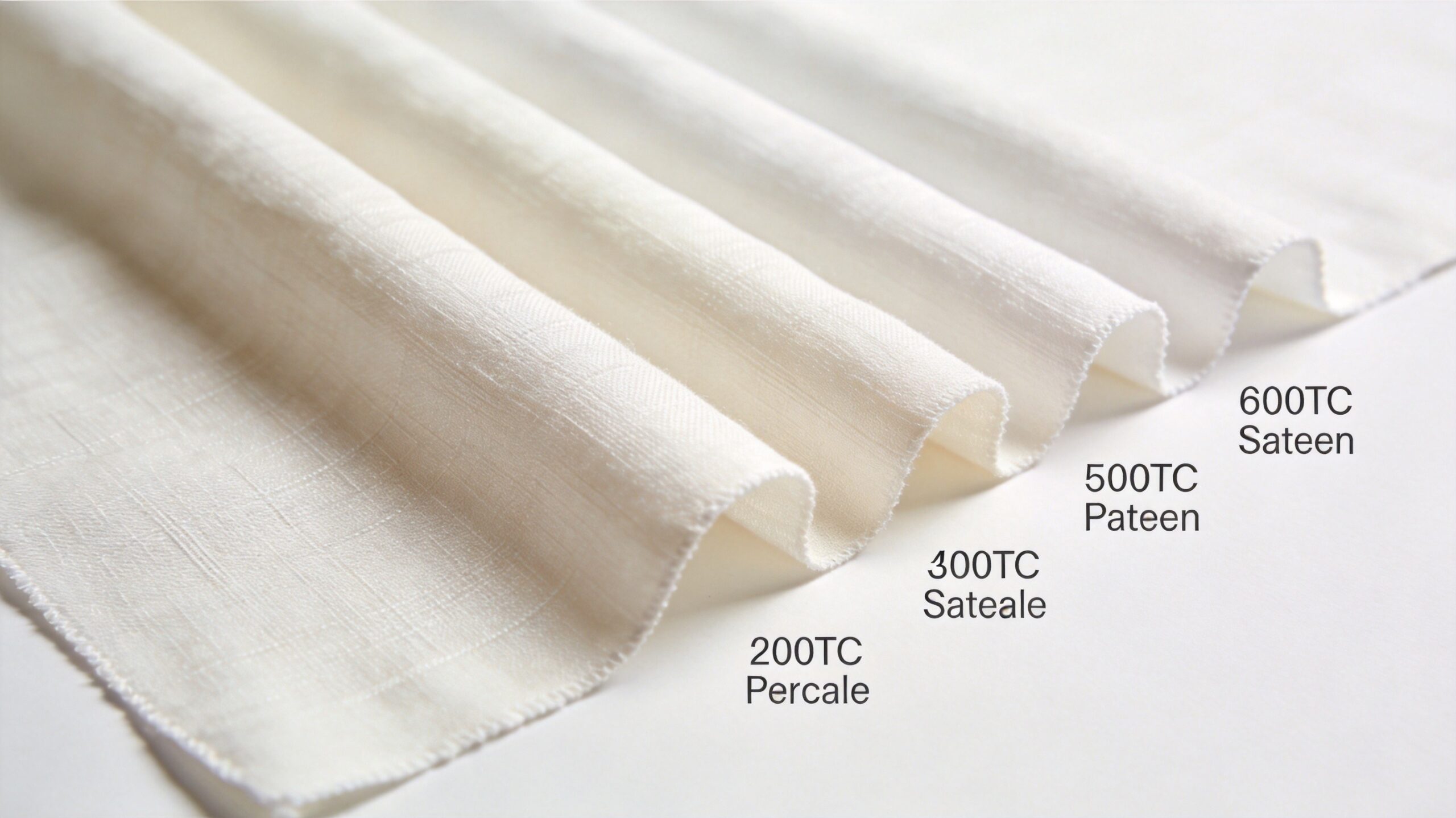
What Thread Count Actually Means
Thread Count is the total number of threads woven into one square inch of fabric, counting both the warp (lengthwise) threads and the weft (crosswise) threads. A fabric with 200 warp threads and 200 weft threads per square inch has a thread count of 400.
In theory, higher thread count means a denser, smoother fabric. However, this simple relationship breaks down at higher numbers because manufacturers use techniques like multi-ply yarns (twisting two or three thinner threads together and counting each one) to inflate the count without improving the fabric.
The Thread Count Sweet Spots by Hotel Star Rating
3-Star Hotels: 200–300 TC Percale
Three-star properties need sheets that feel clean, crisp, and comfortable without excessive cost. A 200–300 TC percale weave in a cotton or cotton-polyester blend delivers exactly this. Percale’s one-over-one-under weave creates a matte finish with a cool, breathable hand-feel that guests associate with freshly laundered bedding.
At this TC range, sheets are lightweight, easy to launder, and dry quickly — all critical for efficient housekeeping operations. Durability is excellent because the simpler weave structure withstands repeated industrial washing better than denser weaves.
For properties in warm climates or those catering to business travelers who value efficiency, percale at 200–300 TC is the pragmatic choice.
4-Star Hotels: 300–400 TC Percale or Sateen
Four-star hotels occupy the middle ground where guests begin to notice and appreciate finer bedding details. The 300–400 TC range offers a meaningful step up in smoothness and softness without crossing into impractical territory.
The choice between percale and sateen at this level depends on your brand positioning:
- Percale (300–400 TC): Choose this for a crisp, cool, “hotel classic” feel. Popular with business-oriented properties and hotels in warm climates.
- Sateen (300–400 TC): Choose this for a silky, slightly warmer feel with a subtle sheen. Appeals to leisure-oriented guests and properties that want a visibly luxurious bed presentation.
At 300–400 TC, you are still in the range where single-ply yarns are standard, meaning the thread count reflects genuine fabric density rather than inflated multi-ply counting. This is the honest sweet spot where quality and value converge.
5-Star Hotels: 400–600 TC Sateen with Long-Staple Cotton
Five-star properties need bedding that delivers an unmistakable luxury experience from the moment a guest slides into bed. A 400–600 TC sateen weave in long-staple or extra-long-staple cotton (such as Egyptian, Supima, or premium combed cotton) achieves this.
The sateen weave (four-over-one-under) creates more yarn surface exposure per square inch, resulting in a silky, lustrous fabric that drapes beautifully. Combined with long-staple fibers that produce smoother, stronger yarns, the result is bedding that feels noticeably different from anything below the 400 TC threshold.
Some 5-star properties also explore 600–800 TC options for their signature suites. However, beyond 600 TC, the incremental improvement in hand-feel is marginal, and the risk of encountering multi-ply inflated counts increases significantly.
Percale vs. Sateen: Understanding the Weave Difference
The weave structure is just as important as thread count in determining how a sheet feels, performs, and ages. Here is a direct comparison:
| Atributo | Percal | Sateen |
|---|---|---|
| Weave Pattern | One-over-one-under (criss-cross) | Four-over-one-under (offset) |
| Surface Feel | Crisp, cool, matte | Silky, smooth, slight sheen |
| Respirabilidade | Excelente | Good (slightly less than percale) |
| Durabilidade | Very high | High (slightly less than percale) |
| Wrinkle Resistance | Moderado | Better (smoother surface) |
| Ideal para | Warm climates, crisp-preference guests | Cool climates, luxury-preference guests |
Neither weave is objectively superior — the right choice depends on your property’s climate, guest profile, and brand positioning.
How Fiber Type Changes the TC Equation
Thread count alone does not determine comfort. The fiber content fundamentally changes how a given TC performs:
100% Cotton
The industry standard. Breathable, soft, and durable. Quality varies dramatically based on staple length — long-staple cotton produces noticeably smoother, stronger yarns than short-staple. At the same TC, long-staple cotton will always feel softer and last longer.
Cotton-Polyester Blends (e.g., 60/40 or 50/50)
Polyester adds durability, wrinkle resistance, and cost savings. Blended sheets at 200–300 TC can feel surprisingly soft and maintain their appearance longer under harsh laundering conditions. Ideal for 3-star properties or high-turnover environments where sheet longevity is critical.
Viscose de bambu
Bamboo-derived viscose is naturally silky, hypoallergenic, and moisture-wicking. It feels softer than cotton at the same TC, making 300 TC bamboo sheets comparable in hand-feel to 500 TC cotton sateen. An excellent choice for eco-conscious properties and hotels marketing wellness positioning. YouMian’s 60s 300TC Bedding Set demonstrates how optimized construction at 300 TC can deliver premium results.
Tencel / Lyocell
Made from sustainably sourced wood pulp, Tencel offers exceptional softness, temperature regulation, and moisture management. Like bamboo, it feels softer than cotton at equivalent TC, allowing hotels to achieve a luxury hand-feel without inflated thread counts.
Microfibra
While not measured in traditional TC (microfiber is measured in GSM), microfiber sheets are an ultra-budget option. They are soft, wrinkle-resistant, and extremely affordable, but they lack the breathability and natural feel of cotton. Best suited for economy properties or as a backup inventory option.
The Thread Count Inflation Problem
Consumers have been trained to seek higher numbers, and some manufacturers have exploited this by using deceptive counting methods:
- Multi-ply yarn inflation: Twisting two 300-count yarns together and claiming 600 TC. The fabric is no denser — it is just thicker.
- Pick insertion tricks: Adding extra filler weft threads that don’t contribute to fabric quality but boost the count.
- Misleading labels: Some “1000 TC” sheets are essentially ordinary 300 TC sheets with inflated multi-ply marketing.
Industry experts generally agree that genuine single-ply thread counts above 600 offer diminishing returns. Anything marketed above 800 TC should be scrutinized carefully, and buyers should request independent lab verification for any premium-priced, high-TC claims.
Cost vs. Experience: Finding the Value Sweet Spot
The relationship between thread count and cost is not linear. The most dramatic improvement in guest experience occurs between 200 TC and 400 TC. Beyond 400 TC, incremental improvements in feel become harder for guests to detect, but costs rise significantly.
| TC Range | Relative Cost | Guest Perception | Expectativa de vida útil |
|---|---|---|---|
| 200 TC | $ | Clean, basic, acceptable | 150–200 lavagens |
| 300 TC | $$ | Comfortable, quality-noticeable | 130–180 lavagens |
| 400 TC | $$$ | Clearly premium, smooth | 120–160 washes |
| 600 TC | $$$$ | Luxurious, silky | 100–140 washes |
| 800+ TC | $$$$$ | Marginal improvement over 600 | Variable (depends on construction) |
For most properties, the optimal investment lies in the 300–400 TC range with high-quality fiber. This delivers the best ratio of guest satisfaction to cost per wash cycle.
Practical Procurement Tips
- Request physical samples. Never purchase bedding based on thread count numbers alone. Hand-feel is the true test.
- Ask about yarn type. A 300 TC sheet made from long-staple, ring-spun, single-ply cotton will outperform a 500 TC sheet from short-staple multi-ply yarn.
- Consider the wash lifecycle. Denser weaves at higher TC may feel better initially but can be more susceptible to pilling and degradation if not constructed properly.
- Factor in laundering costs. Heavier, denser sheets take longer to dry. For large properties, this adds up quickly.
- Align TC with your star rating honestly. Guests at a 3-star hotel will not notice or appreciate 600 TC sateen — they will notice clean, crisp, well-pressed 250 TC percale.
- Work with a supplier who understands the nuance. Partners like YouMian (优棉) can help match bedding specifications to your property tier and guest expectations without overspending.
Special Considerations by Climate and Guest Profile
Warm/humid climates: Favor percale weaves at 200–350 TC. Breathability matters more than silky hand-feel when temperatures are high.
Perguntas frequentes
What is thread count, and how is it measured?
Thread count (TC) is the number of threads per square inch of fabric, counting both warp (vertical) and weft (horizontal) threads. A 200 TC sheet has 200 threads per square inch. Note: some manufacturers use multi-ply yarns to inflate TC (counting each ply separately), so a claimed 600 TC may actually be 200 TC with 3-ply yarns.
What thread count is recommended for each hotel star rating?
2-star/budget: 180–200 TC poly-cotton blend. 3-star: 200–250 TC cotton or blend. 4-star: 250–300 TC combed cotton percale. 5-star/luxury: 300–400 TC long-staple cotton. Above 400 TC provides diminishing returns and is rarely necessary for hotel applications. The sweet spot for most properties is 200–300 TC.
How common is thread count fraud in hotel textiles?
Studies and industry audits suggest 30–40% of textiles claiming 400+ TC significantly overstate their actual count. Inflation methods include multi-ply counting, using micro-filament yarns, or simply false labeling. Independent lab testing (ASTM D3775) is the only reliable verification method. Buy from certified suppliers with transparent testing reports.
Does thread count matter more than fiber type?
Fiber quality often matters more than thread count. A 200 TC sheet made from long-staple Egyptian cotton will feel softer and last longer than a 400 TC sheet from short-staple cotton with multi-ply padding yarns. Always evaluate the combination: fiber type, weave, and finishing alongside TC.
How does thread count affect hotel linen costs?
Each 50 TC increase typically adds 8–15% to per-unit cost. Moving from 200 TC to 300 TC adds approximately 20–30% cost. However, the cost per wash cycle may actually decrease with higher TC, as these sheets often survive more wash cycles before replacement. Calculate total cost of ownership, not just purchase price.
Climas frios: Sateen weaves at 350–500 TC provide a slightly warmer, cozier feel that guests appreciate.
Wellness-oriented properties: Bamboo or Tencel at 300 TC offers natural temperature regulation and moisture-wicking that aligns with a health-conscious brand.
Budget-conscious properties: A cotton-poly blend at 200–250 TC provides acceptable comfort with significantly extended lifespan and lower replacement costs.
Avoiding Common Procurement Mistakes
- Chasing the highest TC: This is the most common mistake. It leads to overspending on bedding that guests cannot distinguish from more affordable options.
- Ignoring fiber content: A 400 TC short-staple cotton sheet feels worse than a 250 TC long-staple cotton sheet.
- Standardizing across all room types: Consider upgrading TC for suites and premium rooms while maintaining a different standard for standard rooms.
- Not testing wash durability: Always request wash-test data showing how the fabric performs after 50, 100, and 150 cycles.
- Overlooking packaging and presentation: How sheets are packaged, labeled, and presented in-room affects perceived quality as much as the fabric itself.
Summary: TC Recommendations at a Glance
| Hotel Tier | Recommended TC | Recommended Weave | Recommended Fiber |
|---|---|---|---|
| 3-Star | 200–300 | Percal | Combed cotton or cotton-poly blend |
| 4-Star | 300–400 | Percale or Sateen | Ring-spun combed cotton |
| 5-Star | 400–600 | Sateen | Long-staple or extra-long-staple cotton |
| Boutique / Bem-estar | 300–400 | Sateen | Bamboo viscose or Tencel |
Making the right thread count choice is about understanding your guests, your operations, and your budget — not about chasing the biggest number on a label. With informed specifications, you can deliver an exceptional sleep experience at every star level while maintaining healthy procurement margins.
Need help selecting the right bedding specifications for your property? Reach out to YouMian’s hospitality bedding specialists for tailored recommendations, fabric samples, and competitive pricing.
Quer saber mais sobre nossos produtos?
Veja todos os produtos agora English
  Русский
  Español de México
  Português do Brasil
  العربية