
El poliéster reciclado (rPET) en la ropa de cama de los hoteles: ventajas, desventajas y mitos
Ir a la sección
¿Qué es el poliéster reciclado rPET?
rPET significa polietileno tereftalato reciclado — el mismo polímero que se utiliza para fabricar botellas de agua de plástico de un solo uso, envases para alimentos y empaques. En lugar de terminar en los vertederos o en el océano, estos plásticos de PET se recogen, se limpian, se trituran hasta convertirlos en escamas, se funden y se extruyen para crear nuevas fibras de poliéster.
El proceso de producción suele seguir estos pasos:
- Colección — Las botellas de PET postconsumo se recolectan a través de programas de reciclaje
- Clasificación y limpieza — Se eliminan los contaminantes, las etiquetas y las tapas
- Trituración — Las botellas se trituran hasta convertirlas en pequeñas escamas
- Fusión y extrusión — Los copos se derriten y se transforman en gránulos de poliéster
- Spinning — Las virutas se vuelven a fundir y se hilan para producir hilo de poliéster
- Tejido o punto — El hilo se transforma en tela apta para textiles de hotel
El resultado es un tejido químicamente idéntico al poliéster virgen, pero que se obtiene a partir de residuos en lugar de la extracción de petróleo. Los principales productores de fibras, como Unifi (REPREVE®), Tory Textiles, y Far Eastern New Century ahora suministran hilo de rPET a escala industrial, lo que lo hace comercialmente viable para los fabricantes textiles de todo el mundo.
Argumentos ambientales a favor del rPET
El argumento más sólido a favor del rPET es su potencial de desviación de residuos. Cada kilogramo de fibra de rPET evita que entre 60 y 70 botellas de plástico terminen en el flujo de residuos. Para un grupo hotelero que adquiere miles de juegos de ropa de cama, fundas de almohada y toallas al año, la cifra acumulada de residuos evitados puede ser considerable.
Más allá de la reducción de residuos, el rPET ofrece ahorros cuantificables de energía y emisiones en comparación con el poliéster virgen:
- 30–50% menos energía se requiere para producir fibra de rPET en comparación con el poliéster virgen
- Aproximadamente 40% menos emisiones de CO₂ a lo largo del ciclo de vida de la producción
- Menor dependencia del petróleo crudo como materia prima
Estas cifras están respaldadas por evaluaciones del ciclo de vida realizadas por la Oficina de Reciclaje Internacional (BIR) y el Oficina Federal Suiza de Medio Ambiente. En comparación con el algodón convencional, el rPET también evita el enorme consumo de agua asociado al cultivo del algodón; se estima que el algodón convencional requiere 10 000 litros de agua por kilogramo de fibra.
Para los hoteles que se han fijado metas ambiciosas de sustentabilidad o que buscan obtener certificaciones como LEED, Green Key, o bien EarthCheck, el uso de textiles que contengan rPET puede contribuir de manera significativa a los objetivos de reducción de residuos y de contabilidad de carbono.
La preocupación por los microplásticos
Sin embargo, el rPET presenta una importante salvedad ambiental que con frecuencia se omite en los materiales de mercadotecnia: El rPET suelta microfibras durante el lavado, exactamente igual que el poliéster virgen.
El poliéster —ya sea reciclado o virgen— es una fibra plástica sintética. Cada vez que se lava una prenda de poliéster, la fricción y la agitación hacen que se desprendan diminutas microfibras (por lo general, de 5 a 20 micrómetros de diámetro) que pasan a las aguas residuales. Estas microfibras atraviesan la mayoría de las plantas de tratamiento de aguas residuales y, finalmente, llegan a ríos, lagos y océanos, donde se acumulan en los ecosistemas acuáticos y entran en la cadena alimentaria.
Una investigación publicada en Ciencia y tecnología ambientales ha demostrado que un solo ciclo de lavado doméstico puede liberar hasta 700 000 microfibras procedentes de una carga de poliéster. No hay evidencia de que las microfibras de rPET se comporten de manera diferente a las microfibras de poliéster virgen; la composición química es idéntica.
Para los hoteles, esto genera una verdadera disyuntiva: la decisión de reducir los residuos plásticos en la etapa de producción puede contribuir, sin quererlo, a la contaminación por plástico en la etapa de uso. Los equipos de compras deben ser transparentes respecto a esta disyuntiva y considerar estrategias de mitigación tales como:
- Especificar estructuras de tejido apretado que sueltan menos fibras
- Instalación sistemas de filtración de microfibra en equipos de lavandería comercial
- Prolongar los ciclos de reemplazo de la ropa de cama mediante mejores protocolos de cuidado
- Explorando tejidos mixtos que combinan rPET con fibras naturales para reducir la pérdida general de pelusa
Comparación de rendimiento: rPET vs poliéster virgen vs algodón
Entender cómo se comporta el rPET en las condiciones reales de un hotel es fundamental para tomar decisiones de compra bien informadas. La siguiente comparación abarca los criterios clave que más importan a los operadores del sector hotelero.
| Propiedad | Poliéster rPET | Poliéster virgen | Algodón convencional |
|---|---|---|---|
| Durabilidad | Alta: resistente a la abrasión y a la formación de bolitas | Alto — equivalente al rPET | Moderado: se degrada más rápido con el lavado industrial |
| Resistencia a las arrugas | Excelente | Excelente | Deficiente — requiere que se presione |
| Tiempo de secado | Rápido | Rápido | Lento: aumenta los costos de energía de la lavandería |
| Absorción de humedad | Bajo (0,41 TP3T de recuperación de humedad) | Bajo (0,41 TP3T de recuperación de humedad) | Alto (recuperación de humedad de 8,51 TP3T) |
| Comodidad de los huéspedes (sensación al tacto) | Moderado — mejorando gracias a la tecnología de los hilos | Moderado | Alto: los huéspedes lo prefieren por su suavidad |
| Desprendimiento de microfibras | Sí, igual que el poliéster virgen | Sí | Insignificante |
| Solidez del color | Excelente | Excelente | Moderado |
| Energía necesaria para producir | 30–50% menos que virgen | Valor de referencia (alto) | Inundaciones y uso del suelo |
| Costo por kg | Moderado | Bajo a moderado | De moderado a alto |
| Resistencia a las manchas | Bueno: su naturaleza hidrofóbica resiste las manchas de origen acuoso | Bien | Poor — absorbs stains readily |
Key takeaway: rPET performs nearly identically to virgin polyester in most practical hotel applications. Its advantages over cotton lie in durability, drying speed, and wrinkle resistance. Its disadvantages are identical to those of virgin polyester — particularly low moisture absorption and microfiber shedding.
Blend Recommendations: The Case for Organic Cotton + rPET
One of the most promising developments in sustainable hotel linen is the emergence of organic cotton and rPET blended fabrics. These blends attempt to capture the best properties of both fiber types while mitigating their individual weaknesses.
A typical blend ratio for hotel bed linen might be 60% organic cotton / 40% rPET o 70/30. In this configuration:
- El organic cotton component provides softness, breathability, and moisture absorption — the qualities guests associate with premium hotel bedding
- El rPET component adds durability, wrinkle resistance, and faster drying times — reducing laundry costs and extending linen lifespan
- El overall microfiber shedding is reduced compared to 100% rPET, because the natural cotton fibers do not contribute to microplastic pollution
- El organic cotton component eliminates pesticide and synthetic fertilizer use associated with conventional cotton
For towel applications, blends tend to skew more heavily toward cotton (80/20 or higher), since guests expect the plush absorbency that cotton provides. rPET is more commonly used in flatwork items such as top sheets, duvet covers, pillowcases, and mattress protectors, where durability and easy care are higher priorities.
Los hoteles deberían solicitar fabric composition certificates from suppliers and verify blend ratios through independent lab testing before committing to large orders.
Certification Landscape for rPET Products
Not all rPET is created equal. The credibility of recycled content claims depends entirely on the certifications and verification standards behind them. Hotel procurement teams should look for the following:
GRS — Global Recycled Standard
El Global Recycled Standard (GRS) is the most widely recognized certification for recycled content. It verifies:
- El percentage of recycled material in a product (minimum 20%, with branding allowed at 50%+)
- Chain of custody from source to final product
- Environmental management practices at processing facilities
- Social compliance criteria for workers
GRS certification is administered by third-party certification bodies such as Control Union, SGS, y Intertek. Hotels should request a valid GRS Transaction Certificate (TC) for each shipment to verify that the claimed recycled content is genuine.
Norma OEKO-TEX 100
While GRS verifies recycled content, Norma OEKO-TEX 100 addresses a different but equally important concern: chemical safety. This certification tests finished textiles for over 350 harmful substances, including formaldehyde, heavy metals, phthalates, and pesticide residues.
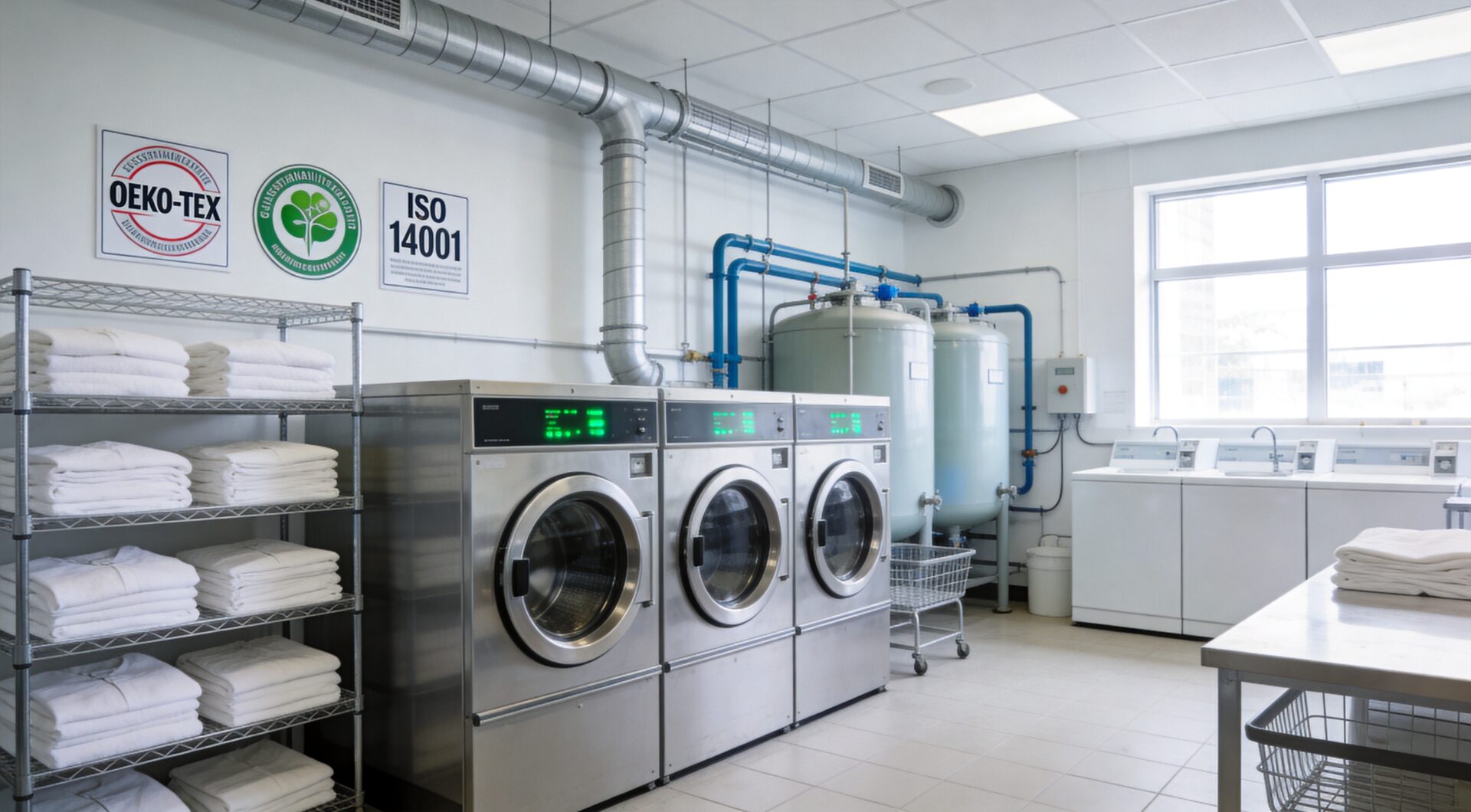
For hotels, OEKO-TEX certification provides assurance that rPET linen is safe for direct skin contact — a critical consideration given that bedding and towels have prolonged contact with guests’ skin. Products carrying the OEKO-TEX label have been tested to meet or exceed international regulatory limits for harmful substances.
Other Relevant Standards
- OEKO-TEX STeP — certifies sustainable production processes at manufacturing facilities
- bluesign® — focuses on chemical management and environmental emissions in textile production
- SCS Global Services Recycled Content Standard — an alternative recycled-content verification
Greenwashing Risks: What “Made from Recycled Bottles” Really Means
The phrase “made from recycled bottles” has become one of the most powerful marketing claims in sustainable textiles. But hotel procurement teams should recognise several common greenwashing tactics:
1. Partial recycled content presented as total. A product containing 15% rPET and 85% conventional polyester may be marketed with imagery of plastic bottles, creating the impression that it is predominantly recycled. Always check the exact percentage.
2. Ignoring the full lifecycle. “Made from recycled bottles” says nothing about chemical treatments during production, energy sources used in manufacturing, microfiber shedding during use, or end-of-life recyclability. A truly sustainable product must address the entire lifecycle.
3. Unverified claims. Without GRS certification or equivalent third-party verification, recycled-content claims are essentially self-declared and impossible to audit.
4. Comparing against the wrong baseline. rPET is often framed as “sustainable” by comparison to virgin polyester. While the relative improvement is real, this framing obscures the fact that natural fibers such as organic cotton, hemp, or linen may have a lower overall environmental impact — particularly when microfiber pollution is accounted for.
Hotels should demand transparent, verified data rather than accepting marketing slogans at face value.
Real-World Hotel Adoption
Several international hotel groups have begun integrating rPET textiles into their linen programs:
- Marriott International has explored recycled polyester in select brands as part of its broader “Serve 360” sustainability platform, targeting responsible sourcing across its supply chain.
- IHG Hotels & Resorts includes recycled-content linen options in its Green Engage framework, encouraging properties to specify sustainable textiles where performance requirements are met.
- Scandic Hotels, the Nordic chain widely regarded as a sustainability leader in hospitality, has used recycled polyester in housekeeping uniforms and select textile applications for several years.
- Accor has committed to sourcing 100% of its textile products from sustainable sources by 2025, with rPET forming part of that strategy.
At the individual property level, boutique and eco-lodges are often the earliest adopters, as their brand positioning aligns closely with environmental storytelling. However, large-scale adoption across hotel groups requires not just willingness but also supply-chain maturity — the ability to source certified rPET textiles at consistent quality and competitive pricing across multiple global markets.
Practical Guidance: When rPET Makes Sense
rPET is not universally the right choice for every hotel linen application. Here is a practical framework for decision-making:
When rPET is a Strong Choice
- High-turnover laundry environments where durability and fast drying are critical (e.g., resort properties with daily linen changes)
- Properties pursuing waste-diversion certifications that can benefit from documented recycled-content procurement
- Mattress protectors and bed runners — items where the performance benefits of polyester are most valued and guest skin contact is indirect
- F&B textiles (napkins, tablecloths) where stain resistance and easy care are priorities
When Natural Fibres Are Better
- Guest-facing bed linen and towels in upscale or luxury properties where comfort is a primary brand differentiator
- Properties located in regions with robust organic cotton supply chains, where organic cotton pricing is competitive
- Properties with advanced laundry water filtration concerns, where microfiber reduction is a priority
- Wellness-focused or eco-lodge brands where guest expectations align with natural materials
A Balanced Approach
Many hotels find that a mixed fiber strategy — using rPET blends for certain applications and natural fibers for others — delivers the best balance of sustainability, performance, guest satisfaction, and cost control. The key is to make evidence-based decisions rather than defaulting to a single material across all categories.
YouMian’s Commitment to Certified Safe Linen
For hotels evaluating rPET blended linen, chemical safety certification is a non-negotiable baseline. Ropa de cama del hotel YouMian tiene OEKO-TEX Standard 100 certification (Certificate Number: SHWO 108278), ensuring that all textile products — including those incorporating rPET fibers — have been rigorously tested for harmful substances and are safe for direct human skin contact.
This certification covers the full range of YouMian’s hotel linen collections, including organic cotton and rPET blended bed linen, pillowcases, and towel ranges. For procurement teams, OEKO-TEX certification eliminates the risk of chemical residue concerns and provides documentation for internal sustainability audits and guest-facing transparency reports.
Looking for certified sustainable hotel linen? Contact YouMian to explore our OEKO-TEX certified organic cotton and rPET blended collections.
Preguntas frecuentes
¿Es seguro el poliéster reciclado rPET para el contacto con la piel de los huéspedes de hotel?
Yes, when the finished textile carries a valid Norma OEKO-TEX 100 certification (such as YouMian’s SHWO 108278). This certification tests for over 350 harmful substances and ensures the product is safe for direct and prolonged skin contact. Without such certification, chemical safety cannot be guaranteed regardless of the fiber source.
¿El rPET reduce la contaminación por microplásticos en comparación con el poliéster virgen?
No. rPET is chemically identical to virgin polyester and sheds microfibers at the same rate—a single domestic wash can release up to 700,000 microfibers. Its real benefits are waste diversion (each kg reuses ~60–70 bottles) and production savings of ~30–50% energy and ~40% CO₂, not reduced microplastic shedding.
¿Qué certificaciones deben exigir los hoteles al comprar ropa de cama de rPET?
At minimum, procurement teams should require GRS (Global Recycled Standard) for verified recycled content and Norma OEKO-TEX 100 for chemical safety. Additional certifications such as bluesign® or OEKO-TEX STeP can further strengthen sustainability credentials.
¿Cómo se compara el costo del lino mezclado con rPET con el del algodón 100%?
rPET blended linen is typically 10–25% less expensive than 100% organic cotton, depending on blend ratios and market conditions. The cost advantage comes from the lower raw material cost of recycled polyester versus organically grown cotton. However, hotels should factor in total lifecycle cost, including laundering expenses and linen replacement frequency.
¿Se puede reciclar la ropa de cama de rPET al final de su vida útil?
Technically yes, but global textile recycling remains limited: most rPET linen is downcycled into industrial wiping cloths or insulation or ends up in landfill—even “biodegradable” options can take 200+ years to break down. End-of-life recyclability should not be the primary reason to choose rPET.
¿Cuál es la proporción ideal de mezcla entre algodón orgánico y rPET en la ropa de cama de los hoteles?
A 60/40 or 70/30 organic cotton to rPET ratio is generally recommended for bed linen. This provides the softness and breathability guests expect from cotton, with added durability, wrinkle resistance, and faster drying from the rPET component. For towels, a higher cotton ratio (80/20 or above) is preferable.
Final Thoughts
rPET recycled polyester is neither a miracle solution nor a cynical greenwashing exercise — it is a material with genuine environmental benefits and real limitations. For hotel procurement teams, the challenge is to evaluate rPET on its merits rather than its marketing, and to make decisions grounded in lifecycle evidence rather than simplistic sustainability narratives.
The most responsible approach is one of strategic material selection: using rPET where it makes the strongest environmental and practical case, choosing natural fibers where guest experience demands it, and demanding full transparency and certification from every supplier in the chain.
Looking for certified sustainable hotel linen? Contact YouMian to explore our OEKO-TEX certified organic cotton and rPET blended collections.
Related Reading:
¿Quieres saber más sobre nuestros productos?
Ver todos los productos ahora English
  Русский
  Español de México
  Português do Brasil
  العربية