
Reusable vs Disposable Hotel Textiles: Environmental and Cost Analysis
Ir a la sección
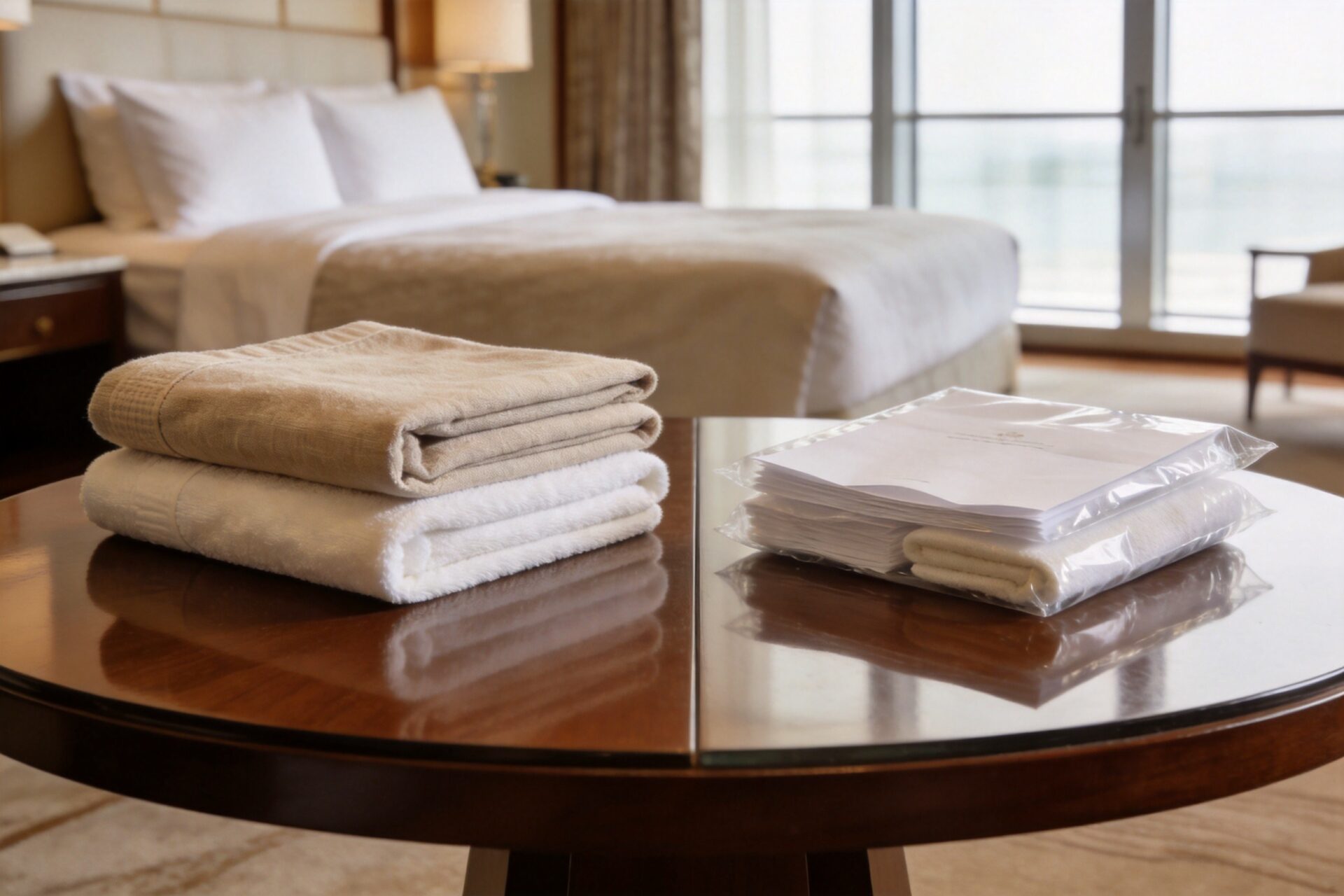
The debate between reusable and disposable hotel textiles has intensified as sustainability moves up the hospitality agenda. From single-use slippers and plastic-wrapped drinking cups to paper napkins and disposable mattress protectors, hotels generate significant textile and non-textile waste. But are reusable alternatives always better for the environment? And do they make financial sense for hotel operators? This analysis examines both the environmental impact and total cost of ownership of reusable versus disposable hotel textiles across key product categories.
The Scope of Hotel Textile Waste
Global hotels generate an estimated 289,000 tons of textile waste annually, according to data from the Global Wellness Institute. A significant portion comes from single-use or short-cycle items:
- Slippers: The average hotel provides 1.5 pairs of disposable slippers per occupied room night. For a 300-room hotel at 75% occupancy, this equals over 123,000 pairs per year.
- Towels: While bath towels are reusable, many properties provide single-use makeup removal wipes, pool towels treated as disposable, or paper hand towels in restrooms.
- Table linens: Conference and event venues frequently use disposable table covers for coffee breaks and buffets.
- Mattress and pillow protection: Some budget chains use disposable fitted protectors changed between every guest rather than washable alternatives.
Understanding the environmental and financial trade-offs requires a life cycle assessment (LCA) approach that accounts for manufacturing, transportation, use-phase laundering, and end-of-life disposal.
Environmental Life Cycle Comparison
Reusable Textiles: Environmental Profile
Reusable hotel textiles—cotton towels, washable slippers, cloth napkins, and fitted mattress protectors—have higher upstream environmental impacts due to raw material cultivation and manufacturing, but these are amortized over hundreds of use cycles.
Key environmental factors for reusable textiles:
- Water use in manufacturing: Producing 1 kg of cotton fabric requires approximately 10,000 liters of water (including agricultural irrigation). However, a single 500-gram bath towel used 300 times consumes only 17 liters of embedded water per use.
- Laundry impact: Each commercial wash cycle uses 8–15 liters of water per pound of linen and 0.3–0.6 kWh of energy. Over 300 cycles, a towel accumulates approximately 3,000–5,000 liters of wash water—far less than the embedded water in 300 disposable alternatives.
- Chemical discharge: Laundry detergents, bleaches, and softeners contribute to water pollution, but commercial wastewater treatment removes 85–95% of contaminants before discharge.
- End of life: Worn cotton textiles can be recycled into wiping cloths, insulation, or regenerated fibers. Approximately 65% of hotel textiles are currently diverted from landfill through recycling or donation programs.
Disposable Textiles: Environmental Profile
Disposable hotel textiles—typically non-woven polypropylene, polyester microfiber, paper, or plant-based “bioplastics”—have lower per-unit manufacturing impact but generate waste with every use.
- Raw material: Most disposable slippers and single-use textiles are made from polypropylene or polyester (fossil-fuel based). A single pair of EVA/non-woven slippers generates approximately 120 grams of CO₂ during manufacturing.
- Waste volume: 123,000 pairs of disposable slippers per year for a 300-room hotel equals 7.4 tons of plastic and textile waste, almost all of which goes to landfill or incineration.
- Biodegradability: Despite “eco-friendly” marketing claims, most non-woven polypropylene does not biodegrade in landfill conditions. Plant-based alternatives (PLA, bamboo non-woven) require industrial composting facilities that are not available in most municipalities.
- Recycling contamination: Mixed-material disposables (fabric upper glued to EVA sole) cannot be economically recycled and are classified as residual waste.
Side-by-Side Environmental Comparison
The table below compares the per-use environmental impact of reusable versus disposable alternatives across common hotel textile categories, based on published LCA studies and industry data:
| Metric (per 1,000 uses) | Reusable Cotton Towels | Disposable Paper Towels | Reusable Slippers (cotton/TPR) | Disposable Slippers (non-woven/EVA) |
|---|---|---|---|---|
| Water consumption (L) | 3,400 | 1,200 | 4,200 | 800 |
| Energy use (kWh) | 180 | 220 | 210 | 310 |
| CO₂ emissions (kg) | 55 | 95 | 62 | 120 |
| Waste to landfill (kg) | 0.8 | 12.5 | 1.2 | 45 |
| Break-even point (uses) | ~8 uses (water); ~3 uses (carbon) | ~12 uses (water); ~5 uses (carbon) | ||
The data shows that while disposable products have lower water use per item (no laundering), reusable textiles achieve a lower per-use carbon footprint after just a handful of uses and dramatically reduce landfill waste. The water used in laundering reusable textiles can be further reduced through high-efficiency equipment, ozone systems, and water recycling—options unavailable for disposable products.
Total Cost of Ownership Analysis
Environmental arguments are compelling, but procurement decisions must also make financial sense. Let us compare the 5-year total cost of reusable versus disposable options for a 300-room hotel at 75% occupancy (82,125 occupied room nights per year).
Slippers: Reusable vs. Disposable
| Factor de costo | Disposable Slippers | Washable Cotton Slippers |
|---|---|---|
| Unit cost | $0.55/pair | $3.50/pair |
| Annual quantity needed | 123,000 pairs | 1,500 pairs inventory (3 par × 500 rooms/slippers needed) |
| Costo anual de compra | $67,650 | $5,250 initial + $1,750 annual replacement (33%) |
| Annual laundry cost | $0 | $8,200 (washing, drying, labor) |
| Annual packaging waste cost | $2,400 (waste disposal) | $0 |
| 5-year total cost | $350,250 | $56,000 |
Washable slippers save approximately $294,000 over five years—an 84% reduction. This analysis assumes washable slippers last 50 washes (conservative for cotton waffle with TPR soles) and includes the labor and utility cost of laundering.
Towels: Reusable Cotton vs. Disposable
For guest bath towels, the comparison is even more favorable for reusable products:
| Factor de costo | Disposable Bath Towels | Reusable Cotton Bath Towels |
|---|---|---|
| Unit cost | $1.20/towel | $8.00/towel (550 GSM) |
| Annual quantity | 164,000 towels (2/room) | 3,600 towels (3.5 par for 300 rooms × 2 per room) |
| Costo anual de compra | $196,800 | $4,800 (15% annual replacement) |
| Annual laundry cost | $0 | $22,000 |
| Waste disposal cost | $4,500 | $200 (recycling worn towels) |
| 5-year total cost | $1,006,500 | $135,000 |
Reusable cotton towels save over $870,000 across five years. This is why disposable bath towels are virtually unheard of in full-service hotels, though they appear in budget capsule hotels and some airport lounges.
Table Linens: Cloth vs. Disposable
| Factor de costo | Disposable Table Covers | Polyester Tablecloths |
|---|---|---|
| Unit cost | $2.50 each | $15.00 each |
| Uses per year (50-event banquet hall) | 5,000 covers | 200 cloths × 50 uses = 10,000 uses |
| Costo anual de compra | $12,500 | $750 (10% replacement) |
| Annual laundry cost | $0 | $3,000 |
| Eliminación de residuos | $1,200 | $0 |
| 5-year total cost | $68,500 | $18,750 |
When Disposables Make Sense
Despite the strong environmental and economic case for reusables, there are scenarios where disposable textiles remain the practical choice:
- Healthcare and quarantine facilities: Infection control protocols may require single-use textiles to prevent cross-contamination.
- Remote locations without laundry infrastructure: Eco-lodges, safari camps, and island resorts may lack reliable water, power, or commercial laundry services.
- One-time large events: Music festivals, sporting events, and disaster relief operations where temporary scale makes laundering impractical.
- Airline and cruise turnarounds: Extremely tight turnaround times may not allow for laundry processing between guests.
In these cases, choose disposable products made from recycled or rapidly renewable materials (rPET non-woven, bamboo fiber, FSC-certified paper) and partner with waste management providers that can compost or recycle them appropriately.
Best Practices for Transitioning to Reusable Textiles
For hotels ready to reduce or eliminate disposable textiles, the following approach minimizes disruption and maximizes return on investment:
1. Audit Current Disposable Usage
Conduct a 30-day waste audit to quantify every disposable textile item, its cost, and its waste volume. Prioritize items with the highest volume and cost—typically slippers, laundry bags, and food service napkins.
2. Invest in Quality Reusable Products
Reusable textiles only deliver savings if they last through enough wash cycles. Specify commercial-grade products designed for hospitality laundering:
- Washable slippers: cotton waffle or terry with TPR/rubber soles, rated for 50+ washes.
- Cloth napkins: 200+ GSM polyester-cotton blend, 220+ wash cycles.
- Mattress protectors: 100% waterproof, breathable polyurethane-laminated cotton, 200+ washes.
- Laundry bags: heavy-duty mesh or cotton canvas with reinforced drawstrings.
Youmian Textile’s bedding and bath linen collections include reusable alternatives across all major disposable categories, all certified to OEKO-TEX Standard 100.
3. Optimize Laundry Operations
The environmental and financial advantage of reusable textiles depends on efficient laundering:
- Install high-efficiency washer-extractors or tunnel washers that use 0.4–0.6 gallons of water per pound (vs. 1.5–2.0 for older equipment).
- Implement ozone or oxygen-based wash systems that reduce water temperature from 75°C to 40°C, cutting energy use by 30–40%.
- Use moisture-sensing dryers to prevent over-drying and extend textile life.
- Recycle 50%+ of wash water through filtration and reverse osmosis systems.
4. Communicate the Change to Guests
Some guests may perceive washable slippers as less hygienic than individually wrapped disposables. Address this proactively through:
- In-room signage explaining the reusable program and its environmental impact.
- Transparent packaging (paper bands or cotton bags) that communicates laundering between uses.
- Certification labels (OEKO-TEX, GOTS) that reassure guests of chemical safety.
- Opt-in programs where guests who decline daily linen changes receive loyalty points or F&B credits.
5. Track and Report Results
Measure waste reduction, cost savings, and guest satisfaction before and after the transition. Hotels that publicly report sustainability outcomes—through Green Key, Green Globe, LEED, or ESG reports—find that the data strengthens their brand positioning with environmentally conscious travelers. This segment represents 38% of luxury travelers and is growing at 11% annually.
Preguntas frecuentes
Are reusable hotel textiles really more hygienic than disposables?
Yes, when laundered properly. Commercial washing at 60–75°C with approved detergents achieves a 99.999% reduction in microorganisms—more effective than the sterile packaging of disposable slippers, which can become contaminated during shipping and storage. Hospitals and healthcare facilities universally use reusable textiles laundered to certified standards.
How much can a hotel save by switching from disposable to reusable slippers?
A 300-room hotel can save approximately $55,000–$65,000 per year by replacing disposable slippers with washable cotton or waffle alternatives. Over a 5-year period, total savings exceed $290,000 after accounting for the higher upfront purchase cost and ongoing laundry expenses.
What about the water used to wash reusable textiles?
While laundering does consume water, life cycle studies consistently show that reusable textiles have a lower total water footprint per use after the break-even point. For cotton towels, the break-even is approximately 8 uses; for slippers, 12 uses. High-efficiency laundry equipment and water recycling systems further reduce the gap. In contrast, disposable products consume water during manufacturing with no opportunity for conservation.
Do guests prefer reusable or disposable hotel amenities?
Surveys by the American Hotel & Lodging Association show that 62% of guests prefer reusable slippers when they are confident about laundering standards, and 71% feel positive about hotels that reduce single-use plastics. The key is communication—guests respond favorably when they understand the environmental rationale and see evidence of hygienic processing.
Can reusable textiles help with green hotel certification?
Yes. LEED, Green Key, and Green Globe all award points for waste reduction, sustainable purchasing, and elimination of single-use items. Replacing disposable textiles with reusable alternatives can contribute 2–5 points across multiple certification categories, making it one of the highest-ROI sustainability initiatives a hotel can undertake. Learn more about our sustainable OEM/ODM capabilities.
Conclusion: Reusables Win on Both Counts
The evidence is clear: across every major category of hotel textile, reusable products deliver a lower total cost of ownership and a smaller environmental footprint than disposable alternatives. The break-even point is measured in handfuls of uses, and the 5-year savings run into hundreds of thousands of dollars for mid-size hotels. While disposables remain necessary in specific contexts—infection control, remote locations, one-time events—the default choice for the vast majority of hotels should be durable, commercial-grade, washable textiles. By investing in quality products, optimizing laundry operations, and communicating the change to guests, hotels can reduce costs, minimize waste, and strengthen their sustainability credentials simultaneously.
Ready to transition from disposables to durable reusable textiles? Póngase en contacto con Youmian Textile for a product catalog and customized cost-saving proposal.
¿Quieres saber más sobre nuestros productos?
Ver todos los productos ahora English
 Русский
 Español de México
 Português do Brasil
 العربية
