
Hotel Bathrobe Weight Guide: GSM, Fabric, and Seasonal Selection
Ir a la sección
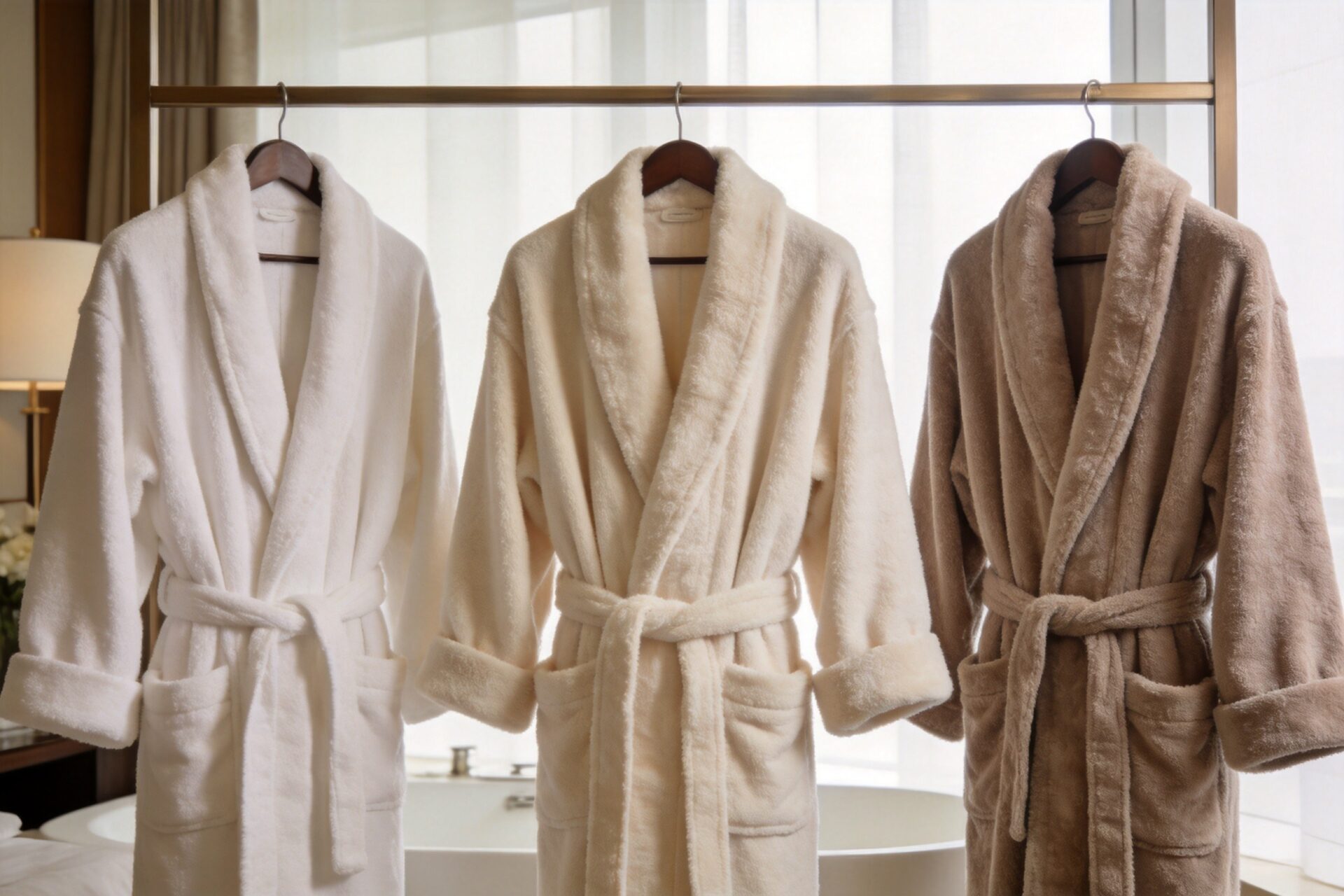
Bathrobe weight is one of the most underappreciated factors influencing guest comfort perceptions and operational costs in hotels. A bathrobe that feels luxuriously plush in a winter ski resort may feel heavy and impractical in a tropical beach resort, while a lightweight summer robe may leave guests cold in an air-conditioned luxury suite. Hotel bathrobe weight, measured in grams per square meter (GSM), determines warmth, absorbency, durability, and laundering expense. This guide explains how GSM applies to bathrobes, compares fabric constructions, provides seasonal recommendations, and helps procurement teams balance guest satisfaction with total cost of ownership.
Understanding GSM for Hotel Bathrobes
GSM measures the density of fabric by weighing a one-meter-square sample. For bathrobes, higher GSM generally means thicker, more absorbent, and warmer fabric—but also heavier when wet, slower to dry, and more expensive to launder. Unlike sheets or towels where GSM applies uniformly, bathrobes combine different fabric zones: the body, sleeves, shawl collar, and belt may use varying weights and constructions.
Bathrobe GSM Categories
| Alcance GSM | Classification | Typical Robe Weight | Nivel de calidez | Best Application |
|---|---|---|---|---|
| 200–300 GSM | Ligero | 0.6–0.9 kg | Light | Spa, summer, tropical climates, poolside |
| 300–400 GSM | Mid-weight | 0.9–1.2 kg | Moderado | Year-round business hotels, transitional seasons |
| 400–500 GSM | Heavy-weight | 1.2–1.6 kg | Warm | Luxury hotels, winter, cool climates |
| 500+ GSM | Ultra-plush | 1.6–2.2 kg | Very warm | Five-star resorts, ski lodges, premium suites |
It is important to note that bathrobe total weight differs from GSM. A men’s size L/XL shawl-collar terry bathrobe at 400 GSM typically weighs 1.2–1.4 kg because the robe contains approximately 3.0–3.5 square meters of fabric. Women’s sizes (S/M) usually weigh 15–20% less due to smaller dimensions.
Fabric Construction and Its Impact on Weight Perception
GSM alone does not tell the full story. Fabric construction significantly affects how a bathrobe feels, absorbs, and wears. The four primary bathrobe constructions used in hospitality each deliver distinct characteristics at similar GSM levels.
Terry Cloth: The Classic Hotel Bathrobe
Terry cloth features uncut loop piles on both sides of the fabric, creating maximum surface area for absorbency. At 350–450 GSM, terry cloth bathrobes are the standard for full-service hotels because they absorb water effectively after showering and provide substantial warmth. The loop piles also create air pockets that insulate without excessive weight. However, terry robes are the slowest to dry—requiring 45–60 minutes in a commercial dryer—and the loops can snag or pull if laundered with sharp objects. A quality terry bathrobe at 400 GSM should withstand 200–300 commercial wash cycles when properly maintained.
Waffle Weave: Lightweight and Quick-Drying
Waffle weave bathrobes use a honeycomb texture that traps air for warmth while allowing rapid moisture evaporation. Typically manufactured at 220–320 GSM, waffle robes weigh 30–40% less than comparable terry robes and dry in 25–35 minutes, reducing dryer energy costs by approximately 40%. Their structured texture resists snagging and maintains a crisp appearance that many guests associate with modern luxury spas. Waffle robes are ideal for warm climates, spa facilities, and hotels prioritizing quick turnover. The trade-off is lower immediate absorbency—waffle fabric wipes rather than absorbs—making it less suitable for guests stepping directly out of a shower.
Velour: The Luxury Surface
Velour bathrobes start as terry cloth but have the outer loops sheared to create a smooth, velvet-like surface while retaining terry loops on the inside for absorbency. At 380–480 GSM, velour robes convey premium luxury and are commonly found in five-star hotels and resorts. The sheared surface provides a silky hand feel and a more tailored appearance than looped terry. However, velour requires more careful laundering—tumble drying on low heat and prompt removal to prevent pile crushing—and typically costs 25–40% more than equivalent terry robes. Expected lifespan is 150–250 washes.
Microfiber and Plush Fleece
Microfiber bathrobes (typically polyester or polyester-polyamide blends) offer an ultra-soft hand feel at low weights (200–280 GSM) with fast drying and excellent durability. Plush fleece robes, usually 100% polyester at 280–380 GSM, provide exceptional warmth-to-weight ratio and are popular in cooler climates. However, synthetic robes do not absorb water as effectively as natural fibers, can generate static electricity in dry environments, and may feel “cheap” to luxury travelers despite their comfort. They are best suited for limited-service properties, budget hotels, or as supplementary robes in addition to cotton options.
Seasonal Bathrobe Selection Strategy
Leading hotels rotate bathrobe inventory seasonally to optimize guest comfort and reduce laundering costs. The following framework provides guidance for properties in various climate zones.
| Season/Climate | Recommended Fabric | GSM | Fundamento |
|---|---|---|---|
| Winter (cold climate) | Terry cloth or velour | 400–500 | Maximum warmth and absorbency post-shower |
| Summer (warm climate) | Waffle weave or lightweight terry | 220–320 | Breathable, quick-drying, prevents overheating |
| Year-round (temperate) | Mid-weight terry | 350–400 | Versatile across seasons with HVAC-controlled rooms |
| Spa/Wellness | Waffle weave | 250–320 | Light coverage between treatments, fast-drying |
| Pool/Beach Resort | Lightweight terry or waffle | 250–350 | Quick-drying in humid environments |
| Ski/Mountain Resort | Heavy terry or velour | 450–550 | Warmth after hot tub, sauna, or cold outdoor exposure |
| Luxury Suite (all climates) | Velour or double-terry | 400–500 | Premium tactile experience justifies higher cost |
Inventory Rotation Economics
Maintaining two seasonal bathrobe sets requires approximately double the inventory investment but extends each robe’s usable life by distributing wash cycles across two sets. For a 300-room hotel, this means 300 winter robes (400+ GSM) and 300 summer robes (220–320 GSM), rather than 300 year-round robes. While the upfront investment increases by roughly 60–80% (since summer robes cost less than winter robes), each set accumulates only 50% of annual wash cycles, potentially doubling the replacement cycle from 2 years to 4 years.
Size, Fit, and Design Features That Matter
Bathrobe weight should be evaluated alongside cut and design, as these factors affect perceived quality and operational durability:
- Shawl collar: Adds 80–150 grams of fabric and provides neck warmth. Standard on luxury robes; requires reinforced stitching at the collar attachment point.
- Kimono collar: Lighter, simpler design that reduces total robe weight by 50–100 grams. Common in spa and Asian-market hotels.
- Hood: Adds 100–180 grams and is popular in resort and family-oriented properties. Hoods require additional drying attention to prevent mildew in the seam area.
- Pockets: Patch pockets add 40–80 grams total. Double-stitched attachment prevents tearing—a common failure point in hospitality robes.
- Belt and loops: A woven cotton belt weighs 60–100 grams. Reinforced belt loops with bartack stitching prevent detachment, a frequent repair issue.
- Hanging loop: A center-back loop allows proper drying between uses and reduces damp-folding wrinkles. A small detail that extends robe life.
Laundering Costs by Robe Weight
The financial impact of bathrobe weight becomes clear when laundering costs are analyzed over the product lifecycle. Heavier robes require more water, detergent, and dryer time per wash cycle.
| Robe Type | GSM | Avg. Weight | Dryer Time | Energy Cost/Wash | Washes/Year* | Annual Energy Cost/Robe |
|---|---|---|---|---|---|---|
| Waffle weave | 280 | 0.8 kg | 30 min | $0.18 | 73 | $13.14 |
| Lightweight terry | 350 | 1.0 kg | 40 min | $0.24 | 73 | $17.52 |
| Standard terry | 400 | 1.2 kg | 50 min | $0.30 | 73 | $21.90 |
| Heavy terry/velour | 480 | 1.5 kg | 60 min | $0.38 | 73 | $27.74 |
*Based on 2 uses per week with 70% occupancy average. For a 300-room hotel, switching from 450 GSM terry robes to 320 GSM waffle robes for summer use (6 months) saves approximately $1,700–$2,200 annually in drying energy alone.
Quality Indicators Beyond GSM
GSM is an important specification, but it does not guarantee quality or durability. When evaluating bathrobe samples, inspect the following indicators:
- Double-needle stitching: All seams should have at least 8–10 stitches per inch with double-needle construction on stress points (shoulders, armholes, collar).
- Combed or ring-spun yarn: Combed cotton removes short fibers, producing a smoother, stronger, less lint-prone robe than carded open-end yarn. Ask for yarn specifications in your RFQ.
- Hemming: Minimum 2-inch double-fold hems on sleeves and bottom prevent curling and fraying after repeated washing.
- Belt construction: Woven belts (not tubular knit) hold shape better and resist stretching. Bartack-reinforced belt loops are essential.
- Color consistency: White robes should have a consistent, bright white without greying. Dyed robes should show even penetration with no white core visible when yarn is untwisted.
- Certifications: OEKO-TEX Standard 100 certification confirms the fabric is free from harmful substances, while GOTS certification applies to organic cotton options.
When sourcing bathrobes, partner with a manufacturer that provides Personalización OEM/ODM for GSM, fabric type, sizing, embroidery, and labeling to match your brand standards and operational requirements.
Preguntas frecuentes
What GSM bathrobes do luxury hotels use?
Most five-star hotels use terry cloth or velour bathrobes at 400–500 GSM. Premium properties like Four Seasons and Ritz-Carlton typically specify 450–500 GSM for standard rooms and may use 500+ GSM double-sheared velour for suites. At this weight, bathrobes deliver the plush, substantial feel that luxury guests expect while maintaining acceptable drying times in commercial laundry operations.
How much does a hotel bathrobe weigh?
A standard adult L/XL hotel terry bathrobe at 400 GSM weighs 1.2–1.4 kg (2.6–3.1 lbs). Lightweight waffle robes at 280 GSM weigh 0.7–0.9 kg (1.5–2.0 lbs). Ultra-plush velour robes at 500 GSM can weigh 1.6–2.0 kg (3.5–4.4 lbs). Weight varies by size, style (shawl collar adds weight), and fabric construction.
Are waffle weave bathrobes absorbent enough for hotel use?
Waffle-weave bathrobes are only moderately absorbent—they wipe moisture from the skin rather than trapping it like terry loops—so they suit spas, poolside and warm climates where guests use the robe mainly for coverage. For post-shower drying, choose terry cloth or a terry-lined waffle hybrid instead; treat the choice as situational rather than universal. (为定性经验结论,正文未给出吸收率量化值。)
¿Con qué frecuencia deberían los hoteles reemplazar los albornoces?
Quality cotton hotel bathrobes should last 200–300 commercial wash cycles, which translates to 2–4 years depending on occupancy and laundering frequency. Signs that robes need replacement include thinning fabric, permanent greying or yellowing, pulled loops that cannot be trimmed, stretched collars, and fraying seams. Rotating two sets seasonally can extend replacement cycles by distributing wear.
Can hotel bathrobes be custom-branded with embroidery?
Yes. Most hotel linen manufacturers offer custom embroidery for bathrobes, including logos, monograms, and brand names. Standard placement is left chest or shawl collar. Embroidery adds $1.50–$4.00 per robe depending on stitch count and thread colors. For best results, specify embroidery before production and request a sewn sample for approval before bulk orders.
Conclusion: Select Bathrobes That Match Your Property and Climate
Choosing the right bathrobe weight requires understanding your hotel’s climate, guest profile, laundry infrastructure, and brand positioning. There is no single “best” GSM—what works for an Alpine ski resort differs fundamentally from what works for a Caribbean beach resort. By matching fabric construction and GSM to seasonal conditions, investing in quality construction details, and calculating total laundering costs rather than just unit price, hotels can select bathrobes that enhance the guest experience while controlling operational expenses. Póngase en contacto con Youmian Textile to request bathrobe samples in multiple GSM and fabric options, or explore our full hotel linen collection for coordinated bedding, towel, and bathrobe programs.
¿Quieres saber más sobre nuestros productos?
Ver todos los productos ahora English
 Русский
 Español de México
 Português do Brasil
 العربية
