
Luxury Hotel Bathrobe Trends for 2027
الانتقال إلى القسم
The hotel bathrobe has evolved from a functional afterthought to a brand statement, a social media prop, and a key driver of guest satisfaction scores. In 2027, luxury hotels are rethinking bathrobe design with a focus on material innovation, sustainability, personalization, and wellness integration. Guests no longer judge a bathrobe solely on softness — they evaluate its weight, weave, environmental credentials, and how it makes them feel during their stay. For procurement managers and hospitality designers, staying ahead of these trends means understanding the shift from generic terry cloth to a diverse landscape of waffle weaves, plush velours, performance fabrics, and eco-conscious materials. In this article, we explore the most significant luxury hotel bathrobe trends for 2027, backed by industry data, material comparisons, and practical sourcing guidance for properties looking to elevate their in-room experience.
The State of the Luxury Bathrobe Market
The global hospitality bathrobe market is projected to reach $1.8 billion by 2028, growing at a CAGR of 6.2%, according to a 2025 report by Grand View Research. Several factors are driving this growth:
- Luxury and lifestyle hotel segments are expanding at 8.5% annually, outpacing the overall hotel market growth of 4.3%.
- Guest review data shows that “comfortable bathrobe” is mentioned in 23% of five-star hotel positive reviews, up from 14% in 2020.
- Hotels report that upgrading bathrobes increases average review scores by 0.15–0.25 points on a 10-point scale — a meaningful improvement in competitive markets.
- Bathrobe sales to guests (retail take-home programs) generate $2,000–$8,000 in annual ancillary revenue per property for luxury hotels.
These numbers explain why four- and five-star properties are willing to invest $35–$90 per bathrobe at wholesale, compared to $15–$25 for mid-scale products.
Trend 1: Waffle Weave and Honeycomb Textures
Waffle weave bathrobes have moved from spa niche to mainstream luxury, driven by their light weight, quick-drying properties, and textured visual appeal.
Why Waffle Weave Is Gaining Traction
- Lightweight comfort: Waffle robes weigh 250–350 GSM, roughly half the weight of plush terry robes (500–700 GSM), making them ideal for warm climates and year-round use.
- Faster drying: The open weave structure allows 40–50% faster drying than terry cloth, reducing laundry energy costs and minimizing mildew risk in humid environments.
- Contemporary aesthetics: The honeycomb texture photographs beautifully for social media and aligns with the minimalist, organic design language of modern luxury hotels.
- Versatility: Waffle robes transition seamlessly from bathroom to balcony, pool deck, or in-room dining, making them suitable for resort and urban properties alike.
Waffle Weave Material Options
| المواد | GSM Range | Key Properties | Wholesale Cost |
|---|---|---|---|
| 100% Cotton waffle | 250–350 | Breathable, absorbent, classic feel | $22–$35 |
| Cotton-poly waffle blend | 220–300 | Wrinkle-resistant, faster drying | $18–$28 |
| Bamboo-cotton waffle | 240–320 | Silky hand-feel, eco-friendly | $28–$42 |
| TENCEL™ waffle | 220–300 | Moisture-wicking, sustainable | $32–$48 |
| Microfiber waffle | 200–280 | Ultra-light, quick-dry, budget option | $12–$20 |
Trend 2: Plush Velour and Sheared Terry
At the opposite end of the spectrum, plush velour and sheared terry robes are experiencing a renaissance, particularly in five-star urban hotels and cold-climate resorts. These robes offer a velvet-like outer surface with looped terry inside, combining luxury aesthetics with maximum absorbency.
Velour vs. Sheared Terry vs. Standard Terry
| مقال مميز | Velour | Sheared Terry | Standard Terry |
|---|---|---|---|
| Outer surface | Cut, smooth, velvet-like | Partially sheared, textured | Looped, traditional |
| Inner surface | Looped terry | Looped terry | Looped terry |
| GSM range | 450–650 | 400–550 | 400–700 |
| Visual appearance | Ultra-luxurious, formal | Refined, upscale | Casual, functional |
| Wash durability | 200–300 cycles | 250–350 دورة | 300–500 cycles |
| Wholesale cost | $40–$75 | $30–$50 | $20–$45 |
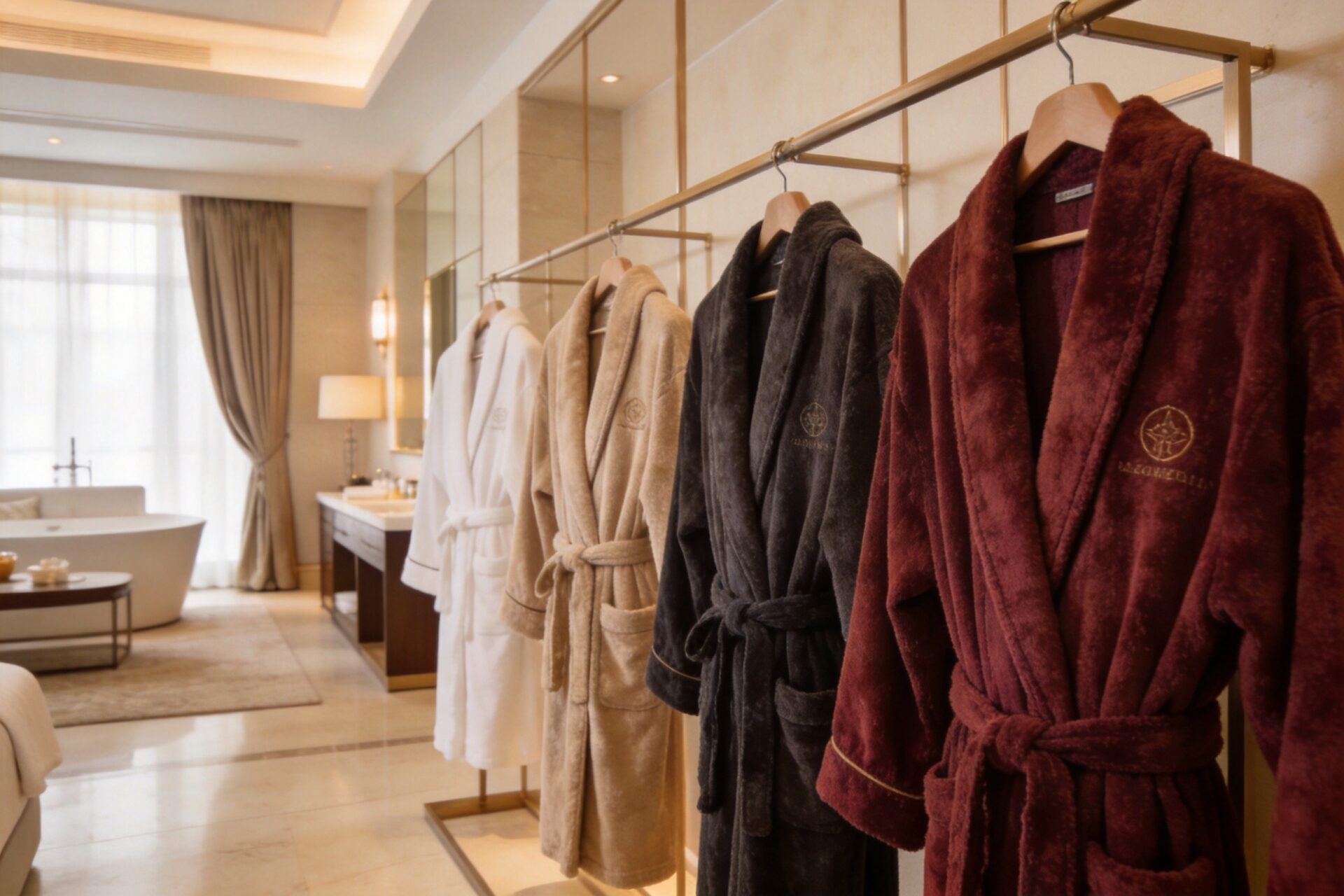
Shawl-collar velour robes in deep charcoal, navy, and burgundy are particularly popular for 2027, replacing the traditional white-only palette. Properties including Auberge Resorts and Six Senses have adopted colored velour robes as part of their brand identity.
Trend 3: Sustainable and Eco-Conscious Materials
Sustainability is no longer a niche differentiator — it is an expectation. A 2025 Booking.com survey found that 68% of luxury travelers actively seek out properties with sustainable practices, and bathrobes are a visible, tactile expression of those values.
Key Sustainable Materials for 2027 Bathrobes
- GOTS-certified organic cotton: Grown without synthetic pesticides or genetically modified seeds, using 91% less water than conventional cotton. Organic cotton terry and waffle robes offer identical performance with a verifiable sustainability story. Expect to pay a 20–30% premium over conventional cotton.
- TENCEL™ Lyocell: Made from sustainably harvested eucalyptus pulp in a closed-loop process that recovers 99% of process solvents. TENCEL™ robes are naturally moisture-wicking, silky to the touch, and fully biodegradable. Blends of 70% TENCEL™ / 30% cotton are the most popular for hospitality use.
- rPET (recycled polyester) blends: Robes incorporating 30–50% rPET derived from plastic bottles offer improved durability and wrinkle resistance while diverting plastic from landfills. A 50/50 cotton-rPET blend uses approximately 12 recycled plastic bottles per robe.
- Bamboo lyocell (closed-loop): Unlike chemically intensive bamboo viscose, closed-loop bamboo lyocell offers an environmentally responsible alternative with natural breathability and softness.
Youmian Textile offers a full range of OEKO-TEX and GOTS certified bathrobes across these material categories, with custom weaving and labeling available through our OEM/ODM program.
Trend 4: Gender-Neutral and Size-Inclusive Design
Luxury hotels are moving away from gendered “his and hers” bathrobes toward universally designed, size-inclusive options that make every guest feel comfortable.
- One-size-plus sizing: Rather than separate S/M and L/XL robes, many properties now offer a generously cut OSFA (One Size Fits All) robe with a 52–56 inch chest and adjustable shawl collar, supplemented by XL/XXL options on request.
- Kimono-style cuts: The traditional kimono silhouette — without a collar, with straight sleeves and a self-tie belt — flatters a wider range of body types than the shawl-collar design and has become the preferred silhouette for brands including Aman and COMO Hotels.
- Adaptive features: Magnetic closures, oversized arm openings, and hook-and-loop belt options are being adopted by properties catering to guests with mobility challenges, reflecting a broader industry commitment to accessibility.
- Kids’ robes: Matching mini-sized bathrobes for children are becoming standard at family-oriented luxury resorts, creating memorable experiences and social media moments.
Trend 5: Customization and Brand Integration
Bathrobes are increasingly viewed as a brand extension rather than a commodity. Customization options for 2027 include:
| Customization Type | الوصف | Typical Cost Premium |
|---|---|---|
| Embroidered logo | 1–4 color embroidery on chest, collar, or pocket | $1.50–$4.00 per robe |
| Woven label | Custom branded size/brand label | $0.30–$0.75 per robe |
| Custom dye color | Pantone-matched robe color (MOQ 500+) | $3–$8 per robe |
| Jacquard weaving | Logo or pattern woven directly into fabric | $5–$12 per robe |
| Custom packaging | Branded hanger, polybag, or gift box | $1–$5 per robe |
| RFID/QR tag | Embedded tag linking to retail purchase page | $0.50–$1.50 per robe |
QR code-enabled bathrobes represent an emerging trend: guests scan a tag to view the robe’s material story, sustainability credentials, and purchase options. Hotels using this technology report a 3–5% conversion rate from scan to retail sale.
Trend 6: Wellness-Focused Features
As hotels deepen their wellness offerings, bathrobes are being designed with therapeutic and sensory benefits in mind:
- Aromatherapy integration: Robes infused with microencapsulated lavender, eucalyptus, or chamomile essential oils that release gradually over 30–50 washes before requiring reapplication. Early adopters report improved guest sleep scores.
- Infrared-reflective fabrics: Ceramic-infused fibers that reflect body heat, providing gentle warmth without weight. Popular in mountain resorts and destination spas, these robes are 30% lighter than equivalently warm plush alternatives.
- Antimicrobial finishes: Silver-ion or zinc-based treatments that reduce bacteria growth and extend freshness between washes. However, buyers should verify that treatments are OEKO-TEX compliant and durable through 100+ wash cycles — many cheap antimicrobial washes lose efficacy after 20–30 launderings.
- Temperature-adaptive fabrics: Phase-change materials (PCMs) originally developed for NASA spacesuits absorb excess heat when the body is warm and release it when cool, maintaining a comfortable microclimate. Outlast® is the leading brand in this category, though the technology adds $15–$25 per robe.
Trend 7: The Retail-ification of Hotel Bathrobes
Perhaps the most financially significant trend is the integration of bathrobes into hotel retail strategies. Guests love hotel robes so much that they want to take them home — and smart hotels are making this easy.
The Retail Bathrobe Opportunity
- Average retail price: $85–$185 for a luxury hotel bathrobe, compared to a wholesale cost of $25–$75.
- Gross margin: 55–70% on in-room retail sales.
- Average units sold per property per month: 8–25 units at luxury hotels, generating $8,000–$35,000 in annual ancillary revenue.
- Marketing value: Every robe sold becomes a brand touchpoint in the guest’s home, extending the hotel experience and driving word-of-mouth referrals.
Successful programs combine in-room display (a tent card or QR code on the hanger), seamless purchasing through the hotel app or front desk, and fulfillment from the hotel’s own inventory or direct-ship from the manufacturer.
Material Selection Guide by Property Type
| Property Type | Recommended Bathrobe | GSM | Key Rationale |
|---|---|---|---|
| Urban luxury hotel | Velour or sheared terry, shawl collar | 450–600 | Elegant, warm, premium feel |
| Beach/tropical resort | Waffle weave, kimono style | 250–350 | Lightweight, quick-drying, breathable |
| Mountain/ski resort | Plush terry or infrared-reflective | 500–700 | Maximum warmth and coziness |
| Wellness spa retreat | TENCEL™ or organic cotton waffle | 250–400 | Sustainable, soft, therapeutic image |
| Boutique/lifestyle hotel | Custom-dyed cotton, unique weave | 300–500 | Brand differentiation, Instagram appeal |
| Serviced apartments / extended stay | Cotton-poly blend, waffle | 280–400 | Durable, low-maintenance, cost-effective |
Sourcing Considerations for 2027
Quality Standards
When evaluating bathrobe suppliers, insist on these minimum specifications:
- Ring-spun or combed yarn for terry robes (not open-end, which pills and sheds excessively).
- Double-stitched seams with 10–12 stitches per inch at stress points.
- Reinforced belt loops and hanging loop.
- OEKO-TEX Standard 100 certification as a baseline; GOTS for organic claims.
- Pre-washed and pre-shrunk to minimize post-laundry shrinkage below 5%.
- Colorfastness rating of 4+ on the AATCC gray scale for both washing and light exposure.
MOQ and Lead Times
For custom hotel bathrobe orders, typical MOQ is 300–500 pieces per color/style, with lead times of 30–45 days for production and 20–35 days for ocean freight. Planning 3–4 months ahead allows for sampling, approval, production, and delivery without rush shipping costs. Youmian Textile maintains an MOQ of 500 pieces per SKU with 30–45 day lead times and offers sample production in 7–10 days.
الأسئلة المتداولة
What GSM should a luxury hotel bathrobe be?
For plush terry or velour robes, 450–650 GSM provides the optimal balance of luxury feel and practical weight. Waffle weave robes should be 250–350 GSM. Below 250 GSM, robes feel thin and cheap; above 700 GSM, they become excessively heavy when wet and slow to dry.
How long should hotel bathrobes last?
With proper commercial laundering, quality cotton terry robes last 200–300 wash cycles (2–4 years in a typical hotel rotation). Waffle weave and velour robes last 150–250 cycles. Cotton-poly blends can extend lifespan to 300–400 cycles but sacrifice some luxury feel.
What is the difference between a shawl collar and kimono bathrobe?
A shawl collar robe has a folded, lapel-style collar that provides warmth around the neck, similar to a tuxedo jacket. A kimono robe has a simple round or V-neck without a folded collar, with straight sleeves. Shawl collars are traditional and warm; kimono styles are modern, lightweight, and universally flattering.
Can hotel bathrobes be custom-dyed to match our brand colors?
Yes. Most manufacturers, including Youmian, offer custom Pantone-matched dyeing for bathrobe orders of 500+ pieces. Color consistency is maintained across batches through spectrophotometer-controlled dyeing with a ΔE tolerance under 1.5.
Does Youmian supply wholesale hotel bathrobes and slippers?
Yes. We manufacture a full range of hotel bathrobes and slippers in terry, waffle, velour, TENCEL™, and organic cotton, with custom embroidery, dyeing, and private-label options. MOQ is 500 pieces per SKU. اتصل بنا for samples and pricing.
Conclusion: Invest in the Robe, Elevate the Stay
The bathrobe is one of the most intimate and memorable touchpoints in a hotel room. In 2027, leading properties are treating it as a strategic brand asset rather than a commodity — choosing materials and designs that align with their brand identity, sustainability commitments, and guest wellness expectations. Whether you opt for a lightweight waffle weave for a tropical resort, a plush velour for an urban flagship, or a TENCEL™ spa robe for a wellness retreat, the key is to source from a manufacturer that combines material expertise, customization capability, and commercial-grade durability. Youmian Textile supplies luxury hotel bathrobes and matching slippers to properties across North America, Europe, the Middle East, and beyond, with OEKO-TEX and GOTS certified quality at competitive wholesale pricing. Request our lookbook and samples to discover the perfect bathrobe for your 2027 property refresh.
هل تريد معرفة المزيد عن منتجاتنا؟
عرض جميع المنتجات الآن English
  Русский
  Español de México
  Português do Brasil
  العربية