
بياضات الفنادق الخالية من انبعاثات الكربون: ماذا يعني ذلك لمنشأتك؟
الانتقال إلى القسم
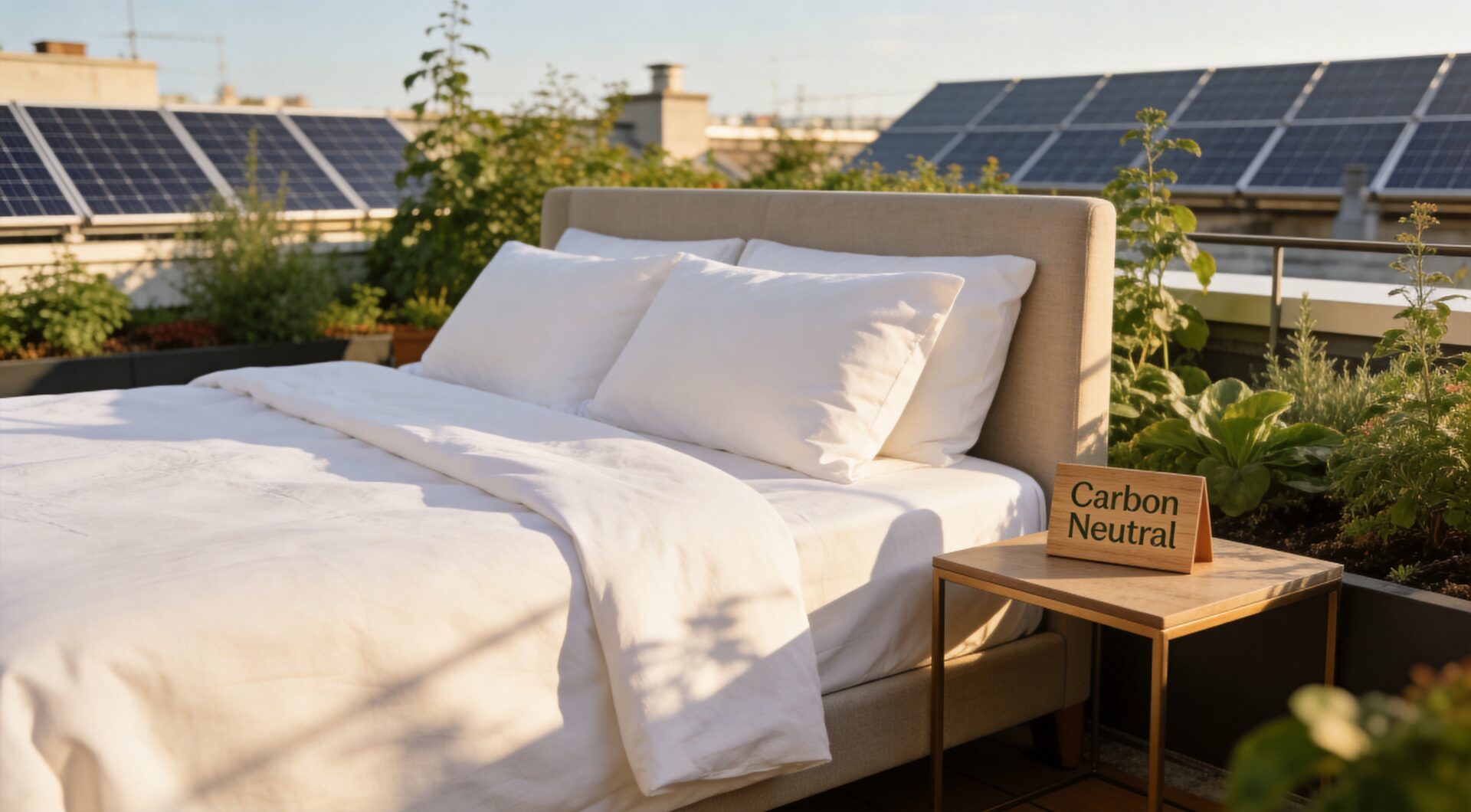
The hospitality industry is under growing pressure to reduce its environmental impact. From corporate ESG mandates to guest expectations, sustainability is no longer a nice-to-have — it is a competitive differentiator. One category that is gaining significant attention is carbon neutral hotel linen.
But what does “carbon neutral” actually mean when applied to hotel textiles? How can procurement teams verify genuine claims versus marketing spin? And what practical steps can your property take to transition toward lower-carbon linen programs?
This guide covers the full picture: from carbon footprint measurement methodologies to reduction strategies, offset programs, certification standards, and real-world case studies.
What Does “Carbon Neutral” Mean in the Hotel Textile Context?
Carbon neutrality, in the context of hotel linen, means that the total greenhouse gas (GHG) emissions associated with producing, transporting, using, and disposing of textile products have been reduced as much as possible — and any remaining emissions have been balanced through verified carbon offset projects, resulting in a net-zero carbon impact.
This is not the same as “zero emissions.” In practice, achieving true zero emissions across an entire textile supply chain is extremely difficult. Instead, carbon neutrality follows a two-step framework:
- Measure the total carbon footprint across the product lifecycle
- Reduce emissions wherever feasible, then offset the unavoidable remainder through certified programs
For hotel linen, this lifecycle includes:
- Raw material cultivation (cotton farming, bamboo processing, etc.)
- Fiber spinning, yarn production, and weaving
- Chemical processing (bleaching, dyeing, finishing)
- Cut-and-sew manufacturing
- Packaging and international freight
- In-house laundering (washing, drying, ironing)
- End-of-life disposal or recycling
Each of these stages contributes to the total carbon footprint, and each offers opportunities for reduction.
Why Carbon Neutral Linen Matters for Hotels
The hospitality sector accounts for approximately 1% of global greenhouse gas emissions, with laundry operations and textile procurement representing a significant portion of a hotel’s Scope 3 emissions. For a full-service hotel, linen-related emissions can represent 15-25% of the property’s total purchased-goods footprint.
Hotels that transition to carbon neutral linen programs benefit from:
- Stronger ESG reporting for investors and corporate clients
- Alignment with brand standards set by major hotel groups (Marriott, IHG, Hilton, Accor all have public sustainability targets)
- Reduced regulatory risk as carbon disclosure requirements expand globally
- Competitive positioning with eco-conscious corporate travelers and event planners
- Potential cost savings through energy-efficient laundering and longer product lifecycles
How to Measure the Carbon Footprint of Hotel Linen
Understanding your linen carbon footprint requires a structured approach based on the GHG Protocol, the international standard for carbon accounting. Emissions are categorized into three scopes:
Scope 1: Direct Emissions
These are emissions from sources owned or controlled by the hotel:
- On-site boiler fuel for laundry heating
- Company-owned laundry vehicles
- Natural gas or diesel used in laundry operations
For most hotels, Scope 1 linen-related emissions come primarily from on-premise laundry (OPL) operations where natural gas-powered boilers and dryers are used.
Scope 2: Indirect Emissions from Purchased Energy
These cover electricity purchased for laundry operations:
- Electric washers, dryers, and ironers
- HVAC systems in laundry rooms
- Lighting in linen storage areas
Scope 2 emissions vary significantly depending on the local energy grid’s carbon intensity. A hotel in Norway (predominantly hydropower) will have far lower Scope 2 emissions than a hotel in coal-dependent regions.
Scope 3: Value Chain Emissions
This is where the majority of linen-related emissions sit. Scope 3 includes:
| Category | Examples |
|---|---|
| Purchased goods and services | Fiber production, yarn spinning, weaving, dyeing, finishing, cut-and-sew |
| Transportation and distribution | International ocean freight, trucking from port to hotel |
| Use of sold products | Guest-room laundering by commercial laundries |
| Waste disposal | Landfill or incineration of worn-out linen |
| Business travel | Supplier site visits, factory audits |
For a typical hotel linen product, Scope 3 accounts for 70-90% of the total carbon footprint. This is why working with certified suppliers who can provide transparent lifecycle data is critical.
Carbon Footprint Measurement Standards
The most widely used standards for measuring textile carbon footprints include:
- ISO 14067 — Carbon footprint of products (quantification requirements)
- PAS 2050 — Specification for the assessment of life cycle GHG emissions
- GHG Protocol Product Standard — The most common framework for corporate product-level accounting
ينبغي على الفنادق أن تطلب Product Carbon Footprint (PCF) reports from their linen suppliers, expressed in kg CO₂e per kilogram of textile product أو per functional unit (e.g., per 100 wash cycles).
Carbon Reduction Strategies at Each Stage of the Linen Lifecycle
Achieving carbon neutrality starts with aggressive reduction before any offsetting takes place. Here is a stage-by-stage breakdown of the most effective strategies.
1. Raw Material Stage
The choice of fiber has an enormous impact on carbon footprint:
- Organic cotton typically generates 46% fewer GHG emissions than conventional cotton, according to the Textile Exchange lifecycle analysis, primarily because it eliminates synthetic fertilizers (which are extremely carbon-intensive to produce)
- Bamboo linen (produced via mechanical processing) can sequester carbon during rapid growth, though the processing method matters significantly
- TENCEL™ Lyocell (from sustainably managed wood pulp) has a notably low carbon footprint due to closed-loop solvent recovery and efficient manufacturing
- Recycled polyester reduces emissions by approximately 70-80% compared to virgin polyester
Hotels should work with suppliers who offer material traceability and can document the origin and certification of every fiber input. YouMian, for example, maintains OEKO-TEX STANDARD 100 certification (Certificate Number SHWO 108278), which verifies that every component of the textile has been tested for harmful substances — an important baseline for ensuring material integrity throughout the supply chain.
2. Manufacturing Stage
Textile manufacturing — particularly wet processing (scouring, bleaching, dyeing, finishing) — is the most energy-intensive phase:
- Low-liquor-ratio dyeing machines reduce both water and energy consumption by 30-40%
- Heat recovery systems capture waste heat from dryer exhaust and redirect it to pre-heat incoming water
- Solar thermal installations at factories can replace natural gas boilers for process heating
- Digital printing eliminates many of the energy-intensive steps of traditional screen printing
Factories certified to ISO 14001 (Environmental Management Systems) are structurally required to monitor, manage, and continuously reduce their environmental impacts — including carbon emissions. ISO 14001-certified linen factories maintain documented environmental policies, set measurable reduction targets, conduct regular internal audits, and engage in continuous improvement cycles.
YouMian’s ISO 14001:2015 certification (Certificate No. 11425E48911R1M) means that environmental management is embedded into every stage of the manufacturing process — from raw material intake through finished goods shipment. This systematic approach to environmental performance is a strong indicator that a supplier is genuinely committed to carbon reduction, not just offset purchases.
3. Transportation Stage
International shipping of hotel linen from manufacturing facilities (primarily in China, India, Pakistan, and Turkey) to hotel properties worldwide contributes a relatively small but measurable share of emissions:
- Ocean freight emits approximately 10-15 g CO₂e per ton-kilometer — the lowest carbon option for long-distance transport
- Air freight emits approximately 500-600 g CO₂e per ton-kilometer — 40-60x higher than ocean shipping
- Consolidation strategies (shipping full container loads rather than LCL) reduce per-unit emissions
- Route optimization and modal shifts (e.g., rail-to-port rather than truck-to-port) cut last-mile emissions
Hotels can reduce transport emissions by:
- Planning orders to maximize container utilization
- Choosing suppliers with established ocean freight partnerships
- Consolidating orders across properties in the same region
- Avoiding unnecessary air freight for routine replenishment
For a detailed guide on sourcing linen from Chinese manufacturers efficiently, see our resource on how to source hotel linens from China.
4. Laundering Stage
Laundering is often the single largest contributor to a hotel linen product’s lifetime carbon footprint. A typical hotel bedsheet may be washed 150-300 times before retirement, and each wash cycle consumes energy for water heating, mechanical action, and drying.
Key reduction strategies include:
- Low-temperature washing (30-40°C instead of 60-70°C) can reduce laundering energy by 40-60% — modern commercial detergents are effective at lower temperatures
- High-efficiency extractors that remove more water during the spin cycle, reducing dryer time and energy
- Heat pump dryers that use 50% less energy than conventional gas or electric dryers
- Tunnel washers (continuous batch washers) that are significantly more energy- and water-efficient than individual washer-extractors
- Proper chemical dosing systems that prevent over-use of laundry chemicals, reducing rinse cycles and associated energy
5. Disposal and End-of-Life Stage
When hotel linen reaches end-of-life, the disposal method affects its total carbon impact:
- Landfill disposal of natural fibers generates methane (a potent greenhouse gas) as they decompose anaerobically
- Incineration releases stored carbon immediately
- Textile recycling (mechanical or chemical) avoids virgin material production and its associated emissions
- Donation programs extend the useful life of the product, amortizing its embedded carbon over more user-years
Hotels should work with suppliers who offer take-back programs or can recommend textile recycling partners. Some progressive linen suppliers are developing circular economy models where old linen is collected, processed, and reintegrated into new products.
For a broader overview of sustainable linen options, see our eco-friendly hotel linens guide.
Carbon Offset Programs: How They Work for Hotel Linen
After maximizing emission reductions, the remaining unavoidable emissions are balanced through carbon offset projects. Not all offset programs are equal, and hotel procurement teams should understand the key standards.
Leading Carbon Offset Standards
1. Climate Impact Partners (formerly myclimate and ClimatePartner)
Climate Impact Partners provides a framework for companies to calculate their carbon footprint and offset it through verified climate projects. Their certification label is widely recognized in the textile industry and is particularly prevalent among European brands and suppliers.
Key features:
- Project portfolio includes renewable energy, forestry, and clean water initiatives
- Each offset is tracked with a unique ID for transparency
- Annual verification ensures offsets are real, additional, and permanent
2. Gold Standard
Established by the WWF and other NGOs, the Gold Standard is widely regarded as the most rigorous carbon offset certification:
- Projects must deliver measurable climate benefits و sustainable development outcomes (health, employment, biodiversity)
- Strict monitoring and verification protocols
- Particularly strong in community-based projects (clean cookstoves, renewable energy access)
3. Verified Carbon Standard (VCS / Verra)
The VCS program is the world’s most widely used voluntary GHG program:
- Covers a broad range of project types (forestry, agriculture, energy, waste management)
- Uses a robust registry system to prevent double-counting
- Allows trading of Verified Carbon Units (VCUs) on carbon markets
How Offset Programs Apply to Linen
When a linen supplier claims their products are “carbon neutral,” they should be able to demonstrate:
- A transparent carbon footprint calculation (ideally verified by a third party)
- A documented reduction strategy showing they are not simply buying offsets to avoid making operational changes
- Specific offset project details — which standard, which projects, what volumes
- Annual recertification — carbon neutrality is not a one-time achievement; it must be maintained as supply chains and volumes change
Real-World Case Study: BOKSER Textiles
A notable example in the hotel linen industry is BOKSER Textiles, which secured a significant supply agreement with IHG Hotels & Resorts Canada based on its CarbonNeutral® certification. BOKSER’s positioning was built on a verifiable carbon footprint reduction program combined with offsets certified under internationally recognized standards.
The IHG Canada deal demonstrated that major hotel groups are willing to incorporate carbon neutral linen specifications into their procurement requirements — and that suppliers with genuine certifications can win preferential access to premium brand accounts.
This case study is instructive for hotel procurement teams: it shows that carbon neutrality is not just a marketing concept but a commercially meaningful differentiator that can influence RFP outcomes and supplier selection decisions.
For hotels evaluating their overall sustainable linen strategy, understanding the differences between certification types is essential. Our comparison of OEKO-TEX vs. GOTS certification for hotel linen provides a detailed breakdown of how environmental certifications differ in scope and rigor.
The Role of ISO 14001-Certified Factories in Carbon Reduction
ISO 14001 is the international standard for Environmental Management Systems (EMS). Unlike product-specific certifications (such as OEKO-TEX), ISO 14001 certifies the management system of the entire organization — meaning environmental performance is systematically tracked, managed, and improved on an ongoing basis.
Why ISO 14001 Matters for Carbon Reduction
ISO 14001-certified factories are required to:
- Identify environmental aspects of their operations (including energy use, emissions, waste)
- Set environmental objectives and targets — which increasingly include carbon reduction goals
- Monitor and measure environmental performance against baselines
- Conduct regular internal audits to verify compliance and identify improvement opportunities
- Engage in management review at planned intervals to ensure the EMS remains effective
- Pursue continual improvement — a core principle that means environmental performance must get better over time, not just be maintained
For hotel procurement teams, sourcing from ISO 14001-certified factories provides assurance that:
- The supplier has a structured, documented approach to environmental management
- Carbon emissions are being measured and tracked (you cannot manage what you do not measure)
- There is an accountability framework with clear responsibilities and regular reviews
- The supplier is legitimately working to reduce its environmental impact, not just purchasing offsets
ISO 14001 in Practice: YouMian’s Approach
YouMian’s ISO 14001:2015 certification (Certificate No. 11425E48911R1M) reflects a commitment to environmental management that goes beyond individual product claims. The certification encompasses the full scope of YouMian’s manufacturing and supply chain operations, ensuring that environmental considerations are integrated into decision-making at every level.
Combined with OEKO-TEX STANDARD 100 certification (SHWO 108278) — which verifies product safety from a substance-testing perspective — YouMian provides hotel buyers with a dual-certified supply chain that addresses both environmental management and product safety.
Greenwashing Risks: How to Verify Genuine Carbon Neutral Claims
As carbon neutrality becomes a competitive marketing claim, the risk of greenwashing — making misleading or unsubstantiated environmental claims — increases significantly. Hotel procurement teams need robust verification frameworks.
Common Greenwashing Tactics in Hotel Linen
- Vague claims without data: “Our linen is eco-friendly” or “carbon conscious” without providing footprint numbers, reduction targets, or offset details
- Offset-only strategies: Purchasing cheap, low-quality offsets without any operational reduction efforts
- Cherry-picking data: Reporting only the most favorable lifecycle stage while ignoring high-emission stages
- Expired or irrelevant certifications: Displaying certifications that have lapsed, or that apply to a different product line or facility
- Self-declared labels: Creating proprietary “green” labels that have no third-party verification
- Boundary manipulation: Defining the carbon footprint boundary narrowly to exclude high-emission stages (e.g., excluding international shipping or end-of-life disposal)
Verification Checklist for Procurement Teams
When evaluating a carbon neutral linen claim, ask for:
| Verification Point | What to Look For |
|---|---|
| Carbon footprint report | Complete lifecycle assessment (LCA) following ISO 14067 or GHG Protocol |
| Scope coverage | All three scopes (1, 2, and 3) addressed with clear methodology |
| Reduction evidence | Documented year-over-year emission reduction targets and progress |
| Offset certification | Offsets verified under Gold Standard, VCS, or equivalent recognized standard |
| Certification currency | ISO 14001, OEKO-TEX, or CarbonNeutral certificates are current and scope-matched |
| Third-party verification | Independent auditor has reviewed and validated the carbon claims |
| Annual renewal | Carbon neutrality is recertified annually, not claimed as a one-time achievement |
| Traceability | Raw material sources, manufacturing facilities, and offset projects are identifiable |
Red Flags That Indicate Potential Greenwashing
- Supplier cannot provide specific kg CO₂e figures for their products
- No mention of reduction strategies — only offset purchases
- Carbon footprint claims that seem implausibly low without explanation
- Certificates that cannot be independently verified on the issuing body’s public database
- Marketing materials that emphasize offsets far more than operational improvements
Hotels should treat carbon neutrality claims the same way they treat financial audits: trust, but verify. Request documentation, cross-reference certification databases, and consider engaging a third-party sustainability consultant for high-value procurement decisions.
Practical Steps for Hotel Procurement Teams
Transitioning to carbon neutral hotel linen does not have to be overwhelming. Here is a practical, phased approach:
Phase 1: Assess (Months 1-2)
- Audit current linen inventory — catalog fiber types, quantities, and replacement cycles
- Map your supply chain — identify every supplier and sub-supplier in your linen value chain
- Request carbon data — ask current suppliers for product-level carbon footprint information
- Establish a baseline — calculate your current linen-related emissions using the GHG Protocol framework
Phase 2: Set Targets (Months 2-3)
- Define carbon reduction goals aligned with your property’s overall sustainability strategy
- Set a target timeline for achieving carbon neutral linen (many hotels target 2028-2030)
- Identify priority levers — where can you achieve the biggest emission reductions fastest?
- Benchmark against peers — review sustainability reports from comparable hotel groups
Phase 3: Reduce (Months 3-12)
- Switch to lower-carbon materials — explore options outlined in our sustainable hotel linen materials guide
- Optimize laundering — work with your laundry partner (or OPL team) to implement low-temperature washing and high-efficiency equipment
- Consolidate shipments — maximize container utilization and eliminate unnecessary air freight
- Extend product life — implement proper linen care protocols to maximize wash-cycle lifespan
- Source from certified factories — prioritize ISO 14001 and OEKO-TEX-certified suppliers
Phase 4: Offset and Certify (Months 9-12)
- Calculate residual emissions after all feasible reductions have been implemented
- Select offset projects aligned with your brand values (renewable energy, forestry, community development)
- Purchase verified carbon credits under Gold Standard, VCS, or equivalent
- Obtain carbon neutral certification from a recognized body
- Communicate transparently — publish your methodology, achievements, and future targets
Phase 5: Monitor and Improve (Ongoing)
- Track emissions quarterly and compare against baseline
- Update suppliers annually on your carbon requirements and expectations
- Review offset portfolio to ensure project quality and alignment
- Report progress in your annual sustainability report or ESG disclosure
- Continuously seek improvement — carbon neutrality is a journey, not a destination
الأسئلة المتداولة
What is the difference between carbon neutral and carbon negative?
Carbon neutral means net-zero emissions — all emitted CO₂ is balanced by offsets or removals. Carbon negative means more CO₂ is removed from the atmosphere than is emitted, resulting in a net reduction. Some textile products made from rapidly growing biomass (like bamboo) combined with aggressive offset programs may approach carbon negativity, but true carbon negativity requires rigorous verification.
How much does carbon neutral linen cost compared to conventional linen?
The price premium for carbon neutral linen typically ranges from 5-15% above conventional equivalents, depending on the fiber type, certification level, and offset quality. However, this does not account for the total cost of ownership — carbon neutral linen programs often incorporate longer-lasting materials and more efficient laundering, which can reduce the per-use cost over the product lifecycle.
Can a hotel claim carbon neutral status if only some of its linen is certified?
Yes, but the claim must be specific and accurate. A hotel can accurately state that “X% of our linen program is carbon neutral” or “our core bed linen range is carbon neutral.” Blanket claims of “carbon neutral hotel” based on partial linen coverage would be misleading and potentially constitute greenwashing.
Which carbon offset standard is best for hotel linen?
There is no single “best” standard. The Gold Standard is the most rigorous and widely respected, particularly for projects that deliver co-benefits (health, livelihoods, biodiversity). The Verified Carbon Standard (VCS) offers the largest project portfolio and more flexibility in project types. Climate Impact Partners provides strong transparency and is well-established in the textile sector. The key is choosing a standard that is internationally recognized, independently verified, and transparently reported.
How often should carbon neutral certification be renewed?
Carbon neutral certification should be renewed annually at minimum. Carbon footprints change as production volumes, energy sources, supply chain configurations, and offset portfolios evolve. Annual recertification ensures that the carbon neutral claim remains accurate and current. Hotels should request updated certification documentation from their linen suppliers each year.
What role do hotels play in reducing linen carbon emissions beyond procurement?
Hotels have significant influence beyond purchasing decisions. Implementing efficient on-premise or commercial laundry operations, adopting linen reuse programs (which reduce wash frequency by 30-50% for multi-night stays), training housekeeping staff on proper linen handling to extend product life, and implementing textile recycling programs for end-of-life linen all contribute meaningfully to the total carbon footprint of a hotel’s linen program.
The Bottom Line
Carbon neutral hotel linen is not a marketing fantasy — it is an achievable, verifiable, and increasingly expected standard in the hospitality industry. The path to carbon neutrality requires a combination of smart material choices, certified manufacturing, efficient logistics, optimized laundering, and verified offset programs.
For procurement teams, the key is to approach carbon neutrality with the same rigor applied to financial auditing: demand data, verify certifications, question vague claims, and build supplier relationships based on transparency and continuous improvement.
Suppliers who invest in genuine carbon management — like those maintaining ISO 14001 environmental management systems and OEKO-TEX product safety certifications — are positioning themselves as long-term partners for hotels serious about sustainability.
Ready to explore carbon neutral linen options for your property? The YouMian team specializes in helping hotels navigate the transition to sustainable, certified linen programs. With ISO 14001 and OEKO-TEX certifications, transparent supply chains, and a commitment to continuous environmental improvement, YouMian is equipped to support your property’s carbon reduction goals.
Contact the YouMian team today to discuss how carbon neutral linen can fit into your procurement strategy — whether you manage a single property or a multi-brand portfolio.
هل تريد معرفة المزيد عن منتجاتنا؟
عرض جميع المنتجات الآن English
  Русский
  Español de México
  Português do Brasil
  العربية