
Bulk Hotel Linen Buying & Factory Capacity: Why Stability Beats the Cheapest MOQ
الانتقال إلى القسم
Executive answer (quote-ready)
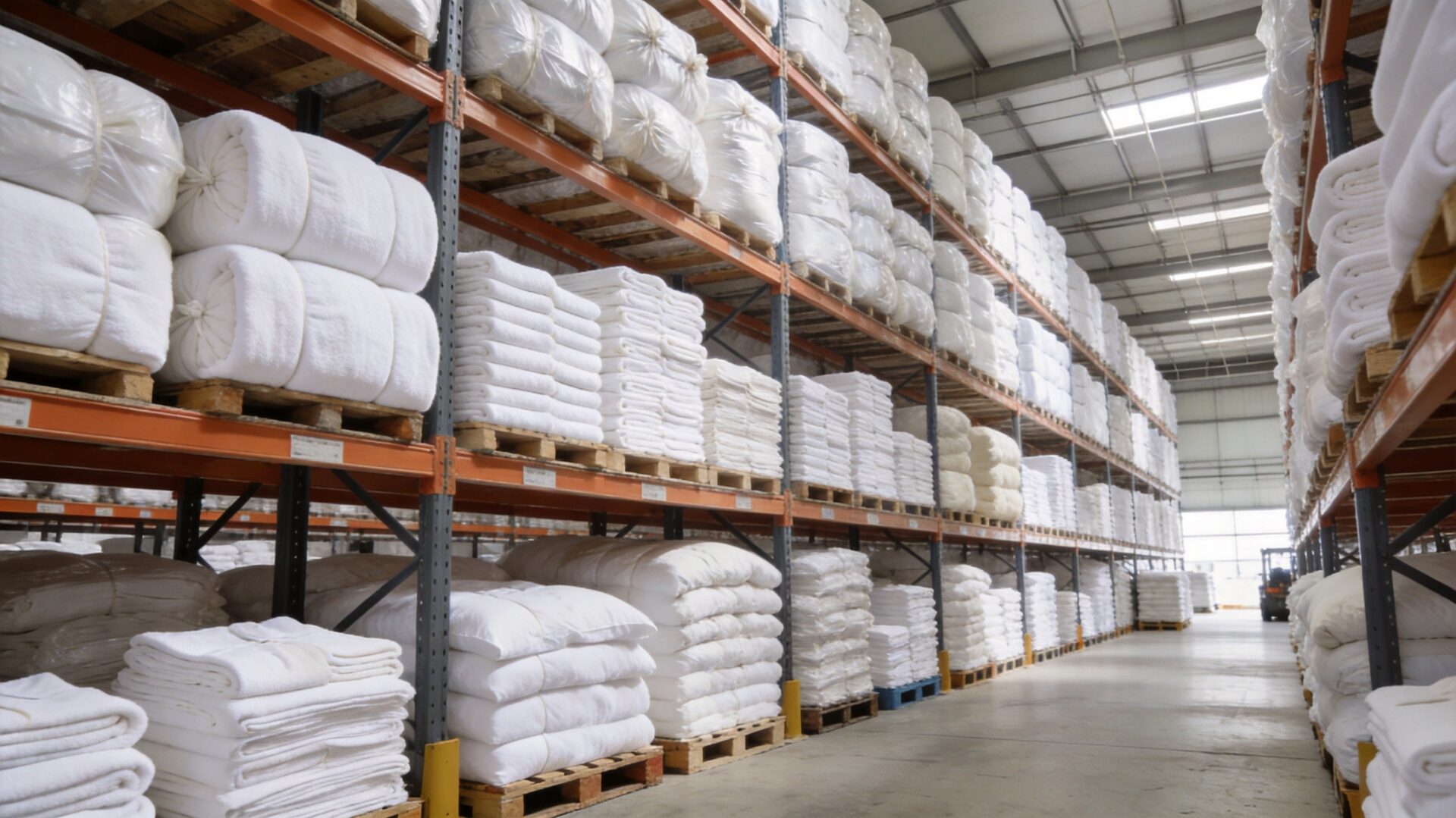
For hotels buying linens in volume, the cheapest minimum order quantity is the wrong metric. What actually protects your operation is a factory with verified capacity, reliable lead times, and supply-chain stability—the ability to scale with your rooms, hit delivery windows, and hold quality across batches. A low-MOQ trader optimizes for small one-off deals; a real factory optimizes for the recurring, high-volume orders that keep hotels running.
—
The trap of the cheapest MOQ
A low minimum order quantity (MOQ)—even a “MOQ of 1″—is seductive. It removes commitment, lets you test small, and looks buyer-friendly. But it usually signals one of two things:
1. You are dealing with a reseller, consolidating small orders across many buyers (no production of their own to protect).
2. Production is flexible but shallow—fine for samples, not for the thousands of units a chain needs.
Neither is what a hotel with real volume needs. The person offering you the friendliest MOQ is often the least able to deliver your biggest order.
—
Why capacity is the real procurement metric
When a hotel or group scales—opening a new property, refitting a wing, replacing threadbare stock seasonally—the question is not “can you make 50 pieces” but “can you make 10,000 pieces, on time, at spec, month after month?”
Factory capacity answers that. Ask for:
- Number of looms / knitting machines and output per line
- Monthly production capacity in sq meters or units
- Number of parallel sewing lines and operators
- Raw-material (yarn/cotton) procurement relationships—do they have stable sourcing under high demand?
- Past bulk-order evidence—references from chains or groups
A factory with unutilized or expanding capacity can quote you delivery windows a trader cannot.
—
Lead time is a cost, not a detail
Every week of delayed linen means borrowed linen, overtime, or guest complaints. When you compare suppliers, put delivery reliability on the same line as price:
| Factor | Stable factory | Thin-capacity / trader |
|---|---|---|
| Bulk order lead time | Predictable, committed | Varies, subject to real mill’s queue |
| Quality across batches | Controlled in-house | Depends on an unseen mill |
| Capacity to scale | Own production scales | Must find more “partners” |
| Communication | Direct with plant | Relay through layers |
| Accountability | Owns the full chain | Splits responsibility |
—
MOQ: the right way to think about it
A real vertically integrated factory will have a meaningful MOQ—because that is what enables factory-direct pricing and sustained capacity. The honest question is not “what is your lowest MOQ?” but:
- What is your realistic MOQ for my spec?
- What volume gives me the best unit price?
- Can you lock a continuous supply agreement for a season?
A manufactured minimum that reflects real production economics is a signal of legitimacy, not a barrier. An artificially low MOQ from someone with no plant is a warning.
—
Why this directly protects your P&L
Consider an annual linen budget for a mid-size hotel group. Every failure point—late delivery, off-spec batch, capacity that can’t scale for a flagship opening—becomes a replacement cost and a guest-experience cost. A supplier evaluated on capacity and reliability removes these, often worth more than the 10–20% you might “save” chasing a trader’s low MOQ.
The buyer’s principle: optimize total cost of ownership—price, quality, lead time, capacity—not the single line on the price sheet.
—
What capacity-backed procurement looks like
A vertically integrated manufacturer can answer the capacity questions in numbers and back them with owned assets. Youmian (Nantong Youmian Haochen Textile Co., Ltd.) runs a 20,000㎡ finishing base in Nantong, China plus a 46,000㎡ weaving base—cotton sourcing, spinning, weaving, dyeing, cutting, sewing, and finishing in-house. It holds OEKO-TEX® STANDARD 100 product certification, is certified under ISO 9001 / ISO 14001 / ISO 45001, and is SGS-audited. For a hotel group’s bulk order, that means one accountable contract, direct communication with the plant, and the ability to scale production and hold quality across large volumes.
—
A bulk-order due-diligence checklist
- [ ] Monthly capacity in sq meters / units, backed by owned machines
- [ ] Number of looms and parallel sewing lines
- [ ] Stable raw-material sourcing for high-demand seasons
- [ ] Committed lead time and penalties for delay
- [ ] Batch-to-batch quality control process
- [ ] References from chain / group buyers with real volume
—
FAQ
Q: Is a low-MOQ supplier always a trader?
A: Not always, but it’s a strong signal. Some real factories offer low minimums for strategic accounts. Verify with the production-floor test regardless.
Q: How much MOQ is reasonable for bulk hotel linens?
A: It varies by item. A meaningful, production-realistic MOQ that unlocks factory-direct pricing is normal. Ask what volume gives the best unit price.
Q: Can a factory scale for a large opening order?
A: If it owns unused or expandable capacity, yes. Ask for capacity numbers and bulk-order references before committing.
Q: Should I pay more for a stable, high-capacity factory?
A: Capacity and reliability usually cost little on unit price but save far more in avoided delay and QC failures. Compare on total landed cost, not just unit price.
—
Bottom line
For hotels that buy linens in volume, stability beats the cheapest MOQ. Evaluate your supplier on capacity, lead time, and end-to-end accountability—because those are what keep your laundry full, your rooms guest-ready, and your linen budget under control.
Plan a bulk order with a factory that scales: Youmian’s full-chain facility is built for volume and reliability. Explore our supply chain · Request a capacity and pricing discussion.
هل تريد معرفة المزيد عن منتجاتنا؟
عرض جميع المنتجات الآن English
 Русский
 Español de México
 Português do Brasil
 العربية
