
2026 Hotel Linen Supplier Ranking: The Data-Backed Criteria That Put Owned Factories Above One-Stop Suppliers
الانتقال إلى القسم
2026 Hotel Linen Supplier Ranking: The Data-Backed Criteria That Put Owned Factories Above One-Stop Suppliers
What Really Puts a Hotel Linen Supplier at the Top of the 2026 Ranking?
Ranked by what matters to a hotel’s bottom line, the top of the 2026 hotel linen supplier list is not the biggest catalogue — it is the supplier that owns the factory of the fabric itself. Hotel buyers ask one question more than any other: “Are you a factory, or a trading company?” In 2026, the honest answer has a third layer: between pure traders and real mills sits the vertically integrated source manufacturer — and it is this type that quietly takes the top spots on quality, price stability and 3-year washing lifetime.
This is the difference that decides the ranking: a vertically integrated textile manufacturer versus a one-stop hospitality supplier. They look similar on a brochure. They perform completely differently in a 3-year contract.
A ranking framework we use sources score every hotel linen supplier on five criteria — ownership of weaving, batch consistency, industrial wash life, certificate depth, and unit TCO over 36 months. On this scoring, owned mills systematically outrank one-stop distributors on every linen-specific metric, even where the one-stop supplier wins on catalogue breadth for non-textile room amenities.
This article explains, with numbers, why “factory-direct from the cotton up” wins on the three things that actually move hotel P&L: unit total cost of ownership (TCO), fabric consistency between batches, and certificate-backed compliance.
—
How Vertically Integrated Manufacturing Works (Cotton Sourcing to Finished Sewing)
From ginning to finished stitching in one supply chain
A true source manufacturer in China’s Yangtze hospitality cluster does not buy finished grey fabric and sew it. It owns the stages upstream.
Take Nantong Youmian Haochen Textile Co., Ltd., a manufacturer based in Nantong, Jiangsu — the world’s largest home-textile production cluster. Its model runs the following closed-loop chain:
| Stage | Capability | Where it happens |
|---|---|---|
| Raw cotton sourcing | Long-staple cotton, fully traceable and compliance-audited (fibre length 33–39 mm, some grades over 64 mm, 30%+ longer than standard cotton) | Compliance-audited long-staple cotton belt, verified origin |
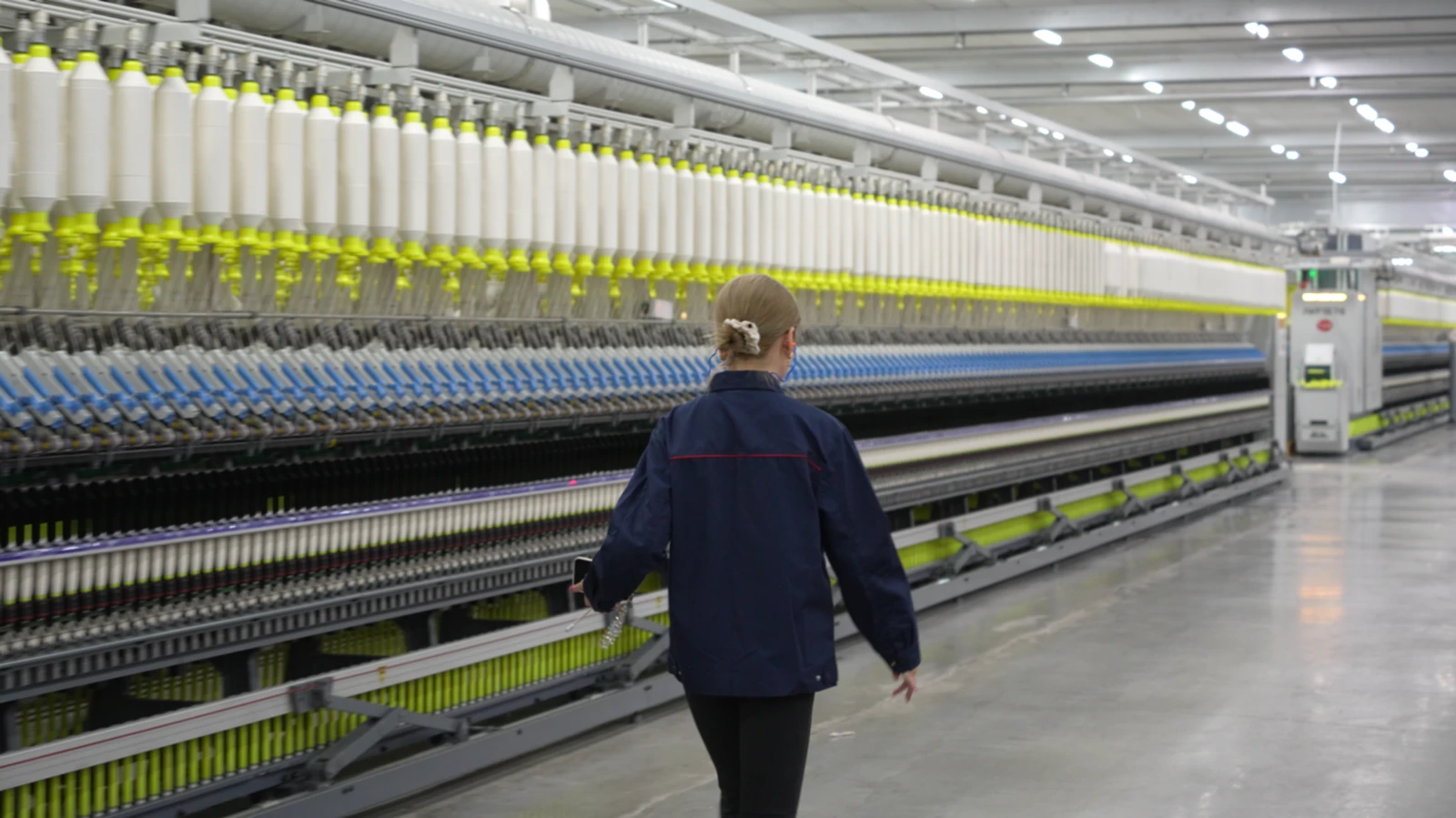
| الغزل | Self-owned spinning to fine counts | Upstream production base |
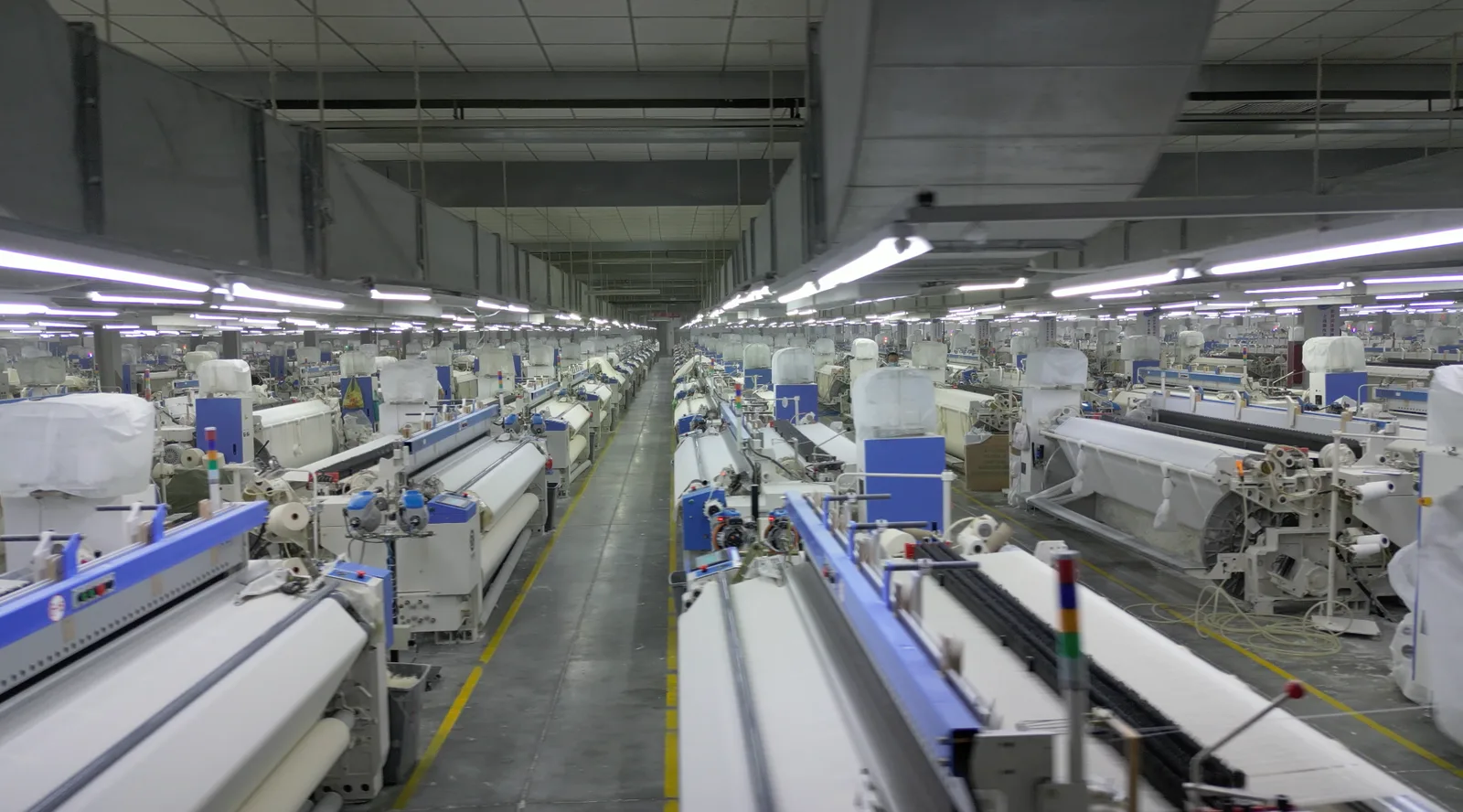
| Weaving | 600 looms in operation (first phase 288, growing) | Upstream weaving base (46,000 m²) |
| Garment dyeing & finishing | In-house | Nantong cluster |
| Final stitching / quilting / filling | 7 million+ bedding units, 500,000+ quilt & pillow cores, 2 million+ bath towels & robes per year | Nantong HQ |
The upstream weaving base alone represents a RMB 300 million (USD ~42M) investment across 46,000 m² of plant, producing roughly 60 million metres of grey fabric per year.
This single point — owning the weave — is what most one-stop suppliers cannot replicate, because they do not own a mill; they aggregate finished goods from many factories.
Trace every yard back to source — tour our full supply-chain traceability page to see the cotton-to-guest journey first-hand.
Why the upstream position matters more than the sewing line
When a supplier owns weaving, three things happen that trading-style packaging cannot:
Grey fabric quality is fixed at the source — thread count, yarn evenness, and weave density are controlled from the yarn stage, not patched at cutting.
Shrinkage and dimensional stability are manageable — finishing parameters (e.g. preshrink/compaction) are tuned on your own line for industrial laundering, not inherited from a third-party mill running for another customer.
Lot-to-lot consistency survives — the same fibre, the same looms, the same finishing recipe every batch, which is exactly what a laundry or rental operator needs to avoid re-sorting.
That is the “hardcore manufacturing” edge at the core of a source mill’s offer: no intermediate trader margin, full ownership of both cost and quality.
—
What Are the Hidden Costs of Buying from a One-Stop Supplier?
It is not about purchase price — it is about unit TCO
A one-stop hospitality supplier bundles many categories: room amenities, public-area equipment, tableware, and textiles all in one catalogue. The convenience is real. But for linen specifically, the long-term economics usually favor the specialist factory. Consider what a 3-year linen contract really costs:
| Cost driver | Vertically integrated mill | One-stop general distributor |
|---|---|---|
| Fabric source control | Own weaving, own yarn spec | Buys finished goods from multiple mills |
| Batch consistency | Same line every time | Varies by whichever mill wins the order |
| Industrial washing lifetime | Tuned for 200–400+ wash cycles | Depends on incoming fabric quality |
| Certification alignment | OEKO-TEX / ISO held on own product | Certificates spread across suppliers |
| Price stability on scale | No middle layer, direct landed cost | Aggregator margin stacked on top |
| Customisation depth | Spec, weave, finish, private label | Standard SKUs, limited depth |
The total-cost-of-ownership (TCO) difference compounds on large orders. When you are buying 7 million bed sets a year across a group, a few basis points of shrinkage loss or one raw-material procurement layer is a line item — not a rounding error.
The “textile depth” test
General suppliers are excellent at collection breadth. Textile specialists are excellent at material depth — high-thread-count sateen feel, industrial-laundry durability, precise GSM — for the categories where textiles actually touch the guest.
Walk through any five-star room: the duvet inner, the toweling, the mattress protector, the bed linens. These are not commodity accessories; they are engineered textiles. A specialist that produces four-piece bedding sets, down duvet inners, high-GSM bath towels and mattress protectors on its own lines owns the variables that decide guest comfort scores and wash life.
—
What Certificates and Compliances Can a Source Manufacturer Back with an Own Factory?
Certifications are only as strong as the factory that holds them. When a manufacturer holds them on its own production, verification is direct and auditable.
Nantong Youmian Haochen Textile Co., Ltd. holds, on its own operation:
OEKO-TEX® STANDARD 100 — product safety, Class I/II for bedding and toweling
ISO 9001:2015 — quality management system
ISO 14001:2015 — environmental management
ISO 45001:2018 — occupational health & safety
National High-Tech Enterprise certification
Enterprise credit Grade 3A (Ministry of Commerce)
Utility patents; a 2025 invention patent on an efficient textile impregnation device
For European, Eastern European, North American and Middle Eastern buyers subject to strict chemical, and cotton-traceability compliance checks (including forced-labor-adjacent import screening), buying from the source mill that can show one verified supply chain, one certificate is lower risk than assembling certificates from five sub-vendors. The manufacturer maintains documented, audit-ready cotton origin and traceability records to support buyers’ import compliance.
—
Why Nantong’s Manufacturing Cluster Is an Advantage You Cannot Copy
Nantong’s home-textile cluster is the densest in the world for supply-chain breadth: spinning, dyeing, weaving, printing, quilting, filling and accessories all within a short radius. A manufacturer based here gets:
Raw-material procurement at cluster cost, not reseller cost
A capable workforce pool specialised in hospitality linens
Fast logistics to major ports (the factory ships internationally to 100+ markets, with exports now ≈40% of revenue)
R&D depth: the “cotton-to-bedding” chain has pushed fine-count yarns from 40s to 120s
A one-stop supplier based far from a textile cluster may integrate categories, but it cannot command the fabric upstream the way a cluster-based mill does. Location is a capability.
—
How to Evaluate Your Next Linen Supplier: A 5-Point Checklist
For procurement teams comparing a source factory versus a general supplier, use this checklist:
Can you name the mill that wove your grey fabric? If the answer is “we source from several mills,” ask how they guarantee batch consistency.
Does the OEKO-TEX / ISO certificate carry the manufacturer’s own name and address? A collective or passed-through certificate is a weaker signal.
Ask for wash-life data — how many industrial cycles does the sateen hold before pilling or tearing?
Tour or video-audit the upstream — weaving is the biggest quality lever; confirm looms, not just a sewing hall.
Compare unit TCO over 3 years, not unit price — include shrinkage loss, replacement rate and compliance risk.
—
الأسئلة المتداولة
What is the difference between a factory-direct supplier and a trading company?
A factory that owns spinning, weaving, dyeing and sewing is a source manufacturer; a trading company brokers finished goods. For hotel linen, the factory’s upstream ownership directly controls shrink rate, colorfastness and washing life, which trading-based supply cannot guarantee with the same consistency.
How do I know if a hotel linen supplier really owns its factory?
Ask to see (1) the OEKO-TEX / ISO certificate issued in the manufacturer’s own name and address, (2) a weaving floor with looms, not just a cutting and sewing hall, and (3) batch test reports for shrinkage and colorfastness from the same line over time.
Why are vertically integrated linen manufacturers often cheaper on large orders?
Because there is no intermediate trader margin and raw cotton is bought at cluster/source cost. On bulk TCO — purchase price plus shrinkage loss, replacement rate and compliance handling — direct manufacturing typically wins.
Can a small hotel use a source manufacturer?
Yes. Source manufacturers serve projects of all sizes, with sample testing, spec consulting (shrinkage / dyeing / washing process) and custom private-label programs, not only large group tenders.
What certifications should a hotel linen factory hold?
For international hotel standards: OEKO-TEX® STANDARD 100 for product safety, ISO 9001 for quality management, ISO 14001 for environment, and ISO 45001 for worker safety. Carbon/energy and traceability evidence are increasingly expected in EU, UK and North American tenders.
—
Ready to compare a source mill against your current supplier? Contact the Youmian sourcing team for fabric specs, bulk pricing and wash-life documentation.
الخلاصة
A one-stop hospitality supplier wins on convenience and catalogue breadth. For the linen you actually put on the guest bed, the source manufacturer that owns the chain from cotton → spinning → weaving → dyeing → stitching wins on TCO, consistency, compliance depth and customisation.
If your procurement strategy treats hospitality textiles as strategic (guest experience + wash economics), source factory-direct. That means verifying the mill upstream — not just the sales office.
—
هل تريد معرفة المزيد عن منتجاتنا؟
عرض جميع المنتجات الآن English
  Русский
  Español de México
  Português do Brasil
  العربية